GDL Courses UK: A Guide for Non-Law Graduates 2026
You studied history. Or biology, or business, or something with absolutely nothing to do with contract law — and now you want to be a solicitor. Fair enough. Half the profession got there the same way. However, the moment you start researching GDL courses UK, you land in a mess of acronyms — GDL, PGDL, SQE1, SQE2 — and it’s genuinely confusing which one still exists, which one you actually need, and which one your chosen university even offers anymore.
Here’s the short version, because you deserve it up front: GDL courses in the UK — short for the Graduate Diploma in Law — were, for decades, the route non-law graduates took to convert their degree into something a law firm would recognise. They’re now being phased out in favour of the Postgraduate Diploma in Law (PGDL) and the Solicitors Qualifying Examination (SQE), although transitional rules mean the GDL isn’t dead yet — just changing shape while everyone watches. If you’re weighing up GDL courses UK as an option, you’re arriving at an interesting moment in legal education history, whether you meant to or not.
I’ll be honest — advising students through this exact maze is part of what we do at GCRD HUB, and the number of people who show up thinking GDL and SQE are competing exams (they’re not; one is preparation, the other is the actual assessment) is higher than you’d expect. So, let’s untangle it properly.
GDL Courses UK Explained: So What Actually Is a GDL, In Plain English?
Strip away the jargon, and a GDL course is a one-year, full-time conversion course (or two years part-time, if you’re working alongside it) built to take someone with zero legal training and get them to roughly the same academic standing as a law graduate. Seven areas get covered, sometimes called the “seven foundations”: contract, tort, criminal law, EU/constitutional law, land law, equity and trusts, and public law. That’s dense material, compressed hard, and it moves fast.
Traditionally, once you’d finished, you would move onto the Legal Practice Course (LPC) and then a training contract. That was the pathway for non-law graduates chasing solicitor qualification for roughly forty years.
Then, in September 2021, everything shifted. The Solicitors Regulation Authority introduced the SQE — a standardised super-exam that, over a transitional period running until 2032, is gradually replacing both the GDL and the LPC. As a result, most law schools have quietly rebranded their GDL as a PGDL, which — content-wise — remains nearly identical. Same seven foundations, same intensity, different name, and it now feeds into SQE preparation rather than the old LPC.
A quick tip that surprises most people: technically, under the SQE system, you don’t need any law conversion course at all to sit the exams. The only academic requirement is holding a degree, in any subject. That said, most advisors — ourselves included — would still steer you toward a proper conversion course, since walking into SQE1 with zero legal grounding is a rough way to spend an exam fee. For the official word on requirements, Prospects’ guide to law conversion courses is worth a read before you commit.
GDL vs PGDL vs SQE — Because the Acronyms Genuinely Trip People Up
Route
Still Running?
Leads To
Typical Length
GDL (traditional)
Only for those who started before Sept 2021; transitional route until 2032
LPC → training contract
1 year full-time
PGDL (rebranded GDL)
Yes — the current standard conversion course
SQE1 preparation
1 year full-time / 2 part-time
SQE1 & SQE2
Yes — mandatory for all new solicitors
Qualification as solicitor (after 2 years’ qualifying work experience)
Exams sat over roughly 12–18 months of prep
Meanwhile, here’s a slightly messier version of that same information, because real life — and honestly, a fair number of university course pages — doesn’t line up as neatly as marketing tables suggest:
Provider naming
Fees (approx.)
Notes
Some unis still call it “GDL”
£9,000–£11,500
Content basically = PGDL, name lags behind
Others: “PGDL” or “MA Law (SQE1)”
£10,000 – £14,500ish, varies a LOT by institution and whether it’s bundled with SQE1 prep
MA Law route can unlock postgraduate loan funding — this matters more than people realise
A handful bundle it as “Law Conversion + SQE Prep”
can run £16,000+
(That second table is a bit rougher on purpose — course fees genuinely are reported inconsistently across providers, so treat any number you see as a starting point for questions, not gospel.)
Why Non-Law Graduates Still Choose GDL and PGDL Routes
Here’s a pattern I keep noticing: people assume converting into law is a last resort, something you do because your first degree “didn’t work out.” That’s rubbish, frankly. Some of the sharpest trainee solicitors I’ve come across studied physics, or languages, or fine art. Consequently, law firms genuinely like the variety — a candidate who can think like a scientist or argue like a linguist brings something a straight LLB graduate sometimes doesn’t.
If you’re weighing up whether GDL courses UK-wide are worth the money and the year of your life, consider:
You get formal legal grounding recognised by employers, not just self-taught SQE cramming
Structured teaching, deadlines, and feedback — genuinely useful if you learn better with pressure and a timetable
A cohort of fellow career-changers, which turns out to be a decent support network later
Many conversion courses now build SQE1 preparation directly into the syllabus, so you’re not paying twice
It isn’t automatically the cheapest path, either. Going straight for self-study plus an SQE preparation course can save money. Nevertheless, cheaper isn’t always better if it means turning up to a notoriously difficult exam under-prepared.
Entry Requirements for GDL and PGDL Courses — And Where International Students Get Caught Out
Most GDL and PGDL programmes ask for a 2:1 in any subject, sometimes a 2:2 with relevant experience. Additionally, English language requirements (usually IELTS 6.5–7.0, sometimes higher for law specifically) catch out a surprising number of applicants from outside the UK — not because their English is weak, but because they didn’t check the specific band requirement for the specific course before applying.
If you’re applying from overseas, visa timing matters more than most people expect. UK universities want documentation submitted early, and a UKVI credibility interview may form part of your visa process — something worth preparing for properly rather than winging it. For the official visa rules themselves, gov.uk’s student visa guidance is the primary source, so it’s worth cross-checking anything a course provider tells you against it.
Fair warning, not a scare tactic: conversion course places for popular universities in London fill up faster than you’d think, particularly for September intakes. If you’re eyeing a 2026 or 2027 start, applying “sometime next year” isn’t a plan.
Funding GDL Courses UK-Wide: The Bit Everyone Avoids Thinking About Until It’s Too Late
Postgraduate loans in England currently cover master’s-level study, which is partly why the MA Law (SQE1) route has become so popular — it’s essentially a conversion course wearing a master’s degree, unlocking funding a standard diploma-level GDL or PGDL wouldn’t. Scholarships exist too, though they’re competitive and often subject-specific. You can check current loan thresholds directly via gov.uk’s postgraduate loan page.
How GDL Courses UK Compare to a Standard Law Degree
Genuinely, once you’ve completed a conversion course, employers largely treat you the same as an LLB graduate. Some firms even prefer non-law hires precisely because of that outside-the-box degree. Still, if you’re torn between converting later versus starting an LLB (Hons) Law degree from scratch, it’s worth comparing timelines and total cost side by side — a full guide sits in our piece on law degrees in the UK, their types and career routes.
For those already eyeing specialisation post-qualification, options such as an LLM in International Commercial Law or an LLM in Employment Law and HR Management sit further down the road, but they’re worth knowing about now, if only to plan your funding across the whole journey rather than course by course.
Choosing Where to Study — It’s Not Just League Tables
Course content across GDL and PGDL programmes is fairly standardised, since the SRA sets the core requirements. Therefore, differentiation tends to come down to teaching style, class sizes, location, and — honestly — how much hand-holding you personally want. Some students thrive in large lecture-hall environments; others need something closer and more accountable. In other words, there’s no universal “best” university here, whatever league tables imply.
Browsing university options is easier with a full list of UK universities rather than piecing it together from scattered course pages. Furthermore, if the whole application process — personal statements, references, visa paperwork, interview prep — feels like a second job on top of your actual job, that’s exactly the gap education guidance and end-to-end admissions support is built for. It’s not glamorous work, but it does save people weeks of confusion.
Frequently Asked Questions About GDL Courses UK
Is the GDL still available in 2026? Yes, but only narrowly. Some providers still run it under that name, and students who started a qualifying route before September 2021 can use transitional arrangements until 2032. Otherwise, new entrants are generally steered toward the PGDL or MA Law (SQE1), since content-wise they’re near-identical.
Do I need a GDL or PGDL to sit the SQE? Not technically — the SRA only requires a degree in any subject to sit SQE1 and SQE2. Even so, most advisors still recommend a conversion course, since walking into the exams with no legal foundation is a hard way to learn contract law.
How much do GDL courses in the UK cost? Figures generally sit between roughly £9,000 and £14,500, though bundled SQE-prep packages can run higher. Because costs vary significantly by provider, always confirm exactly what’s included before enrolling.
Can international students take GDL courses in the UK? Yes. You’ll need to meet English language requirements (commonly IELTS 6.5–7.0) and a UK student visa, which usually involves a credibility interview.
Is a GDL the same as a PGDL? Academically, almost identical — both cover the seven foundations of legal knowledge. The name changed after 2021 largely because of how the qualification now feeds into SQE preparation rather than the old LPC.
If any of this still feels like a fog of acronyms, that’s normal — it confuses people who’ve worked in UK admissions for years, let alone someone applying from another country for the first time. GCRD HUB works through exactly this kind of decision with students daily: comparing GDL and PGDL providers, checking scholarship eligibility, prepping for visa interviews, and generally making sure nobody signs up for the wrong course by accident. If you’d rather talk it through than keep scrolling course pages at midnight, our team’s at 107 Fleet St, London EC4A 2AB, or reachable on +44 (0)20 3983 9001–9003.
Ed Consultant: How They Help You Study Abroad Successfully
Somewhere between the third rejected scholarship form and the sixth browser tab open on a UK university’s admissions page, most students hit a wall. That’s usually the exact moment someone mentions the phrase Ed Consultant — and honestly, it’s about time. An Ed Consultant is, in the simplest terms, the person (or team) who sits between a confused, hopeful student and a foreign university system that was never designed to be intuitive. They read the fine print so you don’t have to. They know which documents actually matter and which are just bureaucratic padding. And if you’re eyeing a course in the UK for 2026, working with a good Ed Consultant might be the single most useful decision you make this year.
I’ve spoken to enough students — and frankly, enough frazzled parents — to know that “study abroad” sounds glamorous right up until you’re staring at a CAS letter wondering what on earth it means. That’s where this article comes in. We’re going to walk through what an Ed Consultant actually does, why the term gets thrown around so loosely, and how to tell a genuinely helpful one from someone just collecting a commission.
Why “Ed Consultant” Isn’t Just Another Buzzword
Let’s clear something up first. An Ed Consultant isn’t a travel agent with a laptop. Nor are they a magic key that guarantees admission to Oxford. What a proper Ed Consultant provides is structured, honest guidance through a process that is — let’s be blunt — designed by institutions, not by students.
The role typically covers:
Shortlisting universities and courses that genuinely match a student’s grades, budget and goals
Managing the paperwork maze (transcripts, personal statements, references)
Advising on scholarships and financial aid routes
Preparing students for visa interviews
Offering pre-departure support once the offer letter lands
Firms like GCRD HUB, based at 107 Fleet St, London EC4A 2AB, work across most of these areas — from education guidance through to end-to-end admissions support. Their focus tends to sit specifically around UK study, which matters, because generic advice rarely holds up against a system as specific as the UK’s tiered visa structure.
The Admissions Maze: Where Most Students Get Stuck
Here’s an uncomfortable truth: most UK university rejections aren’t about grades. They’re about presentation. A personal statement that reads like a CV. A missing reference letter submitted two days after the deadline. An application to the wrong course code entirely (yes, this happens more than you’d think).
A decent Ed Consultant catches these errors before they become disasters. They’ll also flag when a student is applying to a course category that doesn’t suit them — say, jumping straight into a postgraduate course without the right foundation, when an undergraduate route or a level 6 top-up would actually make more sense.
Application Stage
What an Ed Consultant Does
Typical Turnaround
Course shortlisting
Matches grades, budget and career goals to real course options
1–2 weeks
Document preparation
Reviews transcripts, references and personal statements
2–3 weeks
Interview & admission prep
Mock interviews, university-specific coaching
Ongoing until offer
Visa guidance
Prepares students for the credibility interview and paperwork
Varies by embassy
If a visa interview is looming, it’s worth practising with structured mock sessions — GCRD HUB actually runs a UKVI credibility interview practice session specifically for this, which is the sort of thing generic online advice simply can’t replicate.
Money Talks: Scholarships, Funding, and the Questions Nobody Asks
Right, funding. This is where an education consultant genuinely earns their fee, because scholarship information is scattered across dozens of university pages, half of them outdated. A study consultant who actually keeps track of live scholarship windows (not last year’s ones — it happens) can save a family thousands of pounds.
Quick tip that nobody tells you upfront: most UK scholarship deadlines close before the course application deadline, not after. Miss that window and the course offer means very little financially.
An Ed Consultant offering scholarship and financial aid advisory should be actively tracking these dates for you — not just pointing you toward a generic scholarship search engine.
University Placement: Matching Ambition With Reality
There’s a strange tension in study-abroad planning. Students want the “best” university, but rarely stop to ask what “best” actually means for their specific subject. A university ranked highly overall might be mediocre for, say, nursing or architecture, while a lesser-known institution could dominate in that exact field.
This is precisely why university placement services matter. A study consultant worth their salt will pull apart league tables, employability data, and course accreditation status rather than just handing over a shiny brochure. Options can span everything from nursing and physiotherapy to computer science and technology, architecture, or an MBA — each with wildly different entry requirements and career outcomes.
For a broader sense of what full-service guidance actually involves, this piece on studying in the United Kingdom is a decent starting point, and the international students hub page rounds up a fair bit of practical detail too.
(That table’s a bit rough on purpose — real figures shift constantly, and any Ed Consultant worth hiring will confirm exact numbers per university rather than relying on averages like these.)
The Interview Nobody Prepares For: Visa Credibility Checks
This part genuinely trips people up. It’s not the university interview that derails most applications — it’s the visa credibility interview. Immigration officers aren’t testing academic knowledge; they’re testing whether the study plan makes sense as a whole. Why this course? Why this country? What happens afterwards?
According to UK Visas and Immigration guidance, applicants must demonstrate genuine intent to study, alongside proof of funds and course acceptance. A capable education consultant will run mock interviews that mirror this exact line of questioning, rather than generic “tell me about yourself” prep.
Fair warning: vague answers about “wanting a better future” tend to raise more flags than they settle. Specificity is the whole game here.
What Separates a Genuine Ed Consultant From a Sales Agent
This bit matters more than most articles admit. Not every consultancy operates the same way. Some are essentially commission-driven referral services, nudging students toward whichever university pays the highest introduction fee — regardless of fit.
A trustworthy education consultant, by contrast, will:
Ask detailed questions about academic history and long-term goals before suggesting any course
Be transparent about which universities they’re affiliated with
Never guarantee visa approval (nobody legitimately can)
Offer pre-departure orientation, not just admissions help
Stay reachable after the offer letter — not disappear once commission is paid
Life After the Offer Letter: Pre-Departure Support
Getting accepted is genuinely the easy bit compared to what follows — accommodation, banking, healthcare registration, and the sheer logistics of moving continents. Pre-departure orientation is where a lot of consultancies quietly drop the ball, treating the offer letter as the finish line.
It isn’t. GCRD HUB, for instance, structures its support to continue past acceptance, covering practical settling-in guidance rather than ending the relationship at admission. If you’re weighing up options, it’s reasonable to simply get in touch and ask directly what happens after the offer — a good consultancy won’t dodge the question.
FAQ: Quick Answers on Working With an Ed Consultant
Is an Ed Consultant the same as an agent? Not quite. “Agent” often implies a purely transactional, commission-based relationship. A genuine education consultant offers broader, ongoing guidance — course selection, funding advice, visa prep, and settling-in support.
Do I have to pay an Ed Consultant? Fees vary. Some consultancies charge students directly; others are compensated by partner universities. Always ask upfront, in writing.
Can an Ed Consultant guarantee my visa? No — and anyone claiming otherwise should be treated with caution. What they can do is prepare a stronger, more credible application.
How early should I contact an education consultant? Ideally 9–12 months before your intended start date, particularly if scholarships are part of the plan, since many funding deadlines close early.
Do consultants only help with UK universities? Some specialise regionally. GCRD HUB, for example, focuses specifically on UK study, offering deeper familiarity with UK-specific processes rather than spreading across multiple countries thinly.
Where This Leaves You
If there’s one takeaway here, it’s this: the value of an Ed Consultant isn’t the paperwork itself — it’s the judgement behind it. Anyone can fill out a form. Fewer people can tell you honestly whether a course, a university, or a country is actually right for your situation.
Whether you end up working with GCRD HUB or another consultancy entirely, ask sharp questions, check their track record, and don’t be shy about requesting references from past students. Study abroad plans deserve that much scrutiny — and a good education consultant should welcome it, not flinch from it.
Year Placement in UK Universities: Benefits and How It Works
The Year Nobody Warns You About
Somewhere between freshers’ week and finals, a strange rumour starts doing the rounds in seminar rooms: that some students just… disappear for a year. Not dropped out. Not on a gap year sipping smoothies in Bali. They’re on a year placement — a sanctioned, timetabled pause in their degree where they go and work a proper job, then come back to finish their final year like nothing happened.
Except everything has happened. That’s rather the point.
I’ve sat across the table from enough students at GCRD HUB to know the question always arrives the same way: half curiosity, half panic. “Wait, so I take a year off from lectures… to go and work? Is that even allowed? Does it delay my graduation? Will employers actually care?” Yes, yes, sort of, and — almost universally — yes.
A year placement (sometimes labelled a “sandwich year,” a phrase that never fails to amuse first-year students) is a structured, paid or unpaid work placement slotted into a degree, usually between the second and final year. It’s baked into the course structure, assessed in some form, and — this is the bit that surprises people — increasingly expected rather than optional at a growing number of UK universities.
Why Bother? (The Honest Answer, Not the Prospectus One)
University prospectuses will tell you a year placement “enhances employability.” True, but bland. Here’s the less polished version: a year placement is the only point in your entire degree where someone pays you to be mediocre at something in public and still calls it a success.
Think about it. In your third year of a computer science degree, being confused by a company’s legacy codebase isn’t a personal failing — it’s Tuesday. You’re there to learn, stumble, and slowly get competent, all while a manager is quietly grading your improvement rather than your perfection. That’s a wildly different pressure to sitting an exam where one wrong answer costs you marks.
The tangible benefits stack up quickly:
A meaningful line on your CV that isn’t “worked in a coffee shop” (no offence to coffee shops)
Direct exposure to how your subject actually functions outside a seminar room
A funded or partially funded year, depending on the employer and sector
In many cases, a graduate job offer waiting at the other end — some students go back for final year already knowing where they’ll work post-graduation
A sharper, more specific sense of what they don’t want to do, which is arguably just as valuable
Research from graduate careers bodies consistently shows placement students report stronger starting salaries and faster progression than their non-placement peers. It isn’t magic. It’s just that a year of real accountability teaches things a lecture never quite manages to.
How the Year Actually Works (Mechanically Speaking)
Right, let’s get practical, because this is where most of the confusion lives.
Stage
What Happens
Roughly When
Application window
Students apply to placement providers via university careers services or open applications
Autumn term, second year
Interviews & offers
Assessment centres, interviews, sometimes psychometric testing
Winter into spring
Placement year begins
Student pauses academic study, starts full-time work
Summer after second year
Mid-year review
University tutor checks in, sometimes a visit or report submission
Roughly month 6
Return to study
Student re-enrols for final year, often with a placement report or reflective assignment due
Following autumn
Most UK institutions structure the placement year as an “additional” year — meaning a standard three-year degree becomes four years overall (sometimes labelled with “with placement” appended to the course title on your certificate, which is a nice detail employers notice). Some universities integrate it more tightly and call it a sandwich degree from day one.
Funding-wise, tuition fees during the placement year are typically reduced substantially — often capped well below standard fees — while your salary (if the role is paid, and increasingly they are) comes from the employer, not the university. Worth checking the specifics with student finance directly, since policy details shift and nobody wants to build a life plan on a rumour.
Sectors Where This Actually Makes Sense (and Some Surprising Ones)
Business, engineering, and computing degrees have run placement years for decades — it’s practically tradition at this point. But the model has crept into some unexpected corners. Tourism and hospitality management courses now build in placements with hotel groups and event companies. Even health and social care programmes are experimenting with structured practice years abroad the usual clinical placements.
If you’re studying something with a level 6 top-up degree structure, the placement conversation looks slightly different — you’re often joining at a later stage after a foundation or HND, so timing a placement year requires more coordination with your specific pathway. Worth flagging early with your course tutor rather than assuming it slots in automatically.
Subject Area
Typical Placement Sectors
Notes
Business & Management
Retail, banking, consultancy
Often the most competitive applications
Computer Science / Web Development
Software houses, agencies, in-house tech teams
Portfolio matters more than grades here
Tourism & Hospitality
Hotels, events firms, airlines
Seasonal timing can be tricky — plan around peak periods
(Yes, that second table is a little rough round the edges. Not every real-world example fits neatly into a grid — some things resist tidy formatting, much like the actual application process.)
The Application Grind — Where Most Students Trip Up
Here’s an uncomfortable truth: getting a year placement is often harder than getting a graduate job. Fewer roles, more competition, and a slightly odd employer psychology where they’re betting on potential rather than experience.
Quick tip that rarely gets said out loud: treat your placement application with the same seriousness as a full graduate scheme application — tailored CV, tailored cover letter, mock interviews, the lot. Students who breeze through university coursework sometimes stumble here because they’ve never had to sell themselves before.
Common mistakes worth avoiding:
Applying to a handful of big-name companies and nothing else (the sandwich year job market has plenty of strong mid-sized employers who barely advertise)
Leaving applications until after Christmas — many of the best placement roles close by November
Treating the interview like a university interview rather than a genuine job interview
Assuming your university’s careers service will find the role for you (they’ll help, but placements are far more student-led than most expect)
This is precisely where structured education guidance and admissions support tend to matter — not just for the initial university offer, but for navigating placement timelines, application cycles, and even scholarship or financial aid advisory conversations that can affect whether a placement year is financially workable at all. GCRD HUB, among other education consultants, often gets pulled into these conversations specifically because the placement year timeline rarely aligns neatly with a student’s original plan — and that’s fine, plans are meant to bend.
For International Students: A Slightly Different Puzzle
If you’re studying in the UK on a student visa, a year placement introduces a few extra moving parts — visa conditions, working hour limits during term versus placement year, and sponsor reporting requirements. None of it is insurmountable, but it does need checking well before you sign a placement contract, not after.
This is one area where pre-departure orientation and ongoing admissions support genuinely earns its keep, since visa and compliance questions have a habit of surfacing at the worst possible moment — three weeks before a placement start date, say, when everyone’s inbox is already full.
So, Is It Worth It?
Depends who you ask, honestly. Some students find the placement year transformative — a genuine turning point where an abstract subject becomes a tangible career. Others find it disruptive, an awkward pause in the rhythm of student life, and go back to their final year feeling like a stranger in their own course.
My honest take? The value isn’t guaranteed by the placement itself — it’s guaranteed by how deliberately you choose it. A poorly matched placement, chosen purely because it was available, teaches you far less than a well-matched one chosen because it actually fits your subject and your curiosity. Function over prestige, most of the time.
If you’re weighing up whether a year placement fits your course, it’s worth looking specifically at degrees that build the placement into university admissions from the outset — courses like business management, web development, computer science with business development, or applied computing top-up routes tend to have well-worn placement pathways with established employer relationships, which takes some of the guesswork out.
For further reading on how UK universities structure sandwich degrees and placement years more broadly, UCAS and Prospects both maintain fairly up-to-date guidance, and gov.uk’s student finance pages are the most reliable source for placement-year fee caps, since these figures do change year to year.
Frequently Asked Questions
Does a year placement delay graduation? Yes, typically by one academic year, since the placement is added on top of the standard course length rather than replacing existing terms.
Is a year placement paid? Often, though not universally. Many sectors — particularly engineering, tech, and finance — pay competitive salaries; others, especially in charity or creative sectors, may be unpaid or low-paid. Always check before committing.
Can I fail a placement year? It’s uncommon but possible if the reflective assessment or report component isn’t submitted or doesn’t meet requirements. The employment itself is rarely graded pass/fail in the traditional sense.
Do all universities offer a year placement option? No — availability varies significantly by institution and course, which is exactly why checking this at the admissions stage, not after enrolment, saves considerable hassle later.
Is a year placement the same as an internship? Related but not identical. Internships are usually shorter (weeks to a few months) and can happen at any point, including during summer holidays. A year placement is a full academic year, formally embedded in the degree structure.
If any of this feels like a lot to map onto your specific course, that’s a fairly normal reaction — the logistics genuinely do vary university to university. A conversation with an education consultant, or your own university’s careers office, tends to clarify things faster than scrolling forums at 1am (we’ve all been there).
MRes UK: What It Actually Is (And Which Universities Will Let You Do One)
So somebody told you to “just do an MSc” and something in you bristled at that. Fair enough. Not every postgraduate brain wants another year of lectures, seminar readings, and exams that feel suspiciously like undergrad again, just with harder vocabulary. If that’s you, you’ve probably already stumbled across three letters that keep popping up on university course pages: MRes.
Here’s the thing nobody explains properly on those glossy admissions pages — an MRes UK degree isn’t a “lighter PhD” and it isn’t a fancy MSc either. It’s its own animal, built almost entirely around one long, independent research project, with just enough taught structure bolted on to stop you from drowning. For some people it’s the smartest academic decision they’ll ever make. For others, it’s a slow-motion mistake because nobody told them what they were signing up for.
I’ve sat across the table from students choosing between an MSc, an MRes, and an MPhil, watching them nod along to explanations that didn’t actually clarify anything. So let’s fix that. This is the version of the MRes UK conversation that should have happened before you started Googling at 1am, ideally somewhere alongside a broader look at what studying in the UK actually involves.
Right, So What Is an MRes Actually For?
Strip away the marketing language and an MRes (Master of Research) is a UK postgraduate qualification built to train you as a researcher, not just teach you a subject. It’s designed for prospective PhD candidates, offering a programme of projects, seminars, and lectures in a specific research area that can be tailored to help you identify a future PhD topic.
The split matters here. Roughly a third of your time goes into taught elements — your subject area plus training in research methodology — and the remaining two-thirds is spent on your own dissertation. Compare that to an MSc, where the ratio flips almost entirely the other way, and you start to see why people describe the MRes as “PhD-lite.” It isn’t lite in terms of workload. It’s lite in terms of how much anyone is going to hold your hand.
There’s also a formal minimum here that a lot of course pages don’t bother mentioning: UK research master’s programmes must guarantee that at least 70% of the content is project-based, since they’re geared towards students wishing to pursue a research career afterwards. That’s not a suggestion. That’s a rule.
(Quick aside — you’ll sometimes see it written as MARes or MScRes depending on faculty. Same beast, different label. Don’t let that trip you up on application forms.)
MRes vs MSc vs MPhil: The Comparison Nobody Draws Properly
Everyone lumps these together and then wonders why students pick the wrong one. They’re not interchangeable, and the differences aren’t cosmetic.
An MSc is a taught programme — lectures, seminars, assessed coursework, exams, and usually a shorter dissertation tacked on at the end. An MRes flips that structure: minimal formal teaching, maximum independent research. An MRes is primarily focused on independent research with minimal coursework, while an MSc involves more structured classes, assignments, and exams. Browsing GCRD HUB’s postgraduate courses listings is a decent way to see how differently the two are packaged, subject by subject.
Then there’s the MPhil, which gets confused with MRes constantly, usually by people who’ve never actually had to choose between the two. A PhD is a level 8 qualification while an MPhil sits at level 7, and PhDs typically run three to four years in the UK compared to a much shorter MPhil. The dissertation length is where things get genuinely useful to know before you commit: MSc and MA dissertations usually land somewhere between 12,000 and 20,000 words. An MRes dissertation? Expect something considerably longer and more substantial, reflecting the fact that research — not taught content — is the whole point of the degree.
Feature
MSc / MA (Taught)
MRes (Research)
MPhil
Structure
Mostly lectures & seminars
~30% taught, ~70% research
Almost entirely research
Typical duration
1 year full-time
1–2 years
1–2 years
Dissertation length
12,000–20,000 words
Substantially longer
Full research thesis
Best suited for
Industry-focused careers
PhD preparation, research careers
Direct PhD pathway / upgrade route
Who Should Even Bother With an MRes UK Programme
Not everyone. Let’s be honest about that upfront.
If you already know you want a PhD and you want a head start on developing the research muscles you’ll need — literature reviews that don’t fall apart under scrutiny, methodology sections that actually hold water, ethics applications you’ve done before — an MRes is close to ideal. It’s an excellent stepping stone to a PhD, equipping you with advanced research skills, experience in data analysis, and project design that are key components of doctoral studies.
It’s also worth a look if you’re eyeing a field where research chops matter even outside academia. The degree can be especially appealing to those in medicine who want to develop academic research skills to enter competitive specialities such as surgery or public health — a pattern that echoes what we’ve seen browsing nursing and psychology applicants gravitate towards. I’d extend that logic to policy research, data-heavy consultancy roles, and think tanks too — anywhere someone might ask “can you actually design and run a study” rather than “can you recite theory.”
Where it gets shakier: if you’re not sure what you want to research, or you thrive on structure and regular contact hours, an MRes can feel isolating fast. There’s no lecture timetable to hide behind. There’s a supervisor, a blank document, and your own discipline. Some people find that liberating. Others find it a genuinely rough year.
Reality check: an MRes will not make you sound like a doctor at parties, and it definitely won’t shortcut you past a PhD entirely — it’s level 7, one rung below the level 8 doctorate. Anyone implying otherwise is selling something.
The 1+3 Route (And Why Funders Love It)
If you’ve seen “1+3” mentioned on a funded studentship page and skimmed past it, go back and read it properly — it matters. This structure packages a one-year MRes together with a subsequent three-year PhD, and it’s become one of the more common ways UK doctoral training partnerships fund students. These 1+3 programmes typically package a Master’s qualification, often an MRes or MSc, alongside a PhD.
Some departments take this further, folding the MRes and PhD into a single funded pathway from day one. UCL’s Management PhD, for instance, structures things so that the five-year programme includes a one-year MRes and offers full funding to admitted students, complete with a tax-free stipend for those accepted. That’s a genuinely attractive model if you can get onto it — you’re funded from the first year, and the MRes year isn’t a separate, disconnected qualification; it’s baked into your doctoral training.
Worth chasing down specifically when you’re scholarship-hunting, because — and this trips a lot of applicants up — few funding awards explicitly mention “MRes” in their eligibility criteria, even though many UK university scholarships open to all postgraduate courses will quietly include MRes programmes too. Read the fine print. Email the funding office if it’s ambiguous. Don’t assume you’re excluded just because the word “MRes” doesn’t appear in bold on the scholarship page.
Which Universities in the UK Actually Offer MRes Courses
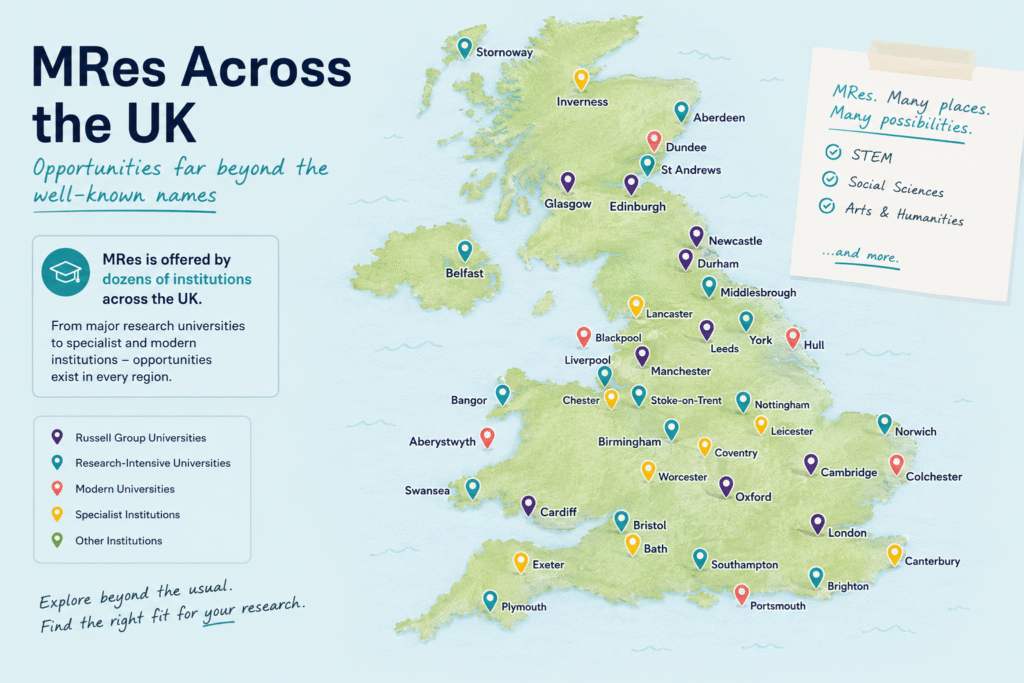
Here’s where it gets genuinely broad. This isn’t a niche, three-university qualification — there are currently over 90 UK institutions listing an MRes programme, spanning everything from Russell Group research powerhouses to smaller specialist institutions with a tight focus on one or two disciplines.
A handful of examples, pulled from very different corners of the sector:
University of Manchester — long-established MRes provision, including Management and Biological Sciences, feeding directly into PhD pipelines.
University College London (UCL) — funded MRes + PhD combined pathways in subjects like Management.
University of Portsmouth — structured MRes routes with a clear third-taught, two-thirds-research split.
University of Bath — noted strength in International Development and Social Sciences research masters.
Brunel University London — MRes options across Social Sciences and Engineering.
University of Stirling — regarded for Educational Research and Humanities MRes provision.
University of Gloucestershire — one of the more affordable MRes entry points.
Queen Mary University of London — MRes/PhD funded pathways via doctoral training partnerships.
Royal Gordon University (RGU) — MRes framed around employability and hands-on research design experience.
That’s a small slice of a much larger picture, and course pages change fast enough that it’s worth checking current offerings directly rather than relying on any list, including this one. GCRD HUB keeps its own running university directory covering partner institutions such as Durham University, Northumbria University, University of Sunderland, and Leeds Beckett University — a reasonable starting point if you want to cross-check research-degree options alongside taught postgraduate courses in the same subject area.
Don’t treat that as exhaustive — it isn’t close. Subject fit matters far more than league table position here, because you’ll spend most of your time working with one supervisor on one project. A brilliant MRes supervisor at a mid-ranked university will serve you better than a disengaged one at a famous institution. This is genuinely one of those situations where who you’ll work with outweighs where.
If narrowing that list down feels overwhelming — and with 90-plus institutions in the mix, it usually does — this is exactly the kind of decision GCRD HUB gets asked about regularly. Their education consultants spend a fair amount of time matching research-focused applicants to supervisors and departments whose current work actually overlaps with what the student wants to investigate, rather than just pointing at prestige.
What It Actually Costs (And Why the Range Is So Wide)
Tuition for an MRes swings dramatically depending on subject, and the split is basically laboratory versus everything else. Non-laboratory subjects such as social sciences or business typically run £14,000 to £22,000 per year for international students, while laboratory-based STEM and medicine programmes can run £25,000 to £32,000 per year. Zoom out across the whole sector and the range widens further still — tuition fees for a Masters by Research overall range from roughly £12,000 to £45,000-plus per year, depending on subject and institution. GCRD HUB’s student finance guidance is a reasonable place to start working out how that maps onto your own budget.
(That table’s deliberately a bit rough round the edges — real fee tables are like that too, honestly, because every university formats theirs differently and cross-comparing them cleanly is close to impossible.)
On top of tuition, budget for a deposit — most universities ask for £5,000 to £10,000 to issue your CAS — and don’t forget living costs, which vary enormously depending on whether you’re based in London or somewhere considerably cheaper.
Entry Requirements: The Bit People Skim Past
Academically, most MRes programmes want a UK 2:1 or international equivalent, though some universities will accept a 2:2 if you can point to relevant work or research experience. English language requirements sit in familiar territory for UK postgraduate study — Manchester’s Management MRes, for example, asks for an IELTS score of 7.0 overall with 6.5 in each individual section.
What genuinely separates MRes applications from standard taught master’s applications is the research proposal. You can’t really wing this one. Universities want to see that you’ve identified a specific question, understand roughly how you’d investigate it, and — ideally — that your proposed research overlaps with an existing supervisor’s interests. This is the step where what education consultants actually do with an application, and interview & admission preparation specifically, genuinely earns its keep, because a vague or unfocused proposal is one of the fastest ways to get quietly filtered out before an offer is even considered.
Visas, Dependants, and the Stuff That Actually Affects Your Life
If you’re coming from outside the UK, there’s a detail worth flagging that a lot of generic “what is an MRes” articles skip entirely: dependant visa rules. An MRes is generally treated as a 1–2 year research-focused degree, and current rules allow dependants to be brought on a UK student visa for research programmes in a way that differs from many standard taught courses under the post-2024 restrictions. That single fact has genuinely swayed a few students I’ve spoken with towards choosing an MRes over an equivalent MSc — not for academic reasons, but for family ones. Worth checking current Home Office guidance directly before you rely on it, because visa rules have a habit of shifting, and it’s exactly the kind of thing worth raising early with an international students advisor rather than discovering mid-application.
Pre-departure orientation covering exactly this kind of practical, easy-to-miss detail — visa nuance, accommodation timing, banking setup — tends to matter far more once you’re actually mid-application than it does when you’re still comparing course pages.
After the MRes: Where People Actually End Up
The PhD pipeline is the obvious next step, and for a lot of MRes graduates it’s exactly where they go. But it isn’t the only outcome, and treating it as the only outcome undersells the degree. Graduates can pursue research-focused roles in academia or industries like healthcare, economics, psychology, and management, and the analytical, project-design, and data-handling skills built during an MRes translate reasonably well into research-adjacent industry roles — market research, policy analysis, R&D functions in larger organisations.
I’ll admit a personal bias here: I think the “MRes only makes sense if you’re doing a PhD” narrative is a bit tired. Plenty of employers outside academia now specifically want people who can design a study, not just discuss one.
Frequently Asked Questions
Is an MRes the same as a PhD? No. An MRes is a level 7 qualification, the same level as other master’s degrees, while a PhD is level 8 — one full level higher, and considerably longer.
Can I go straight from an MRes to a PhD? Often, yes, particularly on 1+3 funded pathways where the MRes is explicitly designed to lead into a doctoral programme with the same funder or department.
Is an MRes harder than an MSc? Different, more than strictly “harder.” There’s less structure and more responsibility for your own time and direction, which some students find more demanding in practice even without more contact hours.
Do UK universities require a research proposal for MRes applications? Generally yes, and it’s usually the single most important part of the application — far more so than in a typical taught master’s application.
How long does an MRes UK degree take? Typically one year full-time or two years part-time, though this varies by university and subject.
Can international students bring family members while studying an MRes? Current rules generally permit this for research degrees, though policy details shift, so always verify directly with UK Visas and Immigration before assuming.
If you’re still stuck choosing between an MSc, MRes, and MPhil — or you know your subject but not your university — a proper conversation with education consultants who look at supervisor fit, funding structure, and visa timing together (rather than one issue at a time) tends to save people months of second-guessing. GCRD HUB offers scholarship & financial aid advisory and university placement services for exactly this kind of decision. You can get in touch via their London office at 107 Fleet St, London EC4A 2AB, or by phone on +44(0)20 39839001.
MA in UK: Complete Guide for International Students
I still remember the exact moment a friend of mine, halfway through a coffee that had gone cold twenty minutes earlier, said: “I think I’m doing my MA in UK.” Not “I’m thinking about it.” Not “maybe.” Just — decided. That was three years ago. She’s now working in London, complaining about the weather like a native, and occasionally sending me photos of overpriced flat whites as evidence of her assimilation.
That conversation stuck with me because it captures something true about postgraduate study in Britain: people don’t drift into an MA in UK the way they might drift into a random online course. It’s usually a deliberate, slightly nerve-wracking, fairly expensive decision — and once people make it, they tend to move fast. Application, visa, flight, done. Which is exactly why so many students end up scrambling for information halfway through the process instead of before it.
So let’s slow down. If you’re weighing up an MA in UK — for real, not just idly Googling at 1am — here’s what actually matters, in the order it tends to matter, minus the fluff.
Why the UK, Specifically? (Because “It’s Famous” Isn’t a Real Answer)
Prestige gets you in the door, but it’s not the reason people stay committed through eighteen months of readings and referencing styles. The practical case for an MA in UK is stronger than most prospectus brochures let on:
Speed. Most UK master’s programmes run for one year, sometimes less. Compare that to two years in the US or parts of Europe, and the maths starts to look very different — less tuition, less rent, less time away from earning a salary.
Course density. British universities offer a genuinely bewildering range of specialised master’s routes. Fancy something niche like the psychology of forensic and criminal behaviour, or something broader like business management? Both exist, often at the same institution.
The Graduate visa. Since 2021, international graduates can stay and work in the UK for two years after finishing (three for PhDs) without needing a job offer first. This single policy has reshaped how people think about return on investment.
None of this means the UK is automatically the “best” choice — Australia, Canada, and Ireland all make credible pitches too. But for people who want a fast, respected, work-friendly route into a new field, an MA in UK tends to punch above its weight.
The Taught vs Research Split (And Why It Trips People Up)
Here’s a mistake I see constantly: students assume all master’s degrees look the same. They don’t.
Taught MAs are structured, module-based, exam-and-essay-driven — closer to an intensive extension of undergraduate study. Research MAs (often labelled MRes or MPhil) are looser, more independent, and essentially a dry run for a PhD. If you’re the sort of person who needs deadlines and structure to function (no judgement — most of us do), a taught MA in UK institutions is the safer bet. If you already have a research question burning a hole in your notebook, look at research routes instead.
Some fields blur the line entirely. Courses like digital health or neuroscience and mental health often combine taught modules with a hefty independent dissertation, so read the module handbook before assuming anything.
What It Actually Costs (Brace Yourself, Slightly)
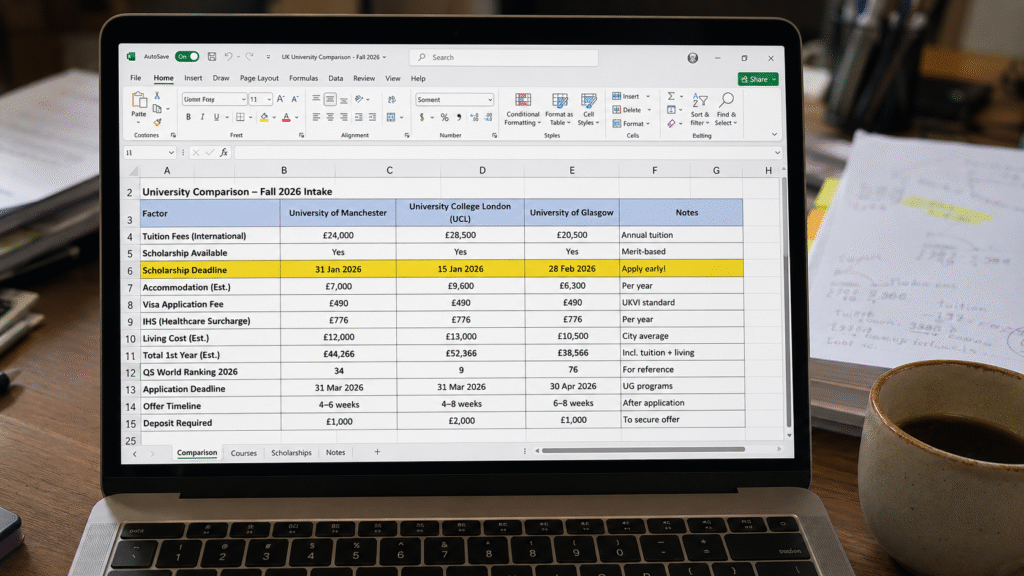
Money is where most enthusiasm quietly dies, so let’s not dance around it. Tuition for an MA in UK varies wildly by university, city, and subject — a humanities MA in a smaller city can cost a fraction of a business or STEM programme in London.
Cost Category
Typical Range (Per Year)
Notes
Tuition fees (international)
£12,000 – £35,000
Business & medicine-adjacent courses sit at the top end
Accommodation (London)
£800 – £1,400/month
Shared housing brings this down considerably
Accommodation (outside London)
£450 – £850/month
Varies a lot by city — Manchester ≠ Bristol
Student visa (Route)
£524 application fee
Plus Immigration Health Surcharge, paid upfront
General living costs
£1,000-ish/month, give or take
Food, transport, the occasional pub night nobody budgeted for
(That last row is deliberately loose — real life doesn’t fit neatly into spreadsheet cells, and anyone who tells you otherwise is selling something.)
A quick warning most guides skip: the UK government updates minimum maintenance fund requirements for the student visa fairly often. Don’t rely on a figure you read six months ago — check the official UK student visa page shortly before you apply, because banks and embassies will hold you to whatever the number is that week.
Funding Doesn’t Have to Mean Family Savings
A lot of students assume self-funding is the only route into an MA in UK, mostly because scholarships feel mythical — like something other, smarter people get. That’s not really true. Funding sources worth chasing include:
University-specific scholarships (often merit-based, sometimes country-specific)
Chevening Scholarships, for those with leadership potential and a strong professional track record
Commonwealth Scholarships, if you’re from an eligible Commonwealth country
Departmental bursaries tied to specific subjects — finance and marketing programmes sometimes have industry-funded awards nobody advertises loudly
This is genuinely one of the areas where scholarship and financial aid advisory support pays for itself — someone who already knows which awards exist for your subject and passport can save you months of scattered Googling.
Picking the Right Course (Not Just the Right University)
Here’s an unpopular opinion: obsessing over university rankings before you’ve nailed down the course is backwards. A mediocre course at a prestigious university will teach you less than an excellent, well-resourced course at a university you’ve never heard of.
Start by asking what you actually want to do afterwards. Want to work in HR? Look at human resource management routes and compare module lists, not just league table positions. Interested in criminal justice? Forensic psychology programmes vary enormously in how much fieldwork versus theory they include. Curious about supply chains and logistics? There’s a whole cluster of specialised options, including global logistics and supply chain management.
Deadlines for an MA in UK are less rigid than undergraduate UCAS deadlines, which is either liberating or dangerous depending on your personality type.
Stage
Typical Window
What Happens
Research & shortlisting
12–18 months before start
Comparing courses, funding, entry requirements
Applications open
September–October
Rolling admissions for most master’s courses
Priority scholarship deadlines
December–February
Miss these and funding options shrink fast
Offers issued
Rolling, often within weeks
Conditional offers common if results are pending
Visa application
After CAS issued
Usually 6 months before course start
Arrival & pre-departure prep
2–4 weeks before term
Accommodation, banking, orientation
Notice there’s no single “deadline day” the way there is for undergraduate applications. That flexibility is exactly why so many students procrastinate and then panic in July.
Slightly blunt tip: if you want scholarship money, treat December like it’s your real deadline — not the course’s official closing date. By the time general applications close, most of the good funding is already gone.
Visas, Paperwork, and the Bit Everyone Dreads
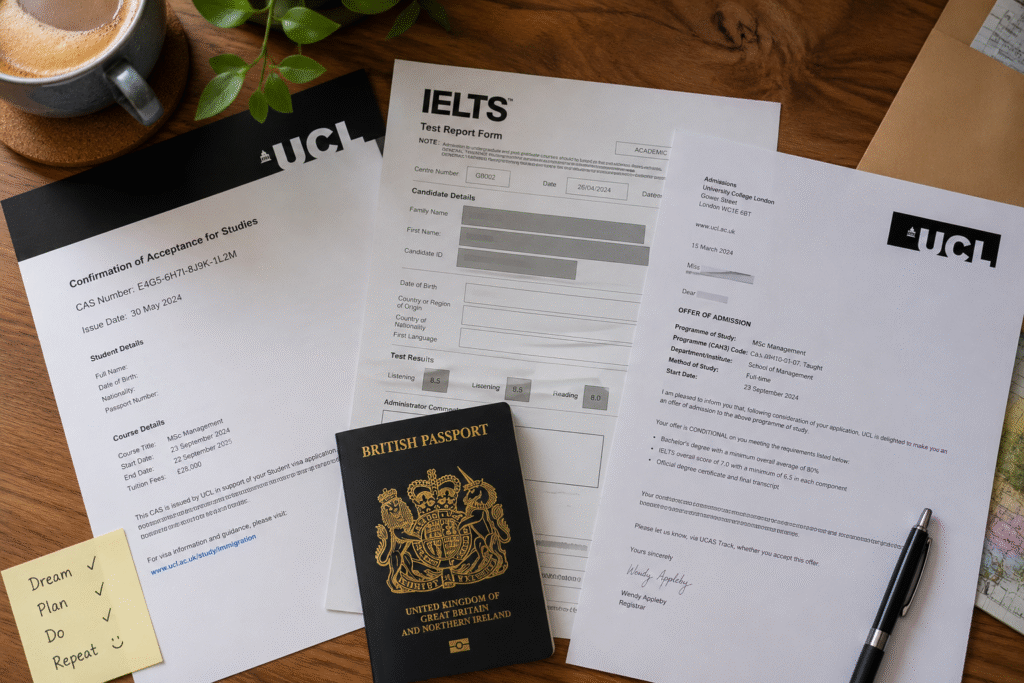
Once you have a confirmed offer, the university issues a CAS (Confirmation of Acceptance for Studies) number, which you’ll need for the Student visa application. It’s tedious, it’s bureaucratic, and it is genuinely worth getting right the first time — visa refusals over small documentation errors are more common than you’d think.
This is where end-to-end admissions support and structured pre-departure orientation earn their keep, frankly. Between financial evidence formatting, English test requirements, and interview preparation for competitive courses, it’s a lot to hold in your head alongside actual coursework anxiety. GCRD HUB, for instance, works through interview and admission preparation, visa documentation checks, and pre-departure orientation as part of guiding students through the process — the kind of unglamorous admin that quietly determines whether your MA in UK plan actually happens on schedule.
An MA in UK isn’t just an academic exercise — for most international students, it’s also the first real test of independent adult life in a new country. Budgeting in a currency that isn’t yours. Figuring out the NHS registration process. Working out which supermarket is actually cheaper (it’s rarely the one closest to your flat, annoyingly).
Part-time work is allowed during term (usually capped at 20 hours a week) and full-time during holidays, which helps offset costs but shouldn’t be relied on as core income — visa conditions are specific, and breaching them isn’t worth the extra shift.
Once the degree wraps up, the Graduate visa route gives two years to work or job-hunt without sponsorship. Fields like computing with artificial intelligence technology, cyber security, and healthcare-adjacent postgraduate routes tend to convert particularly well into skilled worker visas afterwards, given current UK labour shortages — though that landscape shifts, so treat it as a general trend rather than a guarantee.
FAQs People Actually Ask (Not the Polished Ones)
Is an MA in UK worth it financially, compared to staying home? Depends entirely on the field and your home country’s job market. In finance, business, and tech, the salary premium often justifies the cost within a few years. In more niche humanities subjects, the return is more personal than financial — worth being honest with yourself about which category you’re in.
Can I do an MA in UK without an undergraduate degree in the same subject? Often, yes. Many taught master’s programmes — particularly in marketing or human resources — accept students switching fields, sometimes with a conversion module or extra reading before term starts.
How long does an MA in UK actually take? Typically 12 months full-time, occasionally extending to 16 months for programmes with a summer dissertation period. Part-time routes stretch this to two years or more.
Do I need IELTS for every university? Most, yes, though scores and accepted alternatives (like PTE or Duolingo English Test) vary by institution and even by department within the same university.
What’s the biggest mistake applicants make? Underestimating how quickly good scholarship deadlines close, and overestimating how quickly visa paperwork can be assembled under pressure. Start both earlier than feels necessary.
Where This Actually Leaves You
If there’s one thing worth taking from all this, it’s that an MA in UK rewards people who plan slightly earlier than feels natural — scholarships close early, good course spots fill early, visa processing has its own unhurried rhythm regardless of your deadlines. None of it is complicated on its own. It’s just a lot of moving pieces landing at slightly different times.
If you’d rather not track all of it solo, education consultants who work specifically on UK admissions — interview prep, financial aid advisory, university placement, the pre-departure logistics — can take a fair amount of that weight off. GCRD HUB, based at 107 Fleet St, London EC4A 2AB, works through exactly that kind of guidance for students weighing up an MA in UK, and can be reached on +44(0)20 39839001 for anyone who wants a second opinion before committing to an application.
Either way — planned meticulously or figured out on the fly, coffee going cold in the process — an MA in UK tends to reward the people who just start.
Low Cost Universities in UK for International Students (And How to Get In Easily)
Right, let’s talk money — because that’s really why you’re here
Somebody, somewhere, told you a UK degree costs as much as a small house. And look, for some universities, that’s not far off. But here’s the bit nobody puts in the brochure: low cost universities in UK for international students genuinely exist, and they deliver the same globally recognised degree, the same graduate visa route, the same “I studied in London” bragging rights — for a fraction of what you’d pay at the big-name institutions. I’ve sat across the table from students who assumed Russell Group or nothing. Neither is true, and I’d rather you knew that before you remortgage your future on a name.
This isn’t a listicle of “top 10 cheap unis” copied from someone else’s spreadsheet. It’s a proper look at what “low cost” actually means in UK higher education, where the savings hide, where they don’t, and how the admissions process actually plays out when you’re applying from outside the UK.
What “low cost” even means (because it’s not one number)
Here’s the thing that trips people up: UK tuition fees for international students aren’t set centrally. Each university decides its own rate, and the spread is enormous. A Master’s in a niche STEM subject at a research-heavy university might run £24,000 a year. A comparable degree at a smaller, teaching-focused university — often just as accredited, often with smaller class sizes — could sit at £9,000 to £13,000.
Low cost universities in UK for international students tend to share a few traits:
They’re often newer universities (former polytechnics) or smaller specialist institutions
They’re rarely based in central London (location drives cost more than quality does)
They compete on outcomes and support, not prestige marketing budgets
Many offer generous scholarships that quietly bring the “sticker price” down further
None of that means lower quality. It means different priorities. A university spending less on international brand campaigns can spend more on smaller seminar groups.
Unpopular opinion: the “ranking” obsession costs students more than it earns them. Employers overwhelmingly care whether you can do the job, not whether your uni was #14 or #94 on some league table nobody outside academia reads closely.
The actual fee ranges (roughly — always check the current year)
I’ll give you ballpark figures, because exact numbers shift yearly and by course. Treat this as a compass, not gospel — always verify on the university’s own admissions page before you commit to anything.
University Type
Typical Annual Tuition (International)
Where Savings Usually Come From
Low cost universities (regional, post-92)
£8,500 – £13,000
Location, smaller campuses, scholarships
Mid-range universities
£14,000 – £19,000
Balanced reputation vs cost
High-prestige / Russell Group (London-based especially)
£20,000 – £38,000+
Brand, research funding, city premium
And here’s a rougher, messier table — the kind you’d actually scribble on the back of an envelope while comparing offers, because real comparisons rarely line up neatly:
City
Avg Monthly Rent
Uni fee range
Notes
Bradford
£350-450
£9k-£12k
Coventry
£450
£10,500 – £14,000
strong for business courses
London (outer boroughs)
£700+
£11k-£16k
Preston
£300
9,000-11,500
good value
(Yes, that second table is a bit rough round the edges — deliberately, because real budgeting comparisons rarely come pre-formatted for you either. Sort it into your own spreadsheet before you decide.)
Beyond tuition: the costs nobody warns you about
Tuition is maybe 60% of the real conversation. The rest is living costs, and this is where a lot of students get caught out.
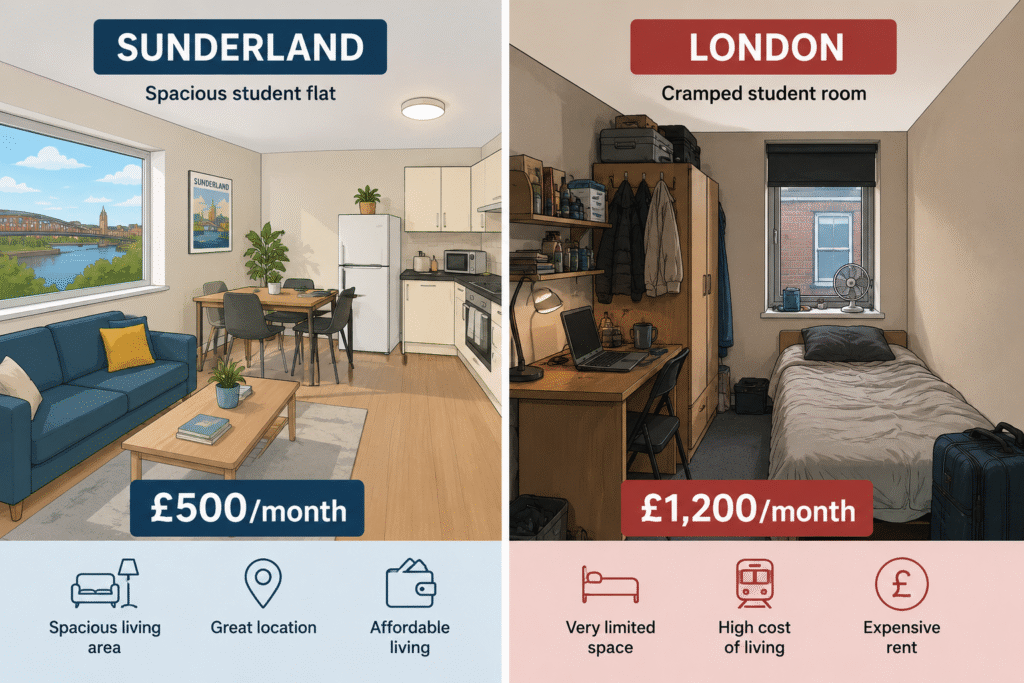
Rent varies wildly by city — a room in Manchester or Leeds can cost half what you’d pay in Zone 2 London. Then there’s the Immigration Health Surcharge, mandatory as part of your visa application, plus the visa fee itself, flights, books, and — this one catches people out — a compulsory maintenance fund you must show as proof of funds before your visa is even granted. Check the current figures directly on gov.uk’s student visa page, since these numbers are reviewed periodically.
My honest advice? Budget for the city, not just the course. Choosing genuinely low cost universities in UK for international students situated outside London can shave thousands off your annual spend without touching your course quality at all.
So which universities actually count as low cost universities in UK for international students?
I’m deliberately not naming a “top 10” list here, and that’s on purpose — league tables of “cheapest unis” go stale within a year, and the right choice depends entirely on your subject. What I’d rather do is point you toward how to find them properly:
Search by subject first, cost second. A brilliant, affordable computing degree does you no good if you wanted to study choreography.
Compare 2026 entry fees directly on official UCAS or university pages — never third-party “aggregator” sites, which are often out of date.
Look specifically at post-92 universities and smaller specialist institutions — this is genuinely where most of the low cost universities in UK for international students cluster.
Cross-check accreditation. Cheap and unaccredited is a trap; cheap and properly accredited is a genuine find.
For reference, UCAS remains the most reliable central source for comparing live fee data across UK institutions, and HESA publishes broader sector statistics if you want the bigger picture.
Course choice actually matters more than people admit
Here’s something I wish more students understood earlier: when you’re scoping out low cost universities in UK for international students, the subject often shapes the cost as much as the university does. Business-related courses, for instance, are widely offered at more affordable rates across dozens of institutions — from a straightforward BA/BSc (Hons) in Business Management to more specialised routes like Business Management with Healthcare or a Level 6 Top-Up Degree in Business Management for students who’ve already completed a diploma abroad.
If your interests run more towards the social sciences, subjects like Criminology, Forensic Psychology, or the more specific Psychology of Forensic & Criminal Behaviour are also widely available at genuinely affordable institutions — proof that “low cost” doesn’t have to mean “limited choice.”
Scholarships: the part everyone skims past too quickly
Don’t skip this section. When people research low cost universities in UK for international students, scholarships are where the real savings often hide — most students never apply because they assume they won’t qualify. Many universities offer:
Merit-based scholarships tied to academic grades (sometimes 10-50% off tuition)
Country-specific bursaries for students from particular regions
Early application discounts — genuinely, applying a term early can save you real money
Alumni or sibling discounts, if a family member studied there before
This is precisely where scholarship and financial aid advisory support earns its keep — it’s not glamorous work, but it’s often the single biggest lever on your final cost.
How the admissions process actually works (step by step)
Right, the practical bit.
Shortlist by subject and budget — not reputation alone.
Check entry requirements — English language scores (usually IELTS 6.0-6.5 for undergrad), academic transcripts, and sometimes a personal statement.
Apply through UCAS (for most undergraduate courses) or directly to the university for postgraduate and some international pathways.
Receive a conditional or unconditional offer.
Accept, secure your CAS (Confirmation of Acceptance for Studies) — you’ll need this for your visa.
Apply for your student visa through the official, showing proof of funds and the CAS number.
Sort accommodation, flights, and pre-departure prep.
On paper it looks tidy. In practice, students trip up constantly on document formatting, missed deadlines, or misunderstanding financial evidence requirements — which is genuinely where end-to-end admissions support and interview & admission preparation make the difference between a smooth application and a rejected one.
A quick word from someone who’s watched this go wrong (and right)
I’ve seen students obsess over finding the single cheapest university in the UK, only to discover the course had no work placement, poor employability support, or — worse — wasn’t properly recognised by employers back home. Cheap isn’t the goal. Value is. A genuinely low cost university in the UK that offers strong graduate outcomes beats a marginally cheaper one with a weak employability record, every single time.
If you’re weighing this up and want a second pair of eyes on it, this is more or less what firms like GCRD Hub do day to day — helping students compare study in UK options properly, matching course choice to budget, and handling the messier admin (interview prep, scholarship applications, visa document checks) so nothing slips through the cracks. Based at 107 Fleet St, London EC4A 2AB, and reachable on +44(0)20 39839001, they work specifically with students trying to make sense of affordable routes into UK higher education — not just push whichever university pays the biggest referral fee.
FAQs about low cost universities in UK for international students
Are low cost universities in UK for international students still recognised internationally? Yes — as long as they hold proper UK accreditation (check the Office for Students register), a degree’s academic value isn’t tied to its price tag.
Can international students get scholarships at low cost UK universities? Frequently, yes. Many affordable universities offer scholarships specifically to widen international access, sometimes stacking with early-application discounts.
What’s the cheapest way to find low cost universities in UK for international students? Generally: choose a post-92 university outside London, apply early for scholarships, and pick a city with lower living costs — Bradford, Preston, and parts of the Midlands are common examples.
Do low cost universities in UK for international students offer the same graduate visa options? Yes. The Graduate Route visa applies regardless of which UK university you attended, provided the course and institution are properly licensed.
How do I know if a “cheap” university is legitimate? Cross-check it against the official
Low cost universities in UK for international students aren’t a compromise — they’re often the smarter, better-supported route into a UK education, provided you choose by subject fit and outcomes rather than name recognition alone. Do your homework on fees, dig into scholarships properly, and get your admissions paperwork right the first time. And if the process feels like wading through fog, that’s precisely the sort of thing education consultants exist to clear up — whether that’s GCRD Hub or another properly established advisory service. Either way: don’t let sticker shock talk you out of a degree that was never actually going to cost what you assumed.
MBA Courses in UK: Which University Actually Gets You Hired?
I once sat across from a guy who’d remortgaged a flat in Lahore to fund his MBA. Eighteen months later he was running analytics for a fintech in Canary Wharf. That’s the gamble we’re talking about — and gambling, frankly, is the right word, because not every MBA pays off the way the brochures promise.
So let’s actually talk about MBA courses in UK institutions — properly, without the marketing gloss.
Why the UK, of all places?
You could do an MBA in Singapore. Boston. Even online, from your sofa, in pyjamas. So why does the UK keep pulling in thousands of international applicants chasing MBA courses in UK every year?
Three reasons, really. The course length (usually one year, not two — your wallet will thank you). The sheer density of employers within a 30-minute tube ride of campus. And the Graduate visa route, which lets you stay and work for two years after finishing — a genuinely useful bit of policy that changed the maths for a lot of people I’ve spoken with. If you want the broader picture first, the Study in the United Kingdom overview is a sensible place to start before drilling into MBA specifics.
Where the good MBA courses in UK actually sit
Forget the marketing rankings for a second. Employers in the UK tend to gravitate toward a fairly predictable shortlist: London Business School, Oxford Saïd, Cambridge Judge, Warwick, Manchester, Imperial. The Financial Times Global MBA Ranking is the one recruiters actually glance at, for what it’s worth.
But — and this is where people get it wrong — the “best” university isn’t always the right one for you. A regional MBA with strong local industry ties (think Leeds, Sheffield, or Northumbria) can land you a job faster than a prestigious name if your target sector is based there. It’s worth browsing the full list of partner universities before narrowing your shortlist.
University
Typical Duration
Average Tuition (Intl.)
Notable Strength
London Business School
15-21 months
£100,000+
Finance, global network
Warwick Business School
1 year FT
£44,000
Consulting placements
Manchester Alliance MBS
1 year
£42,000
Cambridge Judge
12 months
£68,000
Entrepreneurship
Northumbria University (see profile)
1-2 years
around £18,500 — varies by intake
Affordability, regional industry links
(Yes, that table’s a bit ragged on purpose — fees move term to term, so treat the figures as a starting conversation, not gospel.)
What you’ll actually study (it’s not all spreadsheets)
People imagine an MBA as twelve months of Excel. Wrong. Most MBA courses in UK universities build around a core — strategy, finance, leadership, operations — then let you specialise. Want to go deep on business analytics, finance, or digital marketing? Most programmes now let you tilt your electives that way, and you can browse the broader range of postgraduate courses to see how electives stack up against the core MBA. Some, like GCRD HUB’s listed MBA International pathway or the Master in Business Administration programme, are built specifically with international career mobility in mind, which matters if you’re not planning to stay in the UK forever.
Quick reality check: if a programme can’t name three employers its last cohort got hired by, ask why. A good MBA should be able to answer that without flinching.
Entry requirements nobody explains properly
Here’s the bit that trips people up. Most UK MBA programmes want:
A bachelor’s degree (2:1 or equivalent, though some accept 2:2 with work experience)
2-5 years of professional experience — full-time MBAs are stricter on this than you’d think
IELTS 6.5-7.0 overall for non-native English speakers
GMAT or GRE — increasingly optional, but it helps at the top end
If you’re coming from a non-business background, don’t panic. Conversion-style programmes exist precisely so career-switchers — teachers, engineers, doctors — can pivot into management roles. The international students hub is a decent starting point if you want the entry criteria laid out by nationality and qualification type.
The money question everyone dances around
Tuition runs anywhere from £18,000 to over £100,000 depending on the institution’s reputation (and ego, frankly). Add living costs — London will eat roughly £1,300-£1,500 a month out of you, cities like Sheffield or Sunderland considerably less.
Scholarships exist, though they’re competitive. The UK government’s Chevening Scholarships cover full-ride costs for select candidates, and individual universities run their own merit-based funding pots too — worth cross-checking against the international student scholarships breakdown and the wider student finance options before assuming you can’t afford it. This is honestly where having someone walk you through scholarship and financial aid advisory options — which is part of what outfits like GCRD HUB do — saves weeks of confused Googling.
Career prospects: the part you actually care about
Average post-MBA salaries from UK Russell Group business schools hover around £55,000-£75,000 for graduates entering consulting, finance, or tech management roles, according to data published in the QS Global MBA Rankings report. London Business School and Oxford grads often clear six figures within three years. Regional MBAs land lower starting salaries but frequently offer a faster, less competitive route into mid-management.
Sectors hiring MBA grads right now? Consulting (obviously), fintech, healthcare management, renewable energy, and — surprisingly — the NHS’s management arm, which has been quietly recruiting MBA-trained operations leads for years.
Choosing between universities without losing your mind
Don’t just chase rankings. Ask instead:
Does the careers team have relationships in your target industry?
What’s the class size — twelve people or two hundred?
Is there a strong alumni network where you’re planning to work afterward?
Can you actually picture living in that city for a year?
That last one matters more than people admit. I’ve met brilliant students who hated their MBA year purely because they picked a city that didn’t suit them.
A word on the application process itself
Applications usually open 12-18 months before the intended start date. You’ll need a personal statement, references, transcripts, and often an interview — sometimes panel-style, sometimes one-on-one. End-to-end admissions support and interview preparation genuinely change outcomes here; a polished personal statement is rarely written on the first attempt, and most rejected applications I’ve reviewed had vague, generic answers to “why this MBA, why now.”
If you’d rather not navigate university portals solo at 2am, education consultants — GCRD HUB included, based at 107 Fleet St, London EC4A 2AB — offer guidance through admissions, interview prep, and pre-departure support, which for first-time international applicants can be the difference between a smooth process and a stressful one. You can also register your interest directly if you’d like a consultant to walk through your shortlist with you, or browse the wider postgraduate courses catalogue while you’re at it.
FAQs people actually ask
Is an MBA in the UK worth it for international students? Generally yes, particularly if you’re targeting management roles in finance, consulting, or tech — the one-year format also means less time out of the workforce compared to two-year US programmes.
How long do MBA courses in UK universities typically take? Most full-time programmes run 12-15 months; part-time and executive options can stretch to two years.
Do I need a GMAT score for UK MBA courses? Not always. A growing number of universities now waive GMAT requirements for candidates with strong professional experience.
Can I work in the UK after completing an MBA? Yes — the Graduate visa allows two years of post-study work (three for doctoral graduates).
What’s the average cost of MBA courses in UK institutions? Anywhere from roughly £18,000 to over £100,000, depending heavily on the university’s tier and location.
Final thought
Picking from the long list of MBA courses in UK universities isn’t really about finding the “best” one. It’s about finding the one that fits where you want your career to land in three years’ time — and being honest with yourself about budget, city, and industry fit before you sign anything. If that decision feels overwhelming, talking it through with someone who’s guided other students through the same maze (university admissions teams, consultants, whoever) tends to be worth the hour it takes — or just contact us directly and we’ll talk it through. For more guides like this one, the blog has plenty more on UK study options.
Best Universities in Aberdeen UK: Courses, Fees & Student Life
Best Universities in Aberdeen UK: Everything You Need to Know Before Applying
If you’re hunting for the best universities in Aberdeen UK, this is the article to bookmark. Not the glossy-brochure version — the honest one, with actual fee figures, real entry requirements, and the kind of student life detail that official university websites somehow never manage to include.
Aberdeen surprises people. Everyone piles toward London, Edinburgh, or Manchester when shortlisting UK universities, and those cities have earned their reputations. But the universities in Aberdeen collectively serve around 30,000 students — a significant proportion of them international — in a compact, coastal city where tuition is lower, rent doesn’t punish you, and the academic pedigree in certain fields (medicine, energy engineering, nursing) is genuinely world-class. If Aberdeen isn’t on your list yet, read on.
University of Aberdeen: The Ancient One That Still Outperforms Expectations
Founded in 1495 — before Columbus reached the Americas, for context — the University of Aberdeen is the fifth-oldest English-speaking university in the world. Five centuries of academic infrastructure, research culture, and alumni networks. And yet it doesn’t attract the same international frenzy as Oxford or St Andrews, which is arguably its advantage. Acceptance rates are more forgiving. Teaching ratios are relatively intimate. Research outputs in petroleum engineering, medicine, and law are genuinely world-class.
Key Programmes at the University of Aberdeen:
Medicine (MBChB): One of Scotland’s finest medical schools, with strong clinical placements across NHS Grampian. Entry is competitive — typically AAA at A-level or equivalent — but the programme produces consultants, researchers, and GPs with genuine clinical depth.
Petroleum Engineering: Aberdeen’s calling card. The city’s identity as the oil capital of Europe gives energy engineering students access to industry contacts that simply don’t exist elsewhere in the UK. The curriculum is also pivoting meaningfully toward renewable energy — which matters for career trajectories across the next decade.
Law (LLB): Scotland operates under Scots law, distinct from English law. Aberdeen’s law school provides a thorough grounding in both systems. For international students intending to practise in the UK, this is worth understanding before you apply.
Business and Management: The Business School sits within a Russell Group institution, which has measurable impact during graduate recruitment.
Tuition Fees (2025–26 approximate):
Undergraduate (International students): £18,500–£25,000 per year depending on subject
Postgraduate taught (International): £17,000–£24,000 per year
Scottish and UK students may qualify for SAAS funding — a separate system from the Student Finance England model
The campus sits in Old Aberdeen — cobblestoned streets, King’s College chapel, a layout that feels genuinely historical rather than simulating history with modern brickwork.
Robert Gordon University Aberdeen: The Practical Choice Employers Consistently Prefer
In several graduate employment surveys, Robert Gordon University (RGU) outperforms institutions with considerably more prestigious reputations. That’s not accidental. RGU has deliberately structured its courses around employability — sandwich years, industry placements, and live project briefs are built into programmes rather than tacked on as optional extras.
RGU sits south of Aberdeen city centre on Garthdee Campus — a modern, purpose-built site overlooking the River Dee. The facilities reflect the university’s strong industry ties: well-equipped engineering labs, a health sciences simulation centre, and media production suites that look genuinely professional.
Standout Courses at RGU Aberdeen:
Nursing and Midwifery: Consistently ranked highly for student satisfaction. Clinical placements through NHS Grampian cover a wide rural catchment area — which means varied and often complex clinical exposure that urban-only placements rarely provide.
Architecture: Strong studio culture, with graduates regularly picking up awards at national competitions.
Pharmacy: One of the few pharmacy schools in Scotland. Competitive entry, strong MPharm placements, excellent links with both NHS and private sector pharmacies across the north-east.
Oil and Gas / Subsea Engineering: RGU arguably rivals the University of Aberdeen in this specific area, with a dedicated energy faculty and very strong industry integration.
Tuition Fees at RGU (2025–26 approximate):
Undergraduate (International): £14,500–£20,000 per year
Postgraduate taught (International): £13,500–£18,000 per year
RGU sits slightly below the University of Aberdeen on fees — which, across a three or four-year programme, is a meaningful financial difference.
(Something prospectuses almost never clarify: living costs in Aberdeen are lower than almost any other major Scottish city. Rent for a decent room typically runs £500–£750/month. That’s not London. That’s not even Edinburgh.)
🎓 Quick Comparison: Best Universities in Aberdeen UK
University
Founded
Type
UG International Fees (approx.)
Best Known For
University of Aberdeen
1495
Russell Group / Ancient
£18,500–£25,000
Medicine, Law, Petroleum Engineering
Robert Gordon University (RGU)
1992 (university status)
Modern University
£14,500–£20,000
Nursing, Architecture, Energy Engineering
NESCol (North East Scotland College)
Further Ed / Pathway
FE College
Varies (typically lower)
Foundation / HNC / HND pathways
Aberdeen University Courses That Are Actually Worth Your Attention
When people search for universities in Aberdeen UK, they’re often after very specific information that university websites bury under layers of marketing copy. So here’s an honest breakdown of the most in-demand subject areas — and a few that are genuinely underrated.
Energy and Engineering
Aberdeen’s relationship with the energy sector is deep-rooted and still evolving. The North Sea has defined this city economically for five decades. The pivot toward offshore wind, hydrogen energy, and carbon capture has actually increased academic demand in this space rather than reducing it. Both the University of Aberdeen and RGU offer energy programmes with genuine industry integration — live briefs with energy companies, offshore safety training included in some modules, alumni networks concentrated in actual industry roles.
If you’re interested in Artificial Intelligence or Data Science within an engineering context, Aberdeen’s tech scene has grown considerably, driven largely by energy companies digitising their operations.
Health and Allied Health Sciences
The demand for nursing, physiotherapy, and occupational therapy programmes at the best universities in Aberdeen has never been higher. NHS Grampian — one of Scotland’s largest territorial health boards — provides clinical placement infrastructure for both institutions. Students gain exposure to both urban acute care and rural primary care, which is comparatively rare. For international students considering nursing pathways in the UK, this breadth of clinical exposure is worth factoring into your decision.
Business, Finance, and Law at Aberdeen Universities
Both universities in Aberdeen offer business management programmes, though the experience differs quite noticeably. The University of Aberdeen’s Business School operates within a Russell Group environment, with stronger emphasis on research-informed teaching. RGU’s Aberdeen Business School is more explicitly vocational — internships, live consulting projects, and employer panels are regular features rather than special events.
For anyone considering law, the Scottish LLB is a qualifying law degree in Scotland — unlike the English system, where a Graduate Diploma in Law (GDL) conversion is required if you studied a non-law subject. Understanding the LLB route before applying could save you a year of postgraduate study.
Computing and Cybersecurity
One of the genuinely underrated areas at Aberdeen’s universities. Both institutions have invested heavily in computing infrastructure over the last decade, driven by the energy sector’s appetite for software engineers, cybersecurity specialists, and data analysts. Cyber Security degrees at both universities connect students to oil and gas companies that have become prime targets for state-sponsored cyberattacks. Unusual context for a computing degree — but genuinely relevant for career preparation.
What Student Life at Aberdeen Universities Actually Looks Like
Aberdeen has around 230,000 residents — a proper city, not a university town where students overwhelm the local population. The University of Aberdeen Students’ Association (AUSA) runs over 180 clubs and societies. RGU’s students’ association (RGUSA) is smaller but consistently strong on arts, music, and social programming.
A few things worth knowing that don’t make it into official prospectuses:
The weather is real. Aberdeen gets roughly 1,400 hours of sunshine per year. Winters are cold and often grey. The famous Aberdeen granite gives the city a distinctive silver shimmer in sunlight — genuinely beautiful — but January can feel relentless. Worth knowing before you commit to four years.
The nightlife is better than expected. Union Street and the Belmont Street area have a range of bars, clubs, and live music venues. It’s not Glasgow for nightlife, but there’s more than enough on any given weekend.
Food and transport are manageable. A weekly shop runs £30–£50 for a student living sensibly. Public transport within the city is decent; many students cycle.
The coastline is an actual amenity. Footdee — the historic fishing village at the harbour mouth — is walkable from the city centre. Dunnottar Castle is half an hour by bus. Aberdeen students tend to spend their weekends in Aberdeen in a way that students in, say, Leeds or Sheffield often don’t.
📊 Estimated Monthly Student Living Costs in Aberdeen
Approximate figures — treat as a guide, not a precise budget
Expense Category
Budget (£/month)
Notes
Accommodation (private room)
£500–£750
University halls may be slightly less in first year
Food / groceries
£150–£200
Lidl and Asda are well-represented; eating out adds up fast
Transport (city)
£40–£70
First Bus monthly pass; cycling is free
Utilities / internet (if private)
£60–£100
Often included in student lets — check your tenancy agreement
Social / entertainment
£80–£150
Significantly lower than London or Edinburgh
Total (estimated)
~£830–£1,270
Compare to London’s typical £1,400–£2,000+
Aberdeen University Entry Requirements for International Students
Entry requirements are where a lot of international applicants get genuinely lost — partly because the Scottish system differs from England’s, and partly because universities are inconsistent about how they communicate contextual offers versus standard ones.
University of Aberdeen — typical entry:
Most undergraduate programmes require UCAS points in the 120–160 range (roughly BBB to AAA at A-level, or international equivalent). Medicine and Law sit at the higher end. IELTS requirements are typically 6.0–7.0 overall, depending on subject — nursing and medicine require stronger academic English than business programmes.
Robert Gordon University Aberdeen — typical entry:
Slightly more accessible in most subjects. Standard undergraduate offers often sit between 96 and 128 UCAS points, with some professional programmes (pharmacy, nursing) being more selective. IELTS minimums are 6.0 for most programmes, 6.5–7.0 for clinical health subjects.
Both universities in Aberdeen accept IB diplomas, Indian state board examinations, Pakistani HSSC/O and A Levels, Nigerian WAEC/NECO, and many other international qualifications. The challenge is accurately mapping your specific certificate to UK entry requirements — which takes longer than it should when you’re doing it without guidance.
Having someone who already knows how Pakistani A Levels map to Scottish Highers, or how GPA systems translate to UCAS points, genuinely saves weeks of uncertainty. GCRD HUB, based at 107 Fleet St, London EC4A 2AB, provides end-to-end admissions support for international students targeting UK universities — including both Aberdeen institutions — and can clarify exactly where your qualifications sit before you apply. Contact: +44(0)20 39839001–9003.
Scholarships at Universities in Aberdeen: More Available Than Most People Realise
The Saltire Scholarships programme, funded by the Scottish Government, offers awards of £8,000 to international students from Canada, China, India, Japan, Pakistan, and the USA studying in Scotland. Both the University of Aberdeen and RGU have had Saltire Scholarship recipients.
Beyond Saltire, both universities in Aberdeen offer their own merit-based international scholarships — typically ranging from £1,000 to £5,000 per year. These aren’t full rides, but stacked against Aberdeen’s genuinely lower living costs, they make a tangible dent in total study expenditure.
The University of Aberdeen’s Principal’s Global Excellence Scholarship can cover up to 50% of fees for high-achieving international students. Deadlines often fall before UCAS deadlines — something to chase well in advance of your application. For a broader picture of scholarship and financial aid options for international students in the UK, there are funding sources well beyond individual university awards.
Post-Study Work and Careers After Graduating from Aberdeen Universities
The Graduate Route visa allows international students who complete a UK degree to remain for two years after graduation (three years for PhDs). This applies equally to graduates of Aberdeen institutions as it does to London universities. The category has made Scotland significantly more attractive to international students who previously worried about job search timelines after graduation.
Aberdeen’s local graduate job market is weighted toward energy, healthcare, and technology — which maps neatly onto the city’s strongest academic programmes. For those wanting to work elsewhere post-graduation, Aberdeen is 2.5 hours by train to Edinburgh and well-connected to the broader Scottish economy.
Something interesting is happening with Aberdeen’s tech startup ecosystem too. Quietly, without the fanfare of Edinburgh’s “Silicon Glen” identity, Aberdeen has developed a cluster of energy tech and maritime tech startups that are actively recruiting graduates. Worth watching if technology interests you.
Before you apply: Many international students find the UCAS personal statement disproportionately stressful — especially those from education systems where personal reflective writing isn’t standard in applications. Both the University of Aberdeen and RGU place genuine weight on it, particularly for nursing, medicine, and architecture. If you’re writing yours in a second or third language, get it reviewed by someone who understands what UK admissions tutors are actually looking for. GCRD HUB’s admissions preparation service covers this specifically, including interview coaching for university admission and UKVI student visa credibility interview preparation.
FAQs: Universities in Aberdeen UK
Are the universities in Aberdeen UK good for international students?
Genuinely yes — arguably better than cities with flashier reputations. Lower cost of living, accessible campuses, a real city with proper cultural infrastructure, and a strong international student community. Most international students find Aberdeen welcoming and manageable in a way that some larger UK cities aren’t.
Which is the best university in Aberdeen for international students — University of Aberdeen or RGU?
Depends entirely on what you want to study. The University of Aberdeen is a Russell Group research university — stronger for medicine, law, petroleum engineering, and research-heavy disciplines. RGU is better for applied, vocational programmes where graduate employment outcomes matter most — nursing, architecture, pharmacy, energy engineering. Both are fully accredited UK universities. Neither is a second-best choice.
What are the entry requirements for universities in Aberdeen?
University of Aberdeen: typically 120–160 UCAS points, IELTS 6.0–7.0. RGU: typically 96–128 UCAS points, IELTS 6.0–6.5. Both accept a wide range of international qualifications. Professional admissions guidance helps translate your specific certificates into accurate UK equivalents.
Can I work in the UK after studying at an Aberdeen university?
Yes — the Graduate Route visa gives two years of open UK work rights after an undergraduate or postgraduate degree, three years after a PhD. Aberdeen graduates are eligible on the same terms as graduates from any other UK university.
What scholarships are available at Aberdeen universities?
Scottish Government Saltire Scholarships (£8,000), University of Aberdeen Principal’s Global Excellence Scholarship (up to 50% fee reduction), and RGU’s international merit awards. Scholarship advisory services can identify funding specific to your nationality and subject.
Are there pathway routes into Aberdeen universities for international students?
Yes. NESCol offers HNC/HND programmes that pathway into Year 2 at RGU in particular. Foundation and diploma routes are a well-established entry point for international students whose qualifications don’t directly meet undergraduate entry requirements.
Is Aberdeen an affordable city for students?
Aberdeen consistently ranks as one of the more affordable major UK cities for student living. Accommodation, food, and transport costs are considerably lower than London and somewhat lower than Edinburgh and Glasgow — a meaningful factor when calculating total cost of study at any of the universities in Aberdeen.
Why the Best Universities in Aberdeen UK Deserve a Serious Look
The best universities in Aberdeen UK are producing graduates who actually get jobs, in subjects that have genuine demand, in a city that’s undergoing a real economic transformation — from oil dependency toward a diversified knowledge economy that includes renewables, maritime technology, healthcare, and digital industries.
That’s not a minor thing to be part of.
If you’re seriously considering Aberdeen — for a business degree, a clinical programme, an engineering qualification, or something else entirely — the practical next step is getting your qualification equivalencies sorted, understanding your scholarship options, and making sure your UCAS application is as strong as possible before the deadline arrives.
For students navigating this from outside the UK, GCRD HUB provides structured university admissions support covering the entire process from first enquiry to pre-departure orientation — including application strategy and interview preparation. They work with students targeting universities across the UK, not just Aberdeen. But if Aberdeen is where you’re headed, arriving prepared makes a measurable difference.
Nobody tells you this upfront — but the “cost of studying in the UK” conversation is almost always about Oxford and Imperial College London. Two universities. Out of over 160. That’s a bit like saying all food in Italy is expensive because you ate at a tourist trap near the Colosseum.
The truth is messier, more interesting, and frankly more useful: there are genuinely affordable universities in the UK — ones with solid academic reputations, real career pathways, and fees that won’t require you to sell a kidney or remortgage your family home. The low cost universities in UK scene is bigger than most international students ever hear about, and that’s exactly the gap this guide is trying to close.
Whether you’re in Lahore, Lagos, Nairobi, or Dhaka quietly Googling “how much does it cost to study in the UK” at midnight — this one’s for you.
The Price Tag Nobody Mentions First
Before the lists, a quick reality check on what “low cost” actually means in the British university context.
For international students, UK university tuition fees typically land somewhere between £10,000 and £38,000 per year. Yes, that’s a colossal range. The universities dominating every “best universities in the UK” listicle — your Imperials, your UCLs, your London School of Economics — are firmly at the top of that bracket.
But move your attention northward (Manchester, Sunderland, Bradford, Teesside), or toward newer institutions built in the last 30-40 years, and the picture shifts dramatically. Many perfectly respectable universities charge international students between £10,500 and £14,500 per year for undergraduate programmes — and some postgraduate courses sit even lower.
And before you assume “cheaper = worse”: several of these universities hold strong rankings in specific subject areas, appear on UCAS league tables for graduate employability, and produce alumni working across the NHS, FTSE 500 companies, and international organisations. Price and prestige don’t always correlate the way people assume.
Universities That Actually Won’t Clean Out Your Account
Let’s get into specifics, because vague reassurances aren’t useful to anyone.
Here are universities widely recognised as among the most affordable for international students, without compromising on accreditation or quality:
University of Sunderland sits in the northeast of England with fees typically starting around £13,000–£14,500 for international undergraduates. It has a strong reputation in health sciences, business, and media. For postgraduate students, the figures can come in even lower — and Sunderland actively recruits internationally, meaning the admissions process is more streamlined than at many institutions. Explore Sunderland courses →
University of Bolton often surprises people. Fees regularly sit around £12,500–£13,900 for international students, and Bolton is particularly strong in engineering, education, and creative arts. It’s not a name that makes dinner party conversation in London, but it’s a fully accredited, HESA-registered institution with real graduate outcomes. Learn more about University of Bolton
Teesside University in Middlesbrough deserves considerably more attention than it gets. With fees around £13,000 and specialisms in digital technologies, healthcare, and business — it’s become something of a quiet favourite among international applicants who’ve done their homework properly. View Teesside University
Anglia Ruskin University (ARU) has campuses in Cambridge and Chelmsford — yes, Cambridge — with fees that are a fraction of the university you’re now thinking about. ARU is particularly well-regarded for health programmes, business, and education, with international fees that commonly fall in the £13,000–£15,000 range. Anglia Ruskin at GCRD Hub →
University of Bradford has been on a quiet upward trajectory in rankings for sustainability and research. Fees for international students start around £14,000–£15,000 and it offers genuinely strong programmes in pharmacy, social sciences, management, and engineering. Bradford University courses
London Metropolitan University — and here’s where London stops being automatically expensive. London Met offers some of the lowest fees among London institutions, with international tuition from approximately £13,500. For students who need to be in London specifically (for industry connections, internships, or personal reasons), this is a gateway that’s often overlooked. Explore London Metropolitan University
Leeds Beckett University in West Yorkshire is another one that flies quietly under the radar. Strong in sports science, law, business, and media. International undergraduate fees from roughly £13,500. Leeds itself is one of the UK’s most vibrant student cities — affordable to live in, excellent transport links, huge international community. Leeds Beckett programmes
University of Central Lancashire (UCLan) in Preston has grown considerably in academic stature over the last decade. Fees for international undergraduates typically hover around £13,500–£15,000, with particular strengths in journalism, forensic science, nursing, and business. UCLan at GCRD Hub
Northumbria University in Newcastle deserves a special mention — it’s climbed rankings significantly and is now frequently placed in the top 50 UK universities by some metrics, yet maintains relatively competitive international fees around £15,000–£18,000 depending on programme. Northumbria University
Solent University in Southampton is particularly strong in maritime studies, media, and business — and remains one of the more affordable options in the south of England. Solent University →
Quick note for those keeping a mental tally: fees above are approximate and shift annually. Always verify directly with the institution or through a registered education consultancy before making financial commitments.
The Full Picture — What the Fees Don’t Include
Here’s the part of the conversation that gets skipped entirely in promotional brochures:
Tuition is only one column in your budget spreadsheet.
Living costs in the UK vary wildly by city. London sits at one extreme — expect £1,200–£1,600 per month for accommodation, food, transport, and occasional sanity. Cities like Sunderland, Bolton, Preston, and Middlesbrough are genuinely different experiences — students frequently manage on £600–£900 per month, sometimes less with smart accommodation choices.
This is why the total cost of studying in a “cheap London university” can still far exceed a full year at a more expensive university in the north. Location is part of the financial equation, not a secondary consideration.
⚠️ A thing worth knowing: Some universities advertise low tuition but have hidden compulsory fees — lab charges, professional body memberships, field trip costs. Always ask for a full cost breakdown, not just headline tuition figures. The cheapest-looking course isn’t always the cheapest to complete.
Fees Side-by-Side: Low Cost Universities in UK at a Glance
University
Location
Approx. Int’l UG Fees/yr
Strong Subject Areas
University of Bolton
Bolton, Greater Manchester
£12,500 – £13,900
Engineering, Education, Arts
University of Sunderland
Sunderland, NE England
£13,000 – £14,500
Health, Business, Media
Teesside University
Middlesbrough
£13,000 – £15,000
Digital Tech, Healthcare, Business
London Metropolitan
London
£13,500 – £15,000
Law, Business, Computing
Leeds Beckett University
Leeds, West Yorkshire
£13,500 – £15,500
Sports Science, Law, Media
UCLan
Preston, Lancashire
£13,500 – £15,000
Journalism, Forensic Sci, Nursing
Anglia Ruskin University
Cambridge & Chelmsford
£13,000 – £15,000
Health, Education, Business
University of Bradford
Bradford, West Yorkshire
£14,000 – £15,500
Pharmacy, Social Sci, Engineering
Solent University
Southampton
£13,000 – £14,500
Maritime, Media, Business
Northumbria University
Newcastle
£15,000 – £18,000
Law, Design, Computing, Business
*Fees are approximate figures for 2025–26 academic year. Confirm with institutions directly.*
What Courses Are Actually Available at These Universities?
Genuinely good question — because affordability means nothing if your programme of interest isn’t on offer.
The short answer is: a lot more than you’d expect.
Across the low cost universities in UK listed above, you’ll find courses spanning:
Not a narrow selection, is it? The “affordable university” fear that you’ll be stuck with limited course choices is largely unfounded — especially when you’re working with the right guidance to match your profile to the right institution.
Here’s something admissions consultants sometimes forget to say out loud: the UK university admission process for international students is not inherently complicated. It has clear stages. It follows predictable timelines. And the universities offering competitive fees are often more accessible, not less.
For undergraduate programmes, most applications go through UCAS — the centralised UK university admissions service. You can apply to up to five universities with one application. The UCAS deadline for most courses is 25 January, though many universities accept applications later through Clearing.
For postgraduate programmes, applications typically go directly to the university — each has its own online portal, its own requirements, and its own response timeline.
The general documents you’ll need, regardless of level:
Academic transcripts — certified, often requiring translation if not in English
English language proficiency — IELTS (most common), TOEFL, or PTE Academic
Personal statement or Statement of Purpose (SOP) — genuinely important and often underestimated
References or letters of recommendation — usually two for postgraduate applications
CV / résumé — particularly for master’s applications
Passport copy — standard for international applicants
Portfolio — for creative disciplines like architecture, animation, or design
The English language requirement catches many applicants off guard. Most universities require a minimum IELTS score of 6.0 overall (with no band below 5.5) for undergraduate entry, and 6.5 overall for postgraduate. Some programmes in nursing or teaching require higher scores. Always check the specific entry requirements for your chosen programme — they genuinely vary.
Entry Requirements: Roughly What to Expect
Study Level
Academic Requirement
IELTS (min)
Other Notes
Foundation / Level 3
Secondary school (varies)
5.0 – 5.5
Pathway to undergraduate
Undergraduate (Year 1)
A-levels or equivalent (typically BBC–ABB)
6.0 overall
Varies by subject; portfolios for arts
Level 6 Top-Up (Year 3)
HND or Level 5 Diploma
5.5 – 6.0
1-year direct entry to final year
Postgraduate (Masters)
Relevant bachelor’s degree (2:2 min)
6.5 overall
Work experience sometimes accepted in lieu
MBA
Bachelor’s + 2–3 yrs work experience
6.0 – 6.5
Some universities waive GMAT
A Route Many People Don’t Consider: The Level 6 Top-Up
Interesting strategic option here, if you already hold a Higher National Diploma (HND) or a Level 5 qualification from your home country or from a UK college.
Several low cost universities in UK offer what’s called a Level 6 Top-Up — essentially a one-year final year of a bachelor’s degree. You come in at the third year, complete one year of study, and leave with a full UK Honours degree.
This is:
Significantly cheaper than a three-year undergraduate degree
Faster (12 months of study)
Available across business, healthcare, computing, and hospitality disciplines
Explore Level 6 Top-Up options if you’re sitting on an HND or equivalent and wondering whether a UK degree is still accessible. It very much is.
Scholarships: The Part That Might Actually Change Your Calculation
The UK is not as famously scholarship-heavy as the United States — let’s be direct about that. Full-ride scholarships for international students are rare and extremely competitive. But partial funding opportunities are considerably more common and considerably more achievable.
Chevening Scholarships — the UK government’s flagship international scholarship programme — funds a one-year master’s degree at any accredited UK university. Highly competitive, open to applicants with leadership potential and two years of work experience. Worth applying for even if you’re unsure.
Commonwealth Scholarships cover students from Commonwealth countries for postgraduate study. Strong focus on development-related disciplines.
University-specific scholarships are where most international students actually find funding. Many of the low cost universities in UK listed above have international student bursaries, early application discounts, or merit scholarships that can knock £1,000–£4,000 off your annual fees. These don’t get trumpeted loudly — you often need to ask.
External funding from your home country — this is underused. Many home governments, regional bodies, and private foundations offer scholarships specifically for students going abroad. Pakistan’s HEC, Nigeria’s Petroleum Trust Fund, and similar bodies are worth investigating thoroughly.
The Student Visa — A Separate Conversation You Must Have
Securing admission to a university and securing a UK Student Visa are two distinct processes. Universities don’t issue visas — the UK Home Office does, through the Student Visa (formerly Tier 4) route.
Key requirements include:
A Confirmation of Acceptance for Studies (CAS) — issued by your university once you’ve accepted an unconditional offer
Financial evidence showing you can cover tuition fees plus £1,334/month for living costs in London (or £1,023/month outside London) for the duration of your first year
A valid IELTS (UKVI-approved) or alternative accepted English test
Proof of academic qualifications
A completed online application and a visa fee (currently £363 for applications outside the UK)
One thing international students consistently underestimate is the UKVI credibility interview — a formal interview conducted by UK visa officials to assess the genuine intent of your study plans. It’s not a formality. Poor preparation here has derailed applications that were academically strong in every other respect.
GCRD Hub — based in London at 107 Fleet St, London EC4A 2AB — specifically offers UKVI credibility interview preparation as a dedicated service. Worth knowing about, especially if visa interviews feel like uncharted territory.
How to Actually Secure Admission — Without the Chaos
Let’s say you’ve identified two or three universities from this article that look right for your budget and your subject area. What next?
The process looks like this in practice:
Step 1 — Shortlist realistically. Not just by cost, but by entry requirements, location preference, course content, and graduate prospects. A £12,000/year degree in a subject you won’t enjoy is still a poor investment.
Step 2 — Request a pre-assessment. Most reputable education consultancies (and the universities themselves) will review your academic profile informally before you submit a formal application. This saves you application fees on courses you won’t qualify for.
Step 3 — Prepare your personal statement or SOP carefully. This is the element most students treat as a box-ticking exercise and most admissions officers actually read. For competitive programmes, a generic SOP is a rejection. Be specific about why this course, at this university, with your particular background.
Step 4 — Submit early. UK universities work on rolling admissions for many postgraduate programmes. Applying in October or November for September intake puts you in a significantly stronger position than applying in April. Seats and funding get allocated progressively.
Step 5 — Respond promptly to conditional offers. A conditional offer isn’t a confirmed place. You’ll typically need to submit outstanding documents (IELTS, transcripts, references) within a specified window. Miss it, and the offer lapses.
Step 6 — Accept and prepare. Once you have an unconditional offer, your university will issue a CAS number — the lynchpin of your visa application. From there: visa documentation, finances, accommodation, and pre-departure preparation. <div style=”background: #d4edda; border-left: 4px solid #28a745; padding: 16px 20px; border-radius: 0 8px 8px 0; margin: 24px 0; font-family: sans-serif;”> 💡 <strong>Practical tip:</strong> UK universities with strong international recruitment (like those listed in this article) often have dedicated international admissions officers. Emailing them directly — politely, with your profile summary — before formally applying sometimes unlocks faster processing or useful pre-application guidance. </div>
If navigating all of this solo feels overwhelming — or if you’ve had an application rejected and don’t know why — working with an education consultancy that specialises in UK university placements is genuinely worth considering. GCRD Hub (reachable on +44(0)20 3983 9001 / 9002 / 9003) provides end-to-end admissions support, from shortlisting universities to interview preparation and pre-departure orientation. Not a sales pitch — just a factual note that the service exists and is designed specifically for international students navigating exactly this process. Register your interest here.
A Note on “Cheap” vs “Value”
Something that doesn’t come up enough in these conversations: the distinction between a university being inexpensive and being poor value.
There are genuinely low-quality institutions in the UK. Some have had their UKVI licences suspended. Some have poor student satisfaction scores. Some produce graduates who struggle to find work in their field. These are not the universities this article has been discussing.
The institutions named here — Bolton, Sunderland, Teesside, ARU, Bradford, Northumbria, London Met, Leeds Beckett, UCLan, Solent — are all registered on the HESA database, appear on the UK’s Office for Students register, and are recognised by the UK Home Office for student visa sponsorship. That’s the baseline of legitimacy.
Value, though, is more than accreditation. It’s:
How well the programme prepares you for the career you actually want
Whether the university has industry links in your specific sector
The support services available to international students (and whether they’re actually accessible or just listed on a website)
Graduate employability statistics — and in which industries
These factors are harder to compare than a tuition fee, but they matter considerably more in the long run. A £15,000/year degree that leads to a career is better value than a £10,000/year one that leads nowhere in particular.
Frequently Asked Questions
Q: What is the cheapest university in the UK for international students? Fees vary by programme and year of intake, but universities like the University of Bolton, Teesside University, and the University of Sunderland consistently appear among the most affordable for international students, with some programmes starting around £12,500 per year. For the most current figures, this dedicated cheapest universities guide is a good starting point.
Q: Can I study in the UK with a limited budget? Yes — genuinely. Choosing a low cost university in UK outside London, applying for available scholarships, and living in a city with lower costs (the north and midlands are considerably more affordable than the south) makes UK study viable on a budget that many people assume is too small.
Q: Is a degree from a low cost UK university recognised internationally? If the university is registered with the Office for Students and on the HESA database — yes, absolutely. UK degrees are recognised worldwide. The name of the institution matters in certain competitive sectors (finance, law at Magic Circle firms), but for the vast majority of careers, a UK degree is a UK degree.
Q: How long does it take to get a UK student visa? Current processing times are typically 3–4 weeks from outside the UK. Factor this into your timeline — apply for your visa no later than 8–10 weeks before your course start date.
Q: Do I need IELTS to study in the UK? Most universities require it, yes. Some accept alternatives like PTE Academic, TOEFL iBT, or Cambridge English qualifications. Some institutions offer in-sessional English support if your score is slightly below the threshold. Always check with your specific university and programme.
Q: What is a Level 6 Top-Up degree? A one-year programme allowing students with an HND or equivalent Level 5 qualification to complete a full UK Honours degree. Available at many low cost universities in UK in subjects including business management, health and social care, and computing.
Q: Do low cost universities offer postgraduate courses? Yes — many affordable universities have strong master’s programmes. See postgraduate courses available through GCRD Hub for a cross-university view.
Q: Can I work while studying in the UK? Students on a UK Student Visa are typically permitted to work up to 20 hours per week during term time, and full-time during official holidays. This can contribute meaningfully to living costs.
The Bottom Line
The UK has dozens of accredited, quality universities that international students can genuinely afford. The low cost universities in UK conversation isn’t about settling — it’s about making a considered, informed decision rather than defaulting to whichever institutions appear most frequently in glossy brochures.
Tuition from £12,500. Scholarships that can reduce that further. Cities where you can live well on under £900 a month. Degrees that carry international recognition and genuine career value. A student visa route with clear requirements.
None of this is secret information. It just requires knowing where to look — and occasionally having someone in your corner who’s helped a few hundred students navigate the same maze before you arrived at it.
If you’re an international student thinking seriously about the UK and want proper guidance on university selection, application strategy, or student finance — get in touch with GCRD Hub at 107 Fleet St, London EC4A 2AB, or call +44(0)20 3983 9001. The conversation costs nothing, and it’s considerably more useful than reading another rankings table.
UK London University List: Best Options for Students 2026
London Isn’t Just a City. For International Students, It’s a Decision.
There’s a moment — usually somewhere between a YouTube rabbit hole and your third browser tab open to a university ranking site — when the sheer weight of choosing a London university starts to feel genuinely overwhelming. Over 40 universities in a single city. Dozens of campuses spread across zones one through six. Fees that vary wildly. Prestige that means different things depending on who you ask.
And yet, every year, hundreds of thousands of international students pick London above every other city in the world to pursue their degrees. That’s not a coincidence. It’s a city that rewards curiosity, tolerates ambiguity, and opens doors that other cities frankly don’t. Whether you’re drawn by career prospects, the multicultural fabric of the place, or just the fact that your favourite university has a campus a ten-minute walk from a Tube station — London delivers.
But here’s the thing nobody tells you upfront: not every London university is right for every student. The UK London university list looks impressive in aggregate, but the real question is which institution fits your goals, your budget, your field of study, and your post-study ambitions. That’s what this guide is actually about.
The Landscape: What “London Universities” Actually Means
First, let’s clear something up. When people search for a UK London university list, they often expect a tidy, ranked roster. Reality is messier — and more interesting.
London’s universities fall into a few distinct categories:
The University of London federation — a network of semi-independent colleges and institutes that share a federal structure, including UCL, King’s College London, and LSE
Independent universities that happen to be located in London — like Brunel, Westminster, or Middlesex
Post-1992 universities (often called “new universities” or “modern universities”) — institutions that gained university status after the Further and Higher Education Act, like London Metropolitan University, University of Greenwich, and London South Bank
Specialist institutions — the Royal College of Art, Guildhall School of Music & Drama, the London School of Hygiene & Tropical Medicine
Each category serves a different kind of student. A student chasing a research career in biochemistry needs a different institution than someone pursuing a postgraduate diploma in digital marketing or a nursing degree with clinical placements. The UK London university list is not a monolith — it’s a spectrum.
The Big Names (And Why Prestige Is Only Part of the Picture)
Let’s talk about the universities that dominate every ranking list, because they deserve acknowledgement — even if they’re not the whole story.
University College London (UCL) consistently ranks in the global top 10. It’s research-intensive, fiercely competitive, and London’s largest multidisciplinary university. International students make up roughly 40% of its student body. Fees for international undergraduates typically start around £22,000 per year and climb considerably for medicine and engineering.
King’s College London (KCL) — with its stunning Strand campus right on the Thames — is particularly strong in law, health sciences, and humanities. Another institution where the student experience is almost inseparable from London itself.
London School of Economics (LSE) is, famously, one of the most globally connected universities in existence. If you’re in social sciences, economics, or political science, this is a name that carries genuine currency across every continent.
Imperial College London for STEM. Full stop. Science, technology, engineering, mathematics — Imperial’s reputation in these fields is practically self-sustaining. Fees are high, but scholarships for international students do exist and are worth investigating.
Now. If you’re reading this and thinking I didn’t get into UCL or Imperial, so London isn’t for me — please stop. That narrative is both outdated and wrong.
Beyond the Elite: The UK London University List That Actually Helps Most People
Here’s where it gets genuinely useful. The vast majority of international students studying in London attend institutions that don’t consistently appear in the QS top 50 — and they are getting excellent degrees, strong graduate outcomes, and full London experiences.
University of Greenwich — based in a UNESCO World Heritage Site (yes, genuinely), Greenwich offers strong programmes in business, engineering, computing, and health. Its international student community is vibrant, and its campus is one of the most photogenic in the country. GCRD Hub works closely with Greenwich as a partner institution.
London Metropolitan University — deeply embedded in the multicultural north and east London communities. Genuinely accessible entry requirements, strong professional courses in law, social sciences, and business. For students coming from non-traditional educational backgrounds, this university’s flexibility is worth its weight.
University of Roehampton — a quieter, more residential campus in south-west London. Strong in psychology, education, dance, and humanities. The campus park setting feels genuinely surprising given you’re technically inside Greater London.
Solent University London — built around industry connections and professional development, particularly in business, media, and creative arts.
Ravensbourne University London — specialist, design-led, sitting on the Greenwich Peninsula. If you’re in digital media, fashion communication, or UX design, this place has a distinct creative energy that generic university campuses lack.
Birkbeck, University of London — uniquely structured around evening study. Exceptional for international students who are working or who need a more flexible schedule. Academic rigour is genuinely high; it’s a University of London institution.
Royal Holloway, University of London — technically in Egham (just outside Greater London), but part of the University of London federation and considered a London university by most standards. Beautiful campus, excellent programmes in sciences, arts, and business. Often overlooked. Shouldn’t be.
A Practical Comparison: Fees, Entry, and What You’re Actually Getting
(Note: Fees are approximate 2025–26 figures for international undergraduates. Always verify directly with each institution.)
University
Annual Fees (Intl. UG, approx.)
Strong Subjects
Entry Flexibility
UCL
£22,000–£38,000
Research, Medicine, Engineering
Highly Competitive
King’s College London
£21,500–£37,000
Law, Health, Humanities
Competitive
University of Greenwich
£14,000–£16,500
Business, Computing, Engineering
Accessible
London Metropolitan University
£13,500–£16,000
Law, Social Sciences, Business
Very Accessible
University of Roehampton
£14,500–£16,000
Psychology, Education, Humanities
Accessible
Birkbeck, University of London
£13,000–£17,000
Flexible Study, Humanities, Science
Accessible (Evening)
Royal Holloway, Univ. of London
£17,000–£22,000
Sciences, Arts, Business
Moderate
Ravensbourne University
£15,000–£16,500
Design, Digital Media, Fashion
Portfolio-Based
What Nobody Talks About: The Post-Study Work Visa Factor
Here’s something that genuinely shifts the calculus for international students. Since the UK reintroduced the Graduate Route visa (formerly called the Post-Study Work visa), international students who graduate from a UK university can stay in the UK to work — or look for work — for two years after completing an undergraduate or postgraduate degree (three years for PhD graduates).
Every university on this list that holds Student sponsor licence status (and all the major ones do) qualifies you for this route. That means a degree from London Metropolitan University grants the same Graduate Route eligibility as a degree from King’s College London. Let that sink in for a moment. The playing field, at least on the visa side, is more even than the rankings suggest.
This is why choosing your course and institution based on career outcomes and academic fit — not just prestige — genuinely makes strategic sense.
London Versus the Rest of the UK: Is It Worth the Extra Cost?
Bluntly: London is expensive. Student accommodation in zone 2 can run you £1,200–£1,800 per month. A pint (if that’s your thing) costs somewhere between “eye-watering” and “philosophically questionable.” The cost of living is consistently 20–30% higher than cities like Leeds, Bradford, or Sheffield.
But London also pays back. Graduate salaries in London are higher. Networking opportunities are unmatched. If your field has a London concentration — finance, media, tech, law, fashion, healthcare — proximity matters. A part-time job during your studies is far more accessible here simply because there are more jobs to find.
For context: universities like Northumbria University, University of Bradford, Leeds Beckett University, or Teesside University offer strong programmes at significantly lower cost-of-living. They’re not lesser choices — just different trade-offs. If your course doesn’t require London specifically, these are genuinely worth considering alongside any UK London university list you’re working through.
A Quick Word on Postgraduate Study in London
The postgraduate picture in London is rich and slightly chaotic in a good way. One-year taught master’s programmes are the UK norm, which means you’re in and out with a qualification faster than most countries’ equivalents. London’s specific strengths at master’s level include:
MBA and Business — BBP University, Birkbeck, and numerous private providers offer flexible routes
Law (LLM) — King’s, UCL, and several University of London institutions are internationally recognised
Psychology — a competitive but fascinating landscape; Roehampton, Royal Holloway, and others offer specialist masters in psychology pathways
Nursing and Allied Health — nursing courses in London offer excellent NHS placement access
Tech and AI — the concentration of tech companies in London’s “Silicon Roundabout” area makes postgraduate AI, data science, and software engineering degrees here particularly career-relevant
Understanding the Admissions Maze (It’s Not Actually a Maze)
Undergraduate applications in the UK go through UCAS — a centralised system where you apply to up to five universities simultaneously. Postgraduate applications, however, go directly to each institution. This distinction trips people up constantly.
Key dates to hold in mind for 2026 entry:
UCAS undergraduate deadline: 29 January (most courses)
Oxford/Cambridge/Medicine: 15 October (the previous year)
Postgraduate: rolling throughout the year, but earlier is almost always better
International students also need to navigate IELTS or equivalent English language requirements, credential evaluation, and — critically — the Student visa application process. The UKVI credibility interview is something many applicants underestimate; it’s a real conversation where a visa officer assesses whether your study plans are genuine. GCRD Hub’s UKVI interview preparation service exists precisely because this stage catches people off guard.
Worth knowing: Some universities have conditional offer processes that require additional portfolio submissions, auditions, or interviews. For specialist programmes — nursing, architecture, psychology, design — plan for this step. It’s not a rejection. It’s part of the process.
Scholarships and Funding: Less Daunting Than It Appears
A common misconception: scholarships for international students in the UK are rare or only available to academic superstars. Neither is true.
The Chevening Scholarship (government-funded, postgraduate, highly competitive) is the well-known one. But universities themselves offer considerable funding: merit scholarships, country-specific bursaries, early application discounts. The University of Greenwich, for instance, has international student scholarships worth up to £4,000 per year. London Metropolitan and Roehampton both offer partial scholarships for qualifying applicants.
Government funding from students’ home countries is another avenue that often gets overlooked. Nigeria’s Petroleum Technology Development Fund, the Malaysian government’s JPA scholarships, the Saudi Arabian Cultural Mission — these are real sources of funding that require planning but are absolutely available.
London’s Teaching Hospital Network and Why It Matters for Health Students
If you’re applying for medicine, nursing, physiotherapy, or allied health programmes, London has a distinct structural advantage: the teaching hospital network. Institutions like King’s, UCL, and Imperial are directly affiliated with NHS trusts, meaning clinical placements happen within one of the most diverse patient populations in the world.
But even for students at less prominent institutions, London’s density of NHS hospitals, GP practices, and community health services means placement opportunities are genuinely plentiful. An occupational therapy or physiotherapy degree completed in London carries placement experience that’s hard to replicate in smaller cities.
For international students considering a BSc Nursing or Mental Health Nursing degree specifically, understanding how the NHS works and what clinical placements involve is essential preparation — and something good education consultants will walk you through before you even start your application.
A Second Table: London Universities by Specialism
(For students who know what they want to study but haven’t fixed on an institution yet)
Field of Study
London Universities Worth Considering
Notes
Business / MBA
Birkbeck, BBP University, Greenwich, London Met
Strong industry links; flexible study modes
Law (LLB / LLM)
KCL, UCL, BPP University, London Met
BPP is vocational-focused; UCL/KCL more academic
Nursing / Allied Health
King’s, Greenwich, London Met, Canterbury Christ Church (London campus)
Check NMC registration requirements
Computer Science / AI
UCL, Imperial, Greenwich, Middlesex
Tech cluster in East London a real advantage
Psychology
Roehampton, Royal Holloway, Birkbeck, UCL
BPS accreditation matters for clinical routes
Creative Arts / Design
Ravensbourne, UAL, Goldsmiths
Portfolio required; industry connections strong
Architecture / Engineering
UCL, Bartlett, Greenwich, London South Bank
RIBA/ARB accreditation check essential
Public Health
LSHTM, Greenwich, London Met
LSHTM is globally ranked; very research-heavy
The Stuff That Matters Once You’ve Decided
Picking the university is step one. What follows — CAS letters, biometric residence permits, airport arrival, finding accommodation, opening a bank account — is where international students frequently hit friction. Not because it’s impossibly complicated, but because the information is scattered across a dozen government websites and university portals that don’t always talk to each other coherently.
A few things to sort out before you land:
Accommodation — University halls fill up fast. Apply the moment you accept your offer, not after you celebrate.
NHS surcharge — You’ll pay this as part of your visa application. Budget roughly £776 per year of study.
National Insurance number — You’ll need this to work part-time. Apply after you arrive.
Bank account — Some banks now accept a CAS letter and passport; others want a UK address first. Monzo and Starling are genuinely painless for new arrivals.
These are the kinds of things that good education consultants handle as a matter of course — not because students can’t figure them out, but because having someone who’s navigated it dozens of times is simply more efficient when you’re also managing coursework, homesickness, and a new city.
How to Actually Choose from the UK London University List
Right. You’ve read the descriptions, scanned the fees, maybe bookmarked a few pages. Here’s a practical framework for making the actual decision:
Start with accreditation, not rankings. Does the course carry the professional recognition you’ll need after graduating? A nursing degree needs NMC accreditation. A psychology degree needs BPS accreditation. A law degree needs SRA recognition for the vocational stages. Rankings don’t substitute for this.
Look at graduate outcomes data. HESA (the UK Higher Education Statistics Agency) publishes graduate outcomes data. What percentage of a university’s graduates are in professional employment 15 months after graduation? This is a real signal.
Visit, if at all possible. Or at minimum, attend virtual open days. The atmosphere of a campus is a legitimate factor. Some students thrive in the intensity of a research university; others do better in a smaller, community-oriented environment.
Be honest about finances. Extending your studies because you ran out of money is far more disruptive than making a pragmatic choice upfront. A well-chosen degree at London Metropolitan University, completed confidently and on time, is a better outcome than a year at UCL followed by financial withdrawal.
A Note on Getting Help Without Getting Sold To
There’s a real industry of agents and consultants who receive commission from universities to place students — regardless of fit. It’s legal, it’s widespread, and it’s something prospective students should understand going in.
What you want is guidance that starts with your goals and works outward, not from a list of “partner universities” with the highest commission rates. GCRD Hub, based at 107 Fleet St, London EC4A 2AB, works as a registered education consultancy with genuine end-to-end support — from shortlisting universities in the UK London university list that fit your profile, through application, UKVI interview preparation, scholarship advisory, and pre-departure orientation. If you’re navigating this from outside the UK, having someone on the ground in London matters. They can be reached on +44(0)20 39839001 / 9002 / 9003.
That’s not a sales pitch. That’s just what good university placement support looks like.
FAQ: UK London University List for International Students
Q: Which London university is easiest to get into as an international student? Universities like London Metropolitan University, University of Greenwich, and Solent University London tend to have more accessible entry requirements. Entry is typically based on equivalent qualifications from your home country, and many accept a range of English language qualifications.
Q: Is studying in London worth it compared to other UK cities? It depends entirely on your course and your career goals. London’s advantages are real — graduate networks, industry access, cultural exposure — but so are the costs. For some fields, London is irreplaceable. For others, a university in Leeds or Sheffield offers equivalent academic quality at substantially lower living costs.
Q: Can international students work while studying in London? Yes. Students on a valid Student visa can typically work up to 20 hours per week during term time and full-time during official holidays. London’s job market makes part-time work relatively accessible.
Q: How do I apply to London universities as an international student? Undergraduate applications go through UCAS. Postgraduate applications go directly to each university. You’ll need to provide academic transcripts, English language test scores (usually IELTS), a personal statement, and references. Some courses require portfolios or interviews.
Q: What is the cheapest university in London for international students? Cost varies by course, but institutions like London Metropolitan University, University of Greenwich, and Birkbeck typically offer lower international fees than the Russell Group institutions. See also: cheapest universities in the UK for international students.
Q: Do I need IELTS for London universities? Most universities accept IELTS Academic, but many also accept Pearson PTE, TOEFL iBT, or Cambridge C1/C2 Advanced. Some universities have in-house English tests. Requirements typically range from IELTS 6.0 to 7.0 depending on the course.
Q: What is the Graduate Route visa? The Graduate Route allows international students who complete a UK degree to remain in the UK for two years (three for PhDs) to work or look for work. It’s one of the most compelling reasons the UK London university list continues to attract international applicants globally.