Nobody tells you this upfront — but the “cost of studying in the UK” conversation is almost always about Oxford and Imperial College London. Two universities. Out of over 160. That’s a bit like saying all food in Italy is expensive because you ate at a tourist trap near the Colosseum.
The truth is messier, more interesting, and frankly more useful: there are genuinely affordable universities in the UK — ones with solid academic reputations, real career pathways, and fees that won’t require you to sell a kidney or remortgage your family home. The low cost universities in UK scene is bigger than most international students ever hear about, and that’s exactly the gap this guide is trying to close.
Whether you’re in Lahore, Lagos, Nairobi, or Dhaka quietly Googling “how much does it cost to study in the UK” at midnight — this one’s for you.
The Price Tag Nobody Mentions First
Before the lists, a quick reality check on what “low cost” actually means in the British university context.
For international students, UK university tuition fees typically land somewhere between £10,000 and £38,000 per year. Yes, that’s a colossal range. The universities dominating every “best universities in the UK” listicle — your Imperials, your UCLs, your London School of Economics — are firmly at the top of that bracket.
But move your attention northward (Manchester, Sunderland, Bradford, Teesside), or toward newer institutions built in the last 30-40 years, and the picture shifts dramatically. Many perfectly respectable universities charge international students between £10,500 and £14,500 per year for undergraduate programmes — and some postgraduate courses sit even lower.
And before you assume “cheaper = worse”: several of these universities hold strong rankings in specific subject areas, appear on UCAS league tables for graduate employability, and produce alumni working across the NHS, FTSE 500 companies, and international organisations. Price and prestige don’t always correlate the way people assume.
Universities That Actually Won’t Clean Out Your Account
Let’s get into specifics, because vague reassurances aren’t useful to anyone.
Here are universities widely recognised as among the most affordable for international students, without compromising on accreditation or quality:
University of Sunderland sits in the northeast of England with fees typically starting around £13,000–£14,500 for international undergraduates. It has a strong reputation in health sciences, business, and media. For postgraduate students, the figures can come in even lower — and Sunderland actively recruits internationally, meaning the admissions process is more streamlined than at many institutions. Explore Sunderland courses →
University of Bolton often surprises people. Fees regularly sit around £12,500–£13,900 for international students, and Bolton is particularly strong in engineering, education, and creative arts. It’s not a name that makes dinner party conversation in London, but it’s a fully accredited, HESA-registered institution with real graduate outcomes. Learn more about University of Bolton
Teesside University in Middlesbrough deserves considerably more attention than it gets. With fees around £13,000 and specialisms in digital technologies, healthcare, and business — it’s become something of a quiet favourite among international applicants who’ve done their homework properly. View Teesside University
Anglia Ruskin University (ARU) has campuses in Cambridge and Chelmsford — yes, Cambridge — with fees that are a fraction of the university you’re now thinking about. ARU is particularly well-regarded for health programmes, business, and education, with international fees that commonly fall in the £13,000–£15,000 range. Anglia Ruskin at GCRD Hub →
University of Bradford has been on a quiet upward trajectory in rankings for sustainability and research. Fees for international students start around £14,000–£15,000 and it offers genuinely strong programmes in pharmacy, social sciences, management, and engineering. Bradford University courses
London Metropolitan University — and here’s where London stops being automatically expensive. London Met offers some of the lowest fees among London institutions, with international tuition from approximately £13,500. For students who need to be in London specifically (for industry connections, internships, or personal reasons), this is a gateway that’s often overlooked. Explore London Metropolitan University
Leeds Beckett University in West Yorkshire is another one that flies quietly under the radar. Strong in sports science, law, business, and media. International undergraduate fees from roughly £13,500. Leeds itself is one of the UK’s most vibrant student cities — affordable to live in, excellent transport links, huge international community. Leeds Beckett programmes
University of Central Lancashire (UCLan) in Preston has grown considerably in academic stature over the last decade. Fees for international undergraduates typically hover around £13,500–£15,000, with particular strengths in journalism, forensic science, nursing, and business. UCLan at GCRD Hub
Northumbria University in Newcastle deserves a special mention — it’s climbed rankings significantly and is now frequently placed in the top 50 UK universities by some metrics, yet maintains relatively competitive international fees around £15,000–£18,000 depending on programme. Northumbria University
Solent University in Southampton is particularly strong in maritime studies, media, and business — and remains one of the more affordable options in the south of England. Solent University →
Quick note for those keeping a mental tally: fees above are approximate and shift annually. Always verify directly with the institution or through a registered education consultancy before making financial commitments.
The Full Picture — What the Fees Don’t Include
Here’s the part of the conversation that gets skipped entirely in promotional brochures:
Tuition is only one column in your budget spreadsheet.
Living costs in the UK vary wildly by city. London sits at one extreme — expect £1,200–£1,600 per month for accommodation, food, transport, and occasional sanity. Cities like Sunderland, Bolton, Preston, and Middlesbrough are genuinely different experiences — students frequently manage on £600–£900 per month, sometimes less with smart accommodation choices.
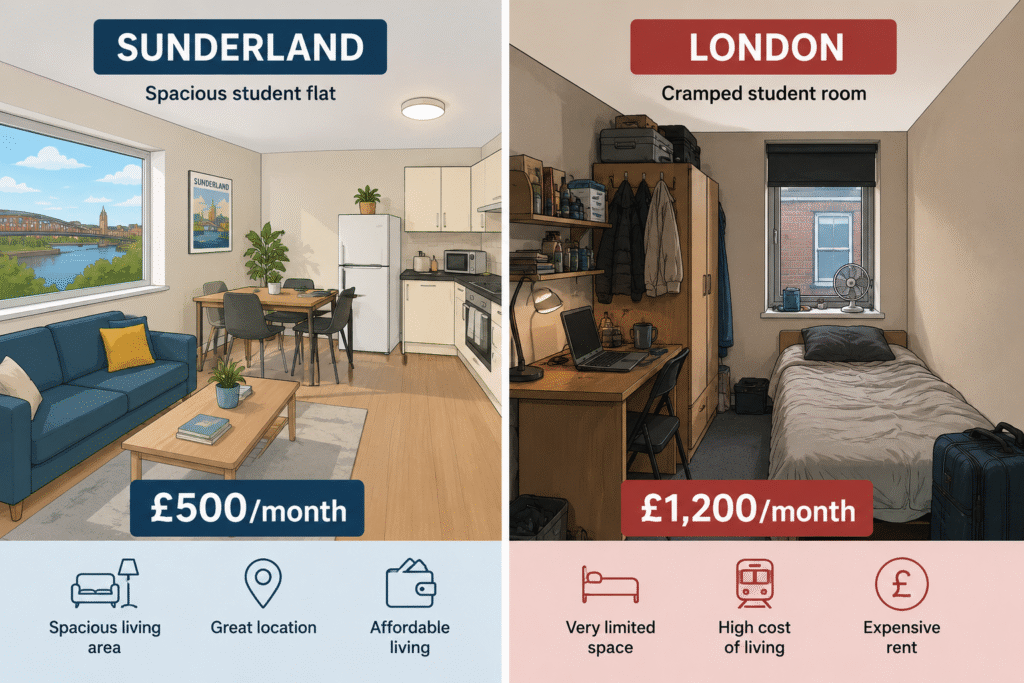
This is why the total cost of studying in a “cheap London university” can still far exceed a full year at a more expensive university in the north. Location is part of the financial equation, not a secondary consideration.
Fees Side-by-Side: Low Cost Universities in UK at a Glance
| University | Location | Approx. Int’l UG Fees/yr | Strong Subject Areas |
|---|---|---|---|
| University of Bolton | Bolton, Greater Manchester | £12,500 – £13,900 | Engineering, Education, Arts |
| University of Sunderland | Sunderland, NE England | £13,000 – £14,500 | Health, Business, Media |
| Teesside University | Middlesbrough | £13,000 – £15,000 | Digital Tech, Healthcare, Business |
| London Metropolitan | London | £13,500 – £15,000 | Law, Business, Computing |
| Leeds Beckett University | Leeds, West Yorkshire | £13,500 – £15,500 | Sports Science, Law, Media |
| UCLan | Preston, Lancashire | £13,500 – £15,000 | Journalism, Forensic Sci, Nursing |
| Anglia Ruskin University | Cambridge & Chelmsford | £13,000 – £15,000 | Health, Education, Business |
| University of Bradford | Bradford, West Yorkshire | £14,000 – £15,500 | Pharmacy, Social Sci, Engineering |
| Solent University | Southampton | £13,000 – £14,500 | Maritime, Media, Business |
| Northumbria University | Newcastle | £15,000 – £18,000 | Law, Design, Computing, Business |
*Fees are approximate figures for 2025–26 academic year. Confirm with institutions directly.*
What Courses Are Actually Available at These Universities?
Genuinely good question — because affordability means nothing if your programme of interest isn’t on offer.
The short answer is: a lot more than you’d expect.
Across the low cost universities in UK listed above, you’ll find courses spanning:
- Business & Management — MBA, Marketing, Human Resource Management, Finance, Business Analytics
- Computing & Technology — Artificial Intelligence, Cyber Security, Data Science, Software Engineering
- Health & Nursing — Nursing programmes, Physiotherapy, Public Health, Occupational Therapy
- Law — LLB Law, LLM International Commercial Law, Employment Law
- Psychology — Psychology conversion courses, Forensic Psychology, Clinical Neuroscience
- Engineering & Construction — Civil Engineering, Architecture, Construction Management
Not a narrow selection, is it? The “affordable university” fear that you’ll be stuck with limited course choices is largely unfounded — especially when you’re working with the right guidance to match your profile to the right institution.
For a full course catalogue, explore all available programmes here.
The Admission Process: Stripped of the Mystery
Here’s something admissions consultants sometimes forget to say out loud: the UK university admission process for international students is not inherently complicated. It has clear stages. It follows predictable timelines. And the universities offering competitive fees are often more accessible, not less.
For undergraduate programmes, most applications go through UCAS — the centralised UK university admissions service. You can apply to up to five universities with one application. The UCAS deadline for most courses is 25 January, though many universities accept applications later through Clearing.
For postgraduate programmes, applications typically go directly to the university — each has its own online portal, its own requirements, and its own response timeline.
The general documents you’ll need, regardless of level:
- Academic transcripts — certified, often requiring translation if not in English
- English language proficiency — IELTS (most common), TOEFL, or PTE Academic
- Personal statement or Statement of Purpose (SOP) — genuinely important and often underestimated
- References or letters of recommendation — usually two for postgraduate applications
- CV / résumé — particularly for master’s applications
- Passport copy — standard for international applicants
- Portfolio — for creative disciplines like architecture, animation, or design
The English language requirement catches many applicants off guard. Most universities require a minimum IELTS score of 6.0 overall (with no band below 5.5) for undergraduate entry, and 6.5 overall for postgraduate. Some programmes in nursing or teaching require higher scores. Always check the specific entry requirements for your chosen programme — they genuinely vary.
Entry Requirements: Roughly What to Expect
| Study Level | Academic Requirement | IELTS (min) | Other Notes |
|---|---|---|---|
| Foundation / Level 3 | Secondary school (varies) | 5.0 – 5.5 | Pathway to undergraduate |
| Undergraduate (Year 1) | A-levels or equivalent (typically BBC–ABB) | 6.0 overall | Varies by subject; portfolios for arts |
| Level 6 Top-Up (Year 3) | HND or Level 5 Diploma | 5.5 – 6.0 | 1-year direct entry to final year |
| Postgraduate (Masters) | Relevant bachelor’s degree (2:2 min) | 6.5 overall | Work experience sometimes accepted in lieu |
| MBA | Bachelor’s + 2–3 yrs work experience | 6.0 – 6.5 | Some universities waive GMAT |
A Route Many People Don’t Consider: The Level 6 Top-Up
Interesting strategic option here, if you already hold a Higher National Diploma (HND) or a Level 5 qualification from your home country or from a UK college.
Several low cost universities in UK offer what’s called a Level 6 Top-Up — essentially a one-year final year of a bachelor’s degree. You come in at the third year, complete one year of study, and leave with a full UK Honours degree.
This is:
- Significantly cheaper than a three-year undergraduate degree
- Faster (12 months of study)
- Available across business, healthcare, computing, and hospitality disciplines
Explore Level 6 Top-Up options if you’re sitting on an HND or equivalent and wondering whether a UK degree is still accessible. It very much is.
Scholarships: The Part That Might Actually Change Your Calculation
The UK is not as famously scholarship-heavy as the United States — let’s be direct about that. Full-ride scholarships for international students are rare and extremely competitive. But partial funding opportunities are considerably more common and considerably more achievable.
Chevening Scholarships — the UK government’s flagship international scholarship programme — funds a one-year master’s degree at any accredited UK university. Highly competitive, open to applicants with leadership potential and two years of work experience. Worth applying for even if you’re unsure.
Commonwealth Scholarships cover students from Commonwealth countries for postgraduate study. Strong focus on development-related disciplines.
University-specific scholarships are where most international students actually find funding. Many of the low cost universities in UK listed above have international student bursaries, early application discounts, or merit scholarships that can knock £1,000–£4,000 off your annual fees. These don’t get trumpeted loudly — you often need to ask.
External funding from your home country — this is underused. Many home governments, regional bodies, and private foundations offer scholarships specifically for students going abroad. Pakistan’s HEC, Nigeria’s Petroleum Trust Fund, and similar bodies are worth investigating thoroughly.
For a detailed breakdown of available funding routes, this scholarship guide for international students covers the landscape properly.
The Student Visa — A Separate Conversation You Must Have
Securing admission to a university and securing a UK Student Visa are two distinct processes. Universities don’t issue visas — the UK Home Office does, through the Student Visa (formerly Tier 4) route.
Key requirements include:
- A Confirmation of Acceptance for Studies (CAS) — issued by your university once you’ve accepted an unconditional offer
- Financial evidence showing you can cover tuition fees plus £1,334/month for living costs in London (or £1,023/month outside London) for the duration of your first year
- A valid IELTS (UKVI-approved) or alternative accepted English test
- Proof of academic qualifications
- A completed online application and a visa fee (currently £363 for applications outside the UK)
One thing international students consistently underestimate is the UKVI credibility interview — a formal interview conducted by UK visa officials to assess the genuine intent of your study plans. It’s not a formality. Poor preparation here has derailed applications that were academically strong in every other respect.
GCRD Hub — based in London at 107 Fleet St, London EC4A 2AB — specifically offers UKVI credibility interview preparation as a dedicated service. Worth knowing about, especially if visa interviews feel like uncharted territory.
How to Actually Secure Admission — Without the Chaos
Let’s say you’ve identified two or three universities from this article that look right for your budget and your subject area. What next?
The process looks like this in practice:
Step 1 — Shortlist realistically. Not just by cost, but by entry requirements, location preference, course content, and graduate prospects. A £12,000/year degree in a subject you won’t enjoy is still a poor investment.
Step 2 — Request a pre-assessment. Most reputable education consultancies (and the universities themselves) will review your academic profile informally before you submit a formal application. This saves you application fees on courses you won’t qualify for.
Step 3 — Prepare your personal statement or SOP carefully. This is the element most students treat as a box-ticking exercise and most admissions officers actually read. For competitive programmes, a generic SOP is a rejection. Be specific about why this course, at this university, with your particular background.
Step 4 — Submit early. UK universities work on rolling admissions for many postgraduate programmes. Applying in October or November for September intake puts you in a significantly stronger position than applying in April. Seats and funding get allocated progressively.
Step 5 — Respond promptly to conditional offers. A conditional offer isn’t a confirmed place. You’ll typically need to submit outstanding documents (IELTS, transcripts, references) within a specified window. Miss it, and the offer lapses.
Step 6 — Accept and prepare. Once you have an unconditional offer, your university will issue a CAS number — the lynchpin of your visa application. From there: visa documentation, finances, accommodation, and pre-departure preparation. <div style=”background: #d4edda; border-left: 4px solid #28a745; padding: 16px 20px; border-radius: 0 8px 8px 0; margin: 24px 0; font-family: sans-serif;”> 💡 <strong>Practical tip:</strong> UK universities with strong international recruitment (like those listed in this article) often have dedicated international admissions officers. Emailing them directly — politely, with your profile summary — before formally applying sometimes unlocks faster processing or useful pre-application guidance. </div>
If navigating all of this solo feels overwhelming — or if you’ve had an application rejected and don’t know why — working with an education consultancy that specialises in UK university placements is genuinely worth considering. GCRD Hub (reachable on +44(0)20 3983 9001 / 9002 / 9003) provides end-to-end admissions support, from shortlisting universities to interview preparation and pre-departure orientation. Not a sales pitch — just a factual note that the service exists and is designed specifically for international students navigating exactly this process. Register your interest here.
A Note on “Cheap” vs “Value”
Something that doesn’t come up enough in these conversations: the distinction between a university being inexpensive and being poor value.
There are genuinely low-quality institutions in the UK. Some have had their UKVI licences suspended. Some have poor student satisfaction scores. Some produce graduates who struggle to find work in their field. These are not the universities this article has been discussing.
The institutions named here — Bolton, Sunderland, Teesside, ARU, Bradford, Northumbria, London Met, Leeds Beckett, UCLan, Solent — are all registered on the HESA database, appear on the UK’s Office for Students register, and are recognised by the UK Home Office for student visa sponsorship. That’s the baseline of legitimacy.
Value, though, is more than accreditation. It’s:
- How well the programme prepares you for the career you actually want
- Whether the university has industry links in your specific sector
- The support services available to international students (and whether they’re actually accessible or just listed on a website)
- Graduate employability statistics — and in which industries
These factors are harder to compare than a tuition fee, but they matter considerably more in the long run. A £15,000/year degree that leads to a career is better value than a £10,000/year one that leads nowhere in particular.
Frequently Asked Questions
Q: What is the cheapest university in the UK for international students? Fees vary by programme and year of intake, but universities like the University of Bolton, Teesside University, and the University of Sunderland consistently appear among the most affordable for international students, with some programmes starting around £12,500 per year. For the most current figures, this dedicated cheapest universities guide is a good starting point.
Q: Can I study in the UK with a limited budget? Yes — genuinely. Choosing a low cost university in UK outside London, applying for available scholarships, and living in a city with lower costs (the north and midlands are considerably more affordable than the south) makes UK study viable on a budget that many people assume is too small.
Q: Is a degree from a low cost UK university recognised internationally? If the university is registered with the Office for Students and on the HESA database — yes, absolutely. UK degrees are recognised worldwide. The name of the institution matters in certain competitive sectors (finance, law at Magic Circle firms), but for the vast majority of careers, a UK degree is a UK degree.
Q: How long does it take to get a UK student visa? Current processing times are typically 3–4 weeks from outside the UK. Factor this into your timeline — apply for your visa no later than 8–10 weeks before your course start date.
Q: Do I need IELTS to study in the UK? Most universities require it, yes. Some accept alternatives like PTE Academic, TOEFL iBT, or Cambridge English qualifications. Some institutions offer in-sessional English support if your score is slightly below the threshold. Always check with your specific university and programme.
Q: What is a Level 6 Top-Up degree? A one-year programme allowing students with an HND or equivalent Level 5 qualification to complete a full UK Honours degree. Available at many low cost universities in UK in subjects including business management, health and social care, and computing.
Q: Do low cost universities offer postgraduate courses? Yes — many affordable universities have strong master’s programmes. See postgraduate courses available through GCRD Hub for a cross-university view.
Q: Can I work while studying in the UK? Students on a UK Student Visa are typically permitted to work up to 20 hours per week during term time, and full-time during official holidays. This can contribute meaningfully to living costs.
The Bottom Line
The UK has dozens of accredited, quality universities that international students can genuinely afford. The low cost universities in UK conversation isn’t about settling — it’s about making a considered, informed decision rather than defaulting to whichever institutions appear most frequently in glossy brochures.
Tuition from £12,500. Scholarships that can reduce that further. Cities where you can live well on under £900 a month. Degrees that carry international recognition and genuine career value. A student visa route with clear requirements.
None of this is secret information. It just requires knowing where to look — and occasionally having someone in your corner who’s helped a few hundred students navigate the same maze before you arrived at it.
If you’re an international student thinking seriously about the UK and want proper guidance on university selection, application strategy, or student finance — get in touch with GCRD Hub at 107 Fleet St, London EC4A 2AB, or call +44(0)20 3983 9001. The conversation costs nothing, and it’s considerably more useful than reading another rankings table.