London Isn’t Just a City. For International Students, It’s a Decision.
There’s a moment — usually somewhere between a YouTube rabbit hole and your third browser tab open to a university ranking site — when the sheer weight of choosing a London university starts to feel genuinely overwhelming. Over 40 universities in a single city. Dozens of campuses spread across zones one through six. Fees that vary wildly. Prestige that means different things depending on who you ask.
And yet, every year, hundreds of thousands of international students pick London above every other city in the world to pursue their degrees. That’s not a coincidence. It’s a city that rewards curiosity, tolerates ambiguity, and opens doors that other cities frankly don’t. Whether you’re drawn by career prospects, the multicultural fabric of the place, or just the fact that your favourite university has a campus a ten-minute walk from a Tube station — London delivers.
But here’s the thing nobody tells you upfront: not every London university is right for every student. The UK London university list looks impressive in aggregate, but the real question is which institution fits your goals, your budget, your field of study, and your post-study ambitions. That’s what this guide is actually about.
The Landscape: What “London Universities” Actually Means
First, let’s clear something up. When people search for a UK London university list, they often expect a tidy, ranked roster. Reality is messier — and more interesting.
London’s universities fall into a few distinct categories:
- The University of London federation — a network of semi-independent colleges and institutes that share a federal structure, including UCL, King’s College London, and LSE
- Independent universities that happen to be located in London — like Brunel, Westminster, or Middlesex
- Post-1992 universities (often called “new universities” or “modern universities”) — institutions that gained university status after the Further and Higher Education Act, like London Metropolitan University, University of Greenwich, and London South Bank
- Specialist institutions — the Royal College of Art, Guildhall School of Music & Drama, the London School of Hygiene & Tropical Medicine
Each category serves a different kind of student. A student chasing a research career in biochemistry needs a different institution than someone pursuing a postgraduate diploma in digital marketing or a nursing degree with clinical placements. The UK London university list is not a monolith — it’s a spectrum.
The Big Names (And Why Prestige Is Only Part of the Picture)
Let’s talk about the universities that dominate every ranking list, because they deserve acknowledgement — even if they’re not the whole story.
University College London (UCL) consistently ranks in the global top 10. It’s research-intensive, fiercely competitive, and London’s largest multidisciplinary university. International students make up roughly 40% of its student body. Fees for international undergraduates typically start around £22,000 per year and climb considerably for medicine and engineering.
King’s College London (KCL) — with its stunning Strand campus right on the Thames — is particularly strong in law, health sciences, and humanities. Another institution where the student experience is almost inseparable from London itself.
London School of Economics (LSE) is, famously, one of the most globally connected universities in existence. If you’re in social sciences, economics, or political science, this is a name that carries genuine currency across every continent.
Imperial College London for STEM. Full stop. Science, technology, engineering, mathematics — Imperial’s reputation in these fields is practically self-sustaining. Fees are high, but scholarships for international students do exist and are worth investigating.
Now. If you’re reading this and thinking I didn’t get into UCL or Imperial, so London isn’t for me — please stop. That narrative is both outdated and wrong.
Beyond the Elite: The UK London University List That Actually Helps Most People
Here’s where it gets genuinely useful. The vast majority of international students studying in London attend institutions that don’t consistently appear in the QS top 50 — and they are getting excellent degrees, strong graduate outcomes, and full London experiences.
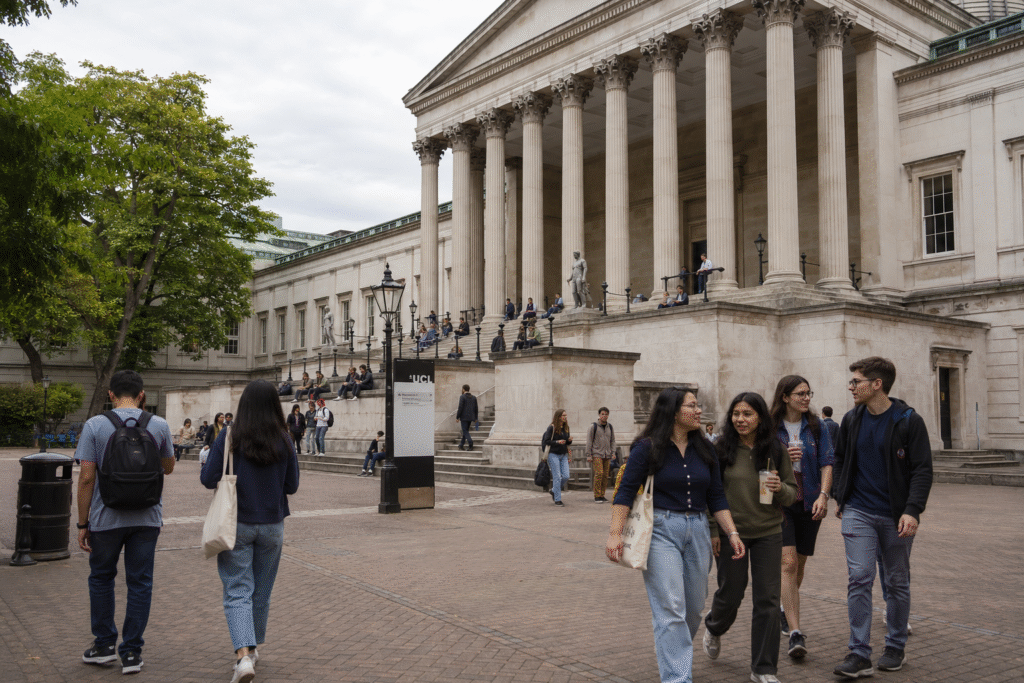
University of Greenwich — based in a UNESCO World Heritage Site (yes, genuinely), Greenwich offers strong programmes in business, engineering, computing, and health. Its international student community is vibrant, and its campus is one of the most photogenic in the country. GCRD Hub works closely with Greenwich as a partner institution.
London Metropolitan University — deeply embedded in the multicultural north and east London communities. Genuinely accessible entry requirements, strong professional courses in law, social sciences, and business. For students coming from non-traditional educational backgrounds, this university’s flexibility is worth its weight.
University of Roehampton — a quieter, more residential campus in south-west London. Strong in psychology, education, dance, and humanities. The campus park setting feels genuinely surprising given you’re technically inside Greater London.
Solent University London — built around industry connections and professional development, particularly in business, media, and creative arts.
Ravensbourne University London — specialist, design-led, sitting on the Greenwich Peninsula. If you’re in digital media, fashion communication, or UX design, this place has a distinct creative energy that generic university campuses lack.
Birkbeck, University of London — uniquely structured around evening study. Exceptional for international students who are working or who need a more flexible schedule. Academic rigour is genuinely high; it’s a University of London institution.
Royal Holloway, University of London — technically in Egham (just outside Greater London), but part of the University of London federation and considered a London university by most standards. Beautiful campus, excellent programmes in sciences, arts, and business. Often overlooked. Shouldn’t be.
A Practical Comparison: Fees, Entry, and What You’re Actually Getting
(Note: Fees are approximate 2025–26 figures for international undergraduates. Always verify directly with each institution.)
| University | Annual Fees (Intl. UG, approx.) | Strong Subjects | Entry Flexibility |
|---|---|---|---|
| UCL | £22,000–£38,000 | Research, Medicine, Engineering | Highly Competitive |
| King’s College London | £21,500–£37,000 | Law, Health, Humanities | Competitive |
| University of Greenwich | £14,000–£16,500 | Business, Computing, Engineering | Accessible |
| London Metropolitan University | £13,500–£16,000 | Law, Social Sciences, Business | Very Accessible |
| University of Roehampton | £14,500–£16,000 | Psychology, Education, Humanities | Accessible |
| Birkbeck, University of London | £13,000–£17,000 | Flexible Study, Humanities, Science | Accessible (Evening) |
| Royal Holloway, Univ. of London | £17,000–£22,000 | Sciences, Arts, Business | Moderate |
| Ravensbourne University | £15,000–£16,500 | Design, Digital Media, Fashion | Portfolio-Based |
What Nobody Talks About: The Post-Study Work Visa Factor
Here’s something that genuinely shifts the calculus for international students. Since the UK reintroduced the Graduate Route visa (formerly called the Post-Study Work visa), international students who graduate from a UK university can stay in the UK to work — or look for work — for two years after completing an undergraduate or postgraduate degree (three years for PhD graduates).
Every university on this list that holds Student sponsor licence status (and all the major ones do) qualifies you for this route. That means a degree from London Metropolitan University grants the same Graduate Route eligibility as a degree from King’s College London. Let that sink in for a moment. The playing field, at least on the visa side, is more even than the rankings suggest.
This is why choosing your course and institution based on career outcomes and academic fit — not just prestige — genuinely makes strategic sense.
London Versus the Rest of the UK: Is It Worth the Extra Cost?
Bluntly: London is expensive. Student accommodation in zone 2 can run you £1,200–£1,800 per month. A pint (if that’s your thing) costs somewhere between “eye-watering” and “philosophically questionable.” The cost of living is consistently 20–30% higher than cities like Leeds, Bradford, or Sheffield.
But London also pays back. Graduate salaries in London are higher. Networking opportunities are unmatched. If your field has a London concentration — finance, media, tech, law, fashion, healthcare — proximity matters. A part-time job during your studies is far more accessible here simply because there are more jobs to find.
For context: universities like Northumbria University, University of Bradford, Leeds Beckett University, or Teesside University offer strong programmes at significantly lower cost-of-living. They’re not lesser choices — just different trade-offs. If your course doesn’t require London specifically, these are genuinely worth considering alongside any UK London university list you’re working through.
A Quick Word on Postgraduate Study in London
The postgraduate picture in London is rich and slightly chaotic in a good way. One-year taught master’s programmes are the UK norm, which means you’re in and out with a qualification faster than most countries’ equivalents. London’s specific strengths at master’s level include:
- MBA and Business — BBP University, Birkbeck, and numerous private providers offer flexible routes
- Law (LLM) — King’s, UCL, and several University of London institutions are internationally recognised
- Psychology — a competitive but fascinating landscape; Roehampton, Royal Holloway, and others offer specialist masters in psychology pathways
- Nursing and Allied Health — nursing courses in London offer excellent NHS placement access
- Tech and AI — the concentration of tech companies in London’s “Silicon Roundabout” area makes postgraduate AI, data science, and software engineering degrees here particularly career-relevant
For a fuller breakdown of what postgraduate study in the capital looks like, the masters programmes in London guide is worth a read.
Understanding the Admissions Maze (It’s Not Actually a Maze)
Undergraduate applications in the UK go through UCAS — a centralised system where you apply to up to five universities simultaneously. Postgraduate applications, however, go directly to each institution. This distinction trips people up constantly.
Key dates to hold in mind for 2026 entry:
- UCAS undergraduate deadline: 29 January (most courses)
- Oxford/Cambridge/Medicine: 15 October (the previous year)
- Postgraduate: rolling throughout the year, but earlier is almost always better
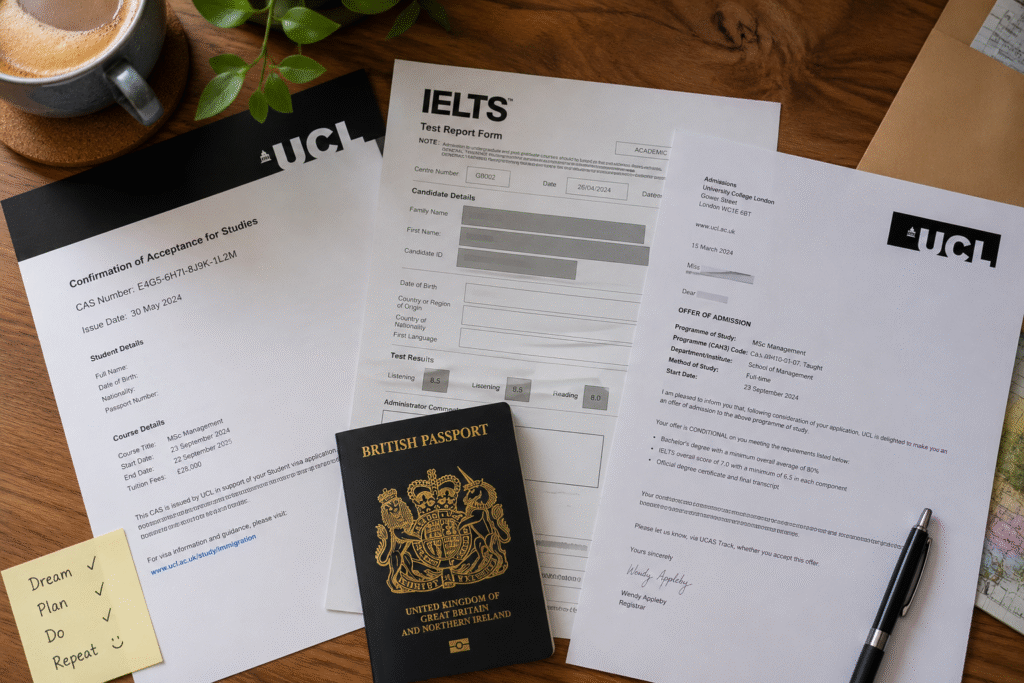
International students also need to navigate IELTS or equivalent English language requirements, credential evaluation, and — critically — the Student visa application process. The UKVI credibility interview is something many applicants underestimate; it’s a real conversation where a visa officer assesses whether your study plans are genuine. GCRD Hub’s UKVI interview preparation service exists precisely because this stage catches people off guard.
Worth knowing: Some universities have conditional offer processes that require additional portfolio submissions, auditions, or interviews. For specialist programmes — nursing, architecture, psychology, design — plan for this step. It’s not a rejection. It’s part of the process.
Scholarships and Funding: Less Daunting Than It Appears
A common misconception: scholarships for international students in the UK are rare or only available to academic superstars. Neither is true.
The Chevening Scholarship (government-funded, postgraduate, highly competitive) is the well-known one. But universities themselves offer considerable funding: merit scholarships, country-specific bursaries, early application discounts. The University of Greenwich, for instance, has international student scholarships worth up to £4,000 per year. London Metropolitan and Roehampton both offer partial scholarships for qualifying applicants.
Government funding from students’ home countries is another avenue that often gets overlooked. Nigeria’s Petroleum Technology Development Fund, the Malaysian government’s JPA scholarships, the Saudi Arabian Cultural Mission — these are real sources of funding that require planning but are absolutely available.
For a practical starting point, the international student scholarships guide breaks down the main categories without the usual vague waffle.
London’s Teaching Hospital Network and Why It Matters for Health Students
If you’re applying for medicine, nursing, physiotherapy, or allied health programmes, London has a distinct structural advantage: the teaching hospital network. Institutions like King’s, UCL, and Imperial are directly affiliated with NHS trusts, meaning clinical placements happen within one of the most diverse patient populations in the world.
But even for students at less prominent institutions, London’s density of NHS hospitals, GP practices, and community health services means placement opportunities are genuinely plentiful. An occupational therapy or physiotherapy degree completed in London carries placement experience that’s hard to replicate in smaller cities.
For international students considering a BSc Nursing or Mental Health Nursing degree specifically, understanding how the NHS works and what clinical placements involve is essential preparation — and something good education consultants will walk you through before you even start your application.
A Second Table: London Universities by Specialism
(For students who know what they want to study but haven’t fixed on an institution yet)
| Field of Study | London Universities Worth Considering | Notes |
|---|---|---|
| Business / MBA | Birkbeck, BBP University, Greenwich, London Met | Strong industry links; flexible study modes |
| Law (LLB / LLM) | KCL, UCL, BPP University, London Met | BPP is vocational-focused; UCL/KCL more academic |
| Nursing / Allied Health | King’s, Greenwich, London Met, Canterbury Christ Church (London campus) | Check NMC registration requirements |
| Computer Science / AI | UCL, Imperial, Greenwich, Middlesex | Tech cluster in East London a real advantage |
| Psychology | Roehampton, Royal Holloway, Birkbeck, UCL | BPS accreditation matters for clinical routes |
| Creative Arts / Design | Ravensbourne, UAL, Goldsmiths | Portfolio required; industry connections strong |
| Architecture / Engineering | UCL, Bartlett, Greenwich, London South Bank | RIBA/ARB accreditation check essential |
| Public Health | LSHTM, Greenwich, London Met | LSHTM is globally ranked; very research-heavy |
The Stuff That Matters Once You’ve Decided
Picking the university is step one. What follows — CAS letters, biometric residence permits, airport arrival, finding accommodation, opening a bank account — is where international students frequently hit friction. Not because it’s impossibly complicated, but because the information is scattered across a dozen government websites and university portals that don’t always talk to each other coherently.
A few things to sort out before you land:
- Accommodation — University halls fill up fast. Apply the moment you accept your offer, not after you celebrate.
- NHS surcharge — You’ll pay this as part of your visa application. Budget roughly £776 per year of study.
- National Insurance number — You’ll need this to work part-time. Apply after you arrive.
- Bank account — Some banks now accept a CAS letter and passport; others want a UK address first. Monzo and Starling are genuinely painless for new arrivals.
These are the kinds of things that good education consultants handle as a matter of course — not because students can’t figure them out, but because having someone who’s navigated it dozens of times is simply more efficient when you’re also managing coursework, homesickness, and a new city.
How to Actually Choose from the UK London University List
Right. You’ve read the descriptions, scanned the fees, maybe bookmarked a few pages. Here’s a practical framework for making the actual decision:
Start with accreditation, not rankings. Does the course carry the professional recognition you’ll need after graduating? A nursing degree needs NMC accreditation. A psychology degree needs BPS accreditation. A law degree needs SRA recognition for the vocational stages. Rankings don’t substitute for this.
Look at graduate outcomes data. HESA (the UK Higher Education Statistics Agency) publishes graduate outcomes data. What percentage of a university’s graduates are in professional employment 15 months after graduation? This is a real signal.
Visit, if at all possible. Or at minimum, attend virtual open days. The atmosphere of a campus is a legitimate factor. Some students thrive in the intensity of a research university; others do better in a smaller, community-oriented environment.
Be honest about finances. Extending your studies because you ran out of money is far more disruptive than making a pragmatic choice upfront. A well-chosen degree at London Metropolitan University, completed confidently and on time, is a better outcome than a year at UCL followed by financial withdrawal.
A Note on Getting Help Without Getting Sold To
There’s a real industry of agents and consultants who receive commission from universities to place students — regardless of fit. It’s legal, it’s widespread, and it’s something prospective students should understand going in.
What you want is guidance that starts with your goals and works outward, not from a list of “partner universities” with the highest commission rates. GCRD Hub, based at 107 Fleet St, London EC4A 2AB, works as a registered education consultancy with genuine end-to-end support — from shortlisting universities in the UK London university list that fit your profile, through application, UKVI interview preparation, scholarship advisory, and pre-departure orientation. If you’re navigating this from outside the UK, having someone on the ground in London matters. They can be reached on +44(0)20 39839001 / 9002 / 9003.
That’s not a sales pitch. That’s just what good university placement support looks like.
FAQ: UK London University List for International Students
Q: Which London university is easiest to get into as an international student? Universities like London Metropolitan University, University of Greenwich, and Solent University London tend to have more accessible entry requirements. Entry is typically based on equivalent qualifications from your home country, and many accept a range of English language qualifications.
Q: Is studying in London worth it compared to other UK cities? It depends entirely on your course and your career goals. London’s advantages are real — graduate networks, industry access, cultural exposure — but so are the costs. For some fields, London is irreplaceable. For others, a university in Leeds or Sheffield offers equivalent academic quality at substantially lower living costs.
Q: Can international students work while studying in London? Yes. Students on a valid Student visa can typically work up to 20 hours per week during term time and full-time during official holidays. London’s job market makes part-time work relatively accessible.
Q: How do I apply to London universities as an international student? Undergraduate applications go through UCAS. Postgraduate applications go directly to each university. You’ll need to provide academic transcripts, English language test scores (usually IELTS), a personal statement, and references. Some courses require portfolios or interviews.
Q: What is the cheapest university in London for international students? Cost varies by course, but institutions like London Metropolitan University, University of Greenwich, and Birkbeck typically offer lower international fees than the Russell Group institutions. See also: cheapest universities in the UK for international students.
Q: Do I need IELTS for London universities? Most universities accept IELTS Academic, but many also accept Pearson PTE, TOEFL iBT, or Cambridge C1/C2 Advanced. Some universities have in-house English tests. Requirements typically range from IELTS 6.0 to 7.0 depending on the course.
Q: What is the Graduate Route visa? The Graduate Route allows international students who complete a UK degree to remain in the UK for two years (three for PhDs) to work or look for work. It’s one of the most compelling reasons the UK London university list continues to attract international applicants globally.