
If you are already a qualified or diploma-level nurse trying to figure out how to turn your existing credentials into a full British honours degree, you are probably feeling a mix of excitement and sheer overwhelm. Between decoding university entry criteria, checking whether a top up nursing degree actually leads to UK clinical registration, worrying about Student Finance England eligibility, or preparing for a UKVI credibility interview, the whole process can feel like a maze with no clear map. Whether you are a mature learner returning to education alongside family and shift work, or an international nurse looking to study in the UK or abroad, that stress is completely understandable. You have already put years into caring for patients, and the last thing you need is to lose months of your time or money because of a misunderstood rule.

The good news is that once you break down how Level 6 nursing pathways work, the path forward becomes much clearer. In this guide, we will walk you through the real academic, financial, and immigration rules so you can make confident decisions without the guesswork.
What Is a Top Up Nursing Degree and Who Is It For?
A top up nursing degree (officially known in the UK as a Level 6 BSc (Hons) Nursing Top-Up) is a shortened, one-year full-time or two-year part-time academic programme. It is designed specifically for nurses who already hold a Level 5 nursing qualification, such as a Higher National Diploma (HND), a Foundation Degree, or an overseas nursing diploma, and want to bridge the academic gap to earn a full UK Bachelor of Science with Honours.
If you have been searching for an rn top up, you will notice that universities offer these courses in two main formats:
- On-campus full-time study: Typically lasting 12 months, ideal for international students who want the full UK university experience or UK-based nurses taking a dedicated study year.
- Flexible or distance learning: Many prospective students look for a nursing top up degree online so they can keep working in their current clinical role while completing their academic modules from home or abroad.
Crucially, an academic Level 6 nursing top-up focuses on evidence-based practice, leadership, clinical governance, global health perspectives, and independent research. It elevates your academic standing, opens doors to senior clinical or management roles, and gives you the undergraduate honours qualification needed to progress onto Postgraduate Courses such as an MSc in Nursing, Public Health, or Healthcare Management.
The Crucial Distinction: Academic Top-Up vs. NMC Registration
Before you submit a single application, you need to understand one vital rule that catches many applicants off guard. Most BSc (Hons) Nursing Top-Up programmes in the UK are academic qualifications, not pre-registration nursing courses.
As UK universities such as the University of Sunderland explicitly state in their programme specifications, a Level 6 top-up does not automatically grant registration with the Nursing and Midwifery Council (NMC). If you trained outside the UK and want to practise as a Registered Nurse in the UK, you must complete the NMC overseas registration process separately, which includes meeting NMC English language requirements and passing the Test of Competence (the Computer-Based Test and the practical OSCE). Many universities design their top up nursing degree in uk curricula to strengthen your clinical reasoning and academic English alongside your studies, which can support your broader professional development, but NMC registration remains an independent regulatory step.
Core Entry, Funding, and Visa Rules for a Top Up Nursing Degree
Understanding the official rules early on helps you avoid wasted application fees and missed intakes. Requirements vary depending on whether you are a UK domestic student or an international applicant, and every institution sets its own specific thresholds.
1. Academic Entry Requirements and UCAS Deadlines
To be considered for a BSc (Hons) Nursing Top-Up, universities generally expect:
- Prior nursing qualification: A Level 5 Diploma in Nursing, Foundation Degree, or equivalent overseas nursing diploma (usually equivalent to 240 UK credits at Levels 4 and 5).
- Current nursing licence: Proof of active registration or a licence to practise as a first-level nurse in your home country or with the NMC (note that some UK pathways for Nursing Associates holding an FdSc may require an 18-month top-up route instead).
- English language proficiency: International applicants typically need an IELTS Academic score of 6.0 to 6.5 overall (with minimum sub-scores set by the university), though exact scores vary by institution.
When it comes to timelines, timing matters. For September entry via UCAS, the equal consideration deadline falls in mid-January (for example, 14 January for 2026 entry and 13 January for 2027 entry). While some universities continue accepting applications after this date or offer direct applications for January, March, or April intakes, applying before the main deadline gives you the strongest chance of full consideration.
2. Student Finance England and Funding Eligibility
Money is often the biggest source of anxiety for mature students. If you are looking at Student Finance in England, strict eligibility criteria and previous study rules apply.
Eligible UK students (such as British citizens, those with Indefinite Leave to Remain, or individuals holding EU Settled Status who meet residency rules) may apply for Tuition Fee Loans and Maintenance Loans through GOV.UK Student Finance. If you already hold a Level 5 qualification such as an HND or Foundation Degree and are “topping up” to an honours degree, you may still qualify for limited funding to cover the top-up year, because your previous years of funded study are factored into your overall entitlement calculation.
However, funding is never automatic. Rules differ across England, Scotland, Wales, and Northern Ireland, and previous higher education study at the same or higher level can affect what you can borrow. Additionally, while pre-registration nursing students in England may access specific NHS Learning Support Fund grants, academic top-up students should verify directly with their chosen university and GOV.UK Student Finance eligibility guidance whether their specific course code qualifies.
3. UKVI Student Visa, CAS, and Work Rules
If you are an international nurse applying for a full-time, on-campus programme in the UK, you will need a Student visa sponsored by a licensed UK university. To apply, you must first meet all academic and deposit conditions so your university can issue a Confirmation of Acceptance for Studies (CAS).
According to GOV.UK Student visa document guidance, you will typically need to prepare:
- A valid passport or travel document.
- Your CAS reference number from your course provider.
- Evidence of funds to cover your remaining tuition fees and living costs, held in an eligible bank account for the required consecutive period as outlined on GOV.UK.
- Tuberculosis (TB) test results and an Academic Technology Approval Scheme (ATAS) certificate if applicable to your country of residence or course.
Many universities also require international applicants to pass a pre-CAS credibility interview, and UK Visas and Immigration (UKVI) may conduct its own credibility interview to confirm that you are a genuine student who understands your course modules, career goals, and financial plan.
What about working while studying? Under UKCISA guidance on Student visa working conditions, students enrolled on a full-time degree-level course (RQF Level 6 or higher) at a Student sponsor with a track record of compliance are generally permitted to work up to 20 hours per week during term time and full-time during official vacations, while self-employment is prohibited. Keep in mind that work rights depend on your sponsor’s licence status, your course level, and your individual immigration conditions, so always check your eVisa or official guidance rather than assuming you can work extra shifts.
3 Common Mistakes When Applying for a Top Up Nursing Degree
Even experienced nurses with strong clinical backgrounds run into avoidable setbacks. Understanding these common application errors and processing delays can save you months of frustration.
1. Confusing an Academic Top-Up With an NMC Registration Programme
One of the most frequent misunderstandings among international nurses is enrolling on a one-year top up nursing degree expecting to graduate with an NMC PIN. When an applicant mentions in a university admissions interview or a UKVI credibility interview that their sole reason for taking the course is to receive automatic UK nursing registration, it signals to the interviewer that they have not properly researched the curriculum. Always frame your academic goals accurately: explain how the Level 6 modules will strengthen your clinical leadership, research skills, and career progression, while acknowledging any separate regulatory exams you plan to take independently.
2. Submitting Incomplete Transcripts or Unverified Nursing Licences
Admissions teams must map your previous diploma credits against UK Level 4 and Level 5 standards. Submitting blurry scans, missing official module transcripts (showing hours of theory and clinical practice), or failing to provide a current Certificate of Good Standing or active nursing licence often triggers administrative holds. If your documents are not in English, certified translations are mandatory. Missing the university’s document deadline can push your offer to the next intake.
3. Underestimating Financial Evidence and Credibility Interviews
For international applicants, rushing the financial preparation stage is a leading cause of CAS delays and visa refusals. Holding funds in the wrong account type, letting a balance dip below the threshold for even a single day during the mandatory 28-day window, or arriving at a credibility interview unable to explain your course modules or why you chose a particular UK university can create unnecessary complications. Treating the credibility interview as a casual chat rather than a structured assessment is an error you can easily avoid with proper preparation.
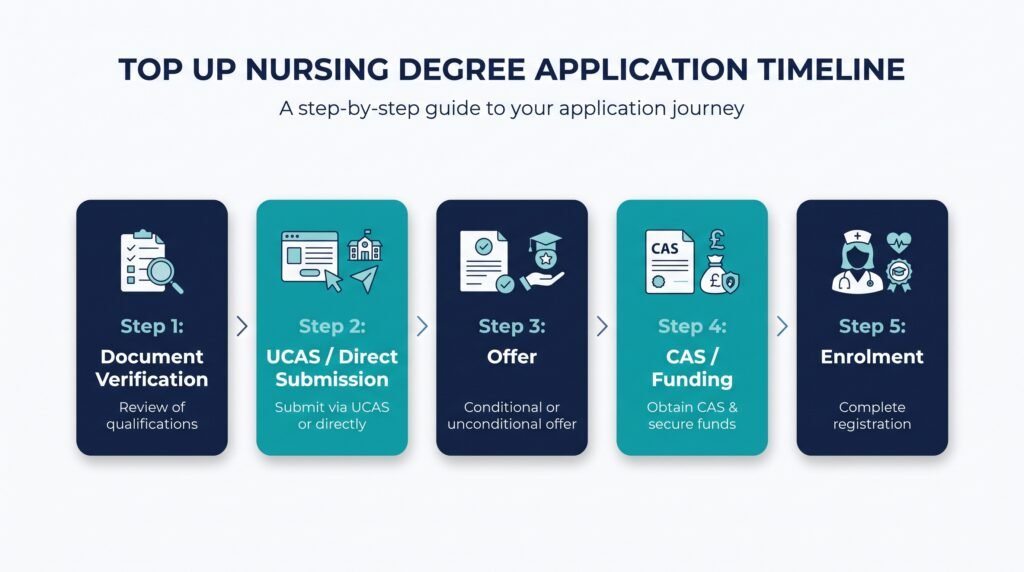
Your Step-by-Step Top Up Nursing Degree Application Checklist
Use this practical workflow to keep your top up nursing degree journey organised from day one:
- Audit your existing credentials: Gather your nursing diploma certificate, full academic transcript (with module credits and clinical hours), and proof of current nursing registration.
- Choose your study mode: Decide whether you need a full-time on-campus top up nursing degree in uk or a flexible nursing top up degree online that fits around current shifts.
- Check your funding or visa budget: Review GOV.UK Student Finance rules if you are an eligible UK resident, or calculate your full tuition plus UKVI living cost requirements if you are applying as an international student.
- Shortlist accredited universities: Compare module content, campus locations, tuition fees, and English language requirements across reputable UK institutions.
- Prepare a tailored personal statement: Clearly explain your nursing background, why you want to upgrade to a BSc (Hons), and how the Level 6 modules align with your long-term healthcare career.
- Submit before key deadlines: Apply via UCAS before the mid-January equal consideration deadline for autumn entry, or submit direct applications early for January, spring, or flexible intakes.
- Complete interview and CAS/funding steps: Practise for both university admissions interviews and UKVI Credibility Interview Practice, and double-check all financial documents before your CAS or loan confirmation is issued.
Why Working With a Registered Educational Advisory Helps
Navigating university portals, credit transfers, Student Finance assessments, and UKVI documentation on your own while working demanding shifts is exhausting. Partnering with an experienced, registered student recruitment consultancy can simplify the application process, help strengthen your application, and mitigate the risk of administrative delays.
Rather than guessing which university will accept your specific overseas diploma or worrying whether your personal statement hits the mark, an advisor reviews your documents before they ever reach an admissions officer. While no reputable consultancy can guarantee university admission, funding approval, or a visa outcome, structured guidance ensures you submit accurate, complete, and well-prepared applications to the right institutions on the first try.
Start Your Nursing Top-Up Journey With GCRD Hub
At GCRD Hub (Global Centre for Research & Development), we are a registered Educational Advisory organisation and leading student recruitment consultancy based in the UK. We work directly with reputable universities across the UK, including Anglia Ruskin University, University of Sunderland, University of Roehampton, Solent University, Canterbury Christ Church University, University of Suffolk, and University of Central Lancashire, alongside partner institutions across Europe, the USA, Canada, Australia, and New Zealand.
Whether you need help selecting the right Level 6 Top-Up Courses, exploring Level 3, 4 & 5 Diplomas, or planning ahead for Undergraduate Courses and Postgraduate Courses, our team offers:
- Free, personalised consultations tailored to your nursing qualifications and career goals.
- End-to-end application and Student Finance guidance so your paperwork is accurate and submitted on time.
- Face-to-face or online University and UKVI Credibility Interview training to help you speak clearly and confidently about your study plans.
Ready to take the next step toward your top up nursing degree? Call our UK advisory team today on +44 (0)20 3983 9001 (or 9002 / 9003) or book your free consultation online through our Contact Page at gcrdhub.com.
Frequently Asked Questions (FAQs)
1. Does a top up nursing degree automatically give me NMC registration?
No. A Level 6 BSc (Hons) Nursing Top-Up is an academic qualification designed for nurses who already hold a diploma and a nursing licence in their home country or in the UK. It does not replace the NMC Test of Competence or English language requirements needed for international nurses to join the UK register.
2. Can I get Student Finance England for a nursing top-up degree?
Eligible UK students (such as British citizens, those with Indefinite Leave to Remain, or EU Settled Status) may apply for Tuition Fee and Maintenance Loans through GOV.UK Student Finance. Because previous higher education study affects your funding entitlement, you should always check your personal eligibility against current official guidance before enrolling.
3. How long does an RN top-up nursing degree take to complete?
Most full-time, on-campus top-up nursing degrees in the UK take one academic year (typically 9 to 12 months) to complete. If you choose a part-time or nursing top up degree online pathway, the programme usually takes 18 to 24 months, depending on the university and your study pace.