
Here’s something nobody tells you when you’re googling “Masters in UK” at 2 AM: the hardest part isn’t getting in—it’s figuring out if you’re even looking at the right thing.
I mean, should you trust a university ranking that puts Imperial above Cambridge for engineering, or the one that doesn’t? Does a 2:1 classification actually translate to your 3.2 GPA, or are you setting yourself up for disappointment? And why does every website make it sound like studying for a Masters in UK is simultaneously the easiest and most impossible thing you’ll ever do?
The truth? Getting a postgraduate degree in Britain is genuinely brilliant for some people and a spectacularly expensive mistake for others. The difference often comes down to knowing what you’re actually signing up for—not the glossy brochure version, but the reality of condensed one-year programmes, eye-watering tuition fees, and a job market that’s… well, let’s just say it’s complicated.
This isn’t going to be one of those articles that lists university names you already know and calls it a day. Whether you’re considering a Master in Business Administration, looking into data science programmes, or eyeing psychology conversion courses, we’re diving into what actually makes UK postgraduate education tick—and whether it deserves the hype.
Why Everyone’s Suddenly Obsessed with a Masters in UK (and Why That Might Be a Problem)
Let’s address the elephant in the lecture hall: pursuing a Masters in UK has become almost fashionable. Over 185,000 Indian students alone were studying in Britain as of 2024, with the majority enrolled in master’s programmes. That’s not including students from Nigeria, Pakistan, Bangladesh, China—the list goes on.
But here’s what’s wild: while everyone’s clamouring to get in, the UK government keeps tightening visa regulations and hiking financial requirements. It’s a bit like queuing for hours outside a club that keeps raising the cover charge.
So what’s the actual appeal?
The one-year structure is genuinely revolutionary if you think about it. While your friends pursuing postgraduate degrees in North America are settling in for a two-year commitment, you could theoretically be done, graduated, and working (thanks to the Graduate Route visa) in the time it takes them to finish their coursework. Time is money, as they say, though we’ll get to exactly how much money in a minute.
Then there’s the prestige factor. Four UK universities sit in the global top ten. Oxford. Cambridge. Imperial. UCL. These names carry weight everywhere from Silicon Valley to Singapore. But—and this is crucial—so do universities you’ve probably never heard of, at least in your specific field.
The Russell Group: Britain’s Answer to the Ivy League (Sort Of)
If you’re researching universities for a Masters in UK, you’ve definitely stumbled across the term “Russell Group.” These 24 research-intensive universities (think Oxford, Cambridge, Manchester, Edinburgh, Warwick) receive two-thirds of all UK research funding and produce over half the country’s research output.
Should you only apply to Russell Group institutions? Absolutely not.
Here’s the thing nobody mentions: Russell Group graduates don’t just get jobs—over 95% find employment or further study within six months, but that statistic glosses over an important detail. Non-Russell Group universities like St Andrews, Bath, and Loughborough consistently outrank some Russell Group members in specific subjects. Your future university matters less than your specific programme and how it aligns with your career goals.
Reality Check: The “Russell Group or bust” mentality has created artificial scarcity. Some phenomenal programmes at universities like Sunderland, Solent, or De Montfort offer better value, more personalised attention, and stronger industry connections than their more famous counterparts. Don’t let rankings think for you.
The Money Talk Nobody Wants to Have (But We’re Having It Anyway)
Right. Let’s talk about what pursuing a Masters in UK actually costs, because the figures thrown around online range from “surprisingly affordable!” to “you’ll need to sell a kidney.”
Tuition fees for international students typically sit between £10,000 and £35,000 per year. That’s roughly ₹10.4 lakhs to ₹36.4 lakhs annually. MBA programmes and medicine? You’re looking at fees that can breach £55,000.
But wait—there’s more! (As they say in those infomercials nobody asked for.)
| Expense Category | London (Annual) | Outside London (Annual) |
|---|---|---|
| Accommodation | £9,600 – £15,000 | £6,000 – £9,600 |
| Food & Groceries | £2,400 – £3,600 | £1,800 – £2,800 |
| Transport | £1,500 – £2,000 | £600 – £1,200 |
| Books & Materials | £500 – £800 | £500 – £800 |
| Personal & Social | £1,500 – £3,000 | £1,200 – £2,400 |
| Total Living Costs | £15,500 – £24,400 | £10,100 – £16,800 |
Add your tuition to your living expenses, and you’re looking at a total investment of roughly £25,000 to £60,000 for your entire programme. That’s assuming you don’t develop a sudden obsession with West End theatre or decide Edinburgh’s whisky scene requires thorough investigation.
Can you work whilst studying? Yes—up to 20 hours per week during term time. Will that cover your expenses? Probably not entirely, but it helps. And crucially, it gives you UK work experience, which UK employers value far more than you’d expect.
Scholarships: The Bit That Actually Gives You Hope
Before you close this tab in despair, know this: there’s scholarship money floating around if you know where to look. Russell Group universities offer multiple scholarships to attract talented Indian students, with most scholarship deadlines closing between December 2024 and February 2025.
The Chevening Scholarship, GREAT Scholarships, Commonwealth Scholarships—these aren’t mythical creatures. They’re real, they’re substantial, and yes, the competition is fierce. But someone has to win them. Why not you?
Many universities also offer their own funding, particularly for research-based programmes. If you’re pursuing a public health degree or clinical nutrition programme, sector-specific scholarships might be available too.
What You’ll Actually Study: The Most Popular Masters Programmes Right Now
The landscape of postgraduate education shifts faster than British weather. What was cutting-edge three years ago might be oversaturated now. What seemed niche could be tomorrow’s gold rush.
Currently? These programmes dominate applications for a Masters in UK:
Business & Management remains the heavyweight champion. MBAs, naturally, but also specialised programmes in finance, marketing, human resource management, and project management. The London Metropolitan University and University of Greenwich offer particularly strong business programmes with solid industry connections.
Data Science, AI, and Computer Science have exploded. Although Data Science & Big Data is still extremely popular, student interest is more moderate than it used to be. Artificial Intelligence is quickly becoming one of the most popular degrees, with interest continuing to grow significantly. If you’re eyeing artificial intelligence or cyber security programmes, you’re riding a wave that shows no signs of breaking.
Healthcare and Psychology programmes, from nursing to physiotherapy, occupational therapy to forensic psychology, attract students who want direct patient care experience alongside academic rigour. Fair warning: these programmes are intense. Genuinely, properly intense.
Engineering remains rock-solid. Whether it’s civil engineering, architectural engineering, or specialised fields, UK engineering degrees command respect globally. Institutions like University of Leeds and University of Sheffield have particularly strong engineering faculties.
The Programmes Nobody Talks About (But Maybe Should)
Here’s where it gets interesting. Whilst everyone’s fighting for spots in computer science, some brilliant programmes fly under the radar:
- Supply Chain Management and Logistics – Post-pandemic, these fields have become unexpectedly hot. Companies are desperate for people who understand global supply networks.
- Digital Health – The intersection of healthcare and technology. Small cohorts, massive industry demand.
- Neuroscience & Mental Health – Mental health has moved from stigmatised to centre-stage. Programmes are expanding rapidly.
- Architecture – Yes, it’s a five-year commitment (typically Part 1, then Part 2), but UK-trained architects are recognised internationally. Cardiff University and others offer exceptional programmes.
The Requirements: What You Actually Need to Get In
Applying for a Masters in UK isn’t rocket science, but it’s also not as straightforward as uploading your CV and crossing your fingers. Let’s break down what universities actually want to see.
Academic Qualifications (The Foundation)
Most UK universities ask for the equivalent of a 2:1 or 2:2 honours degree. For Indian students, this usually means you’ll need a 60-65% minimum in your bachelor’s degree, though competitive programmes might demand 70% or higher. That CGPA of 6.5-7.0 everyone mentions? It’s real, and it matters.
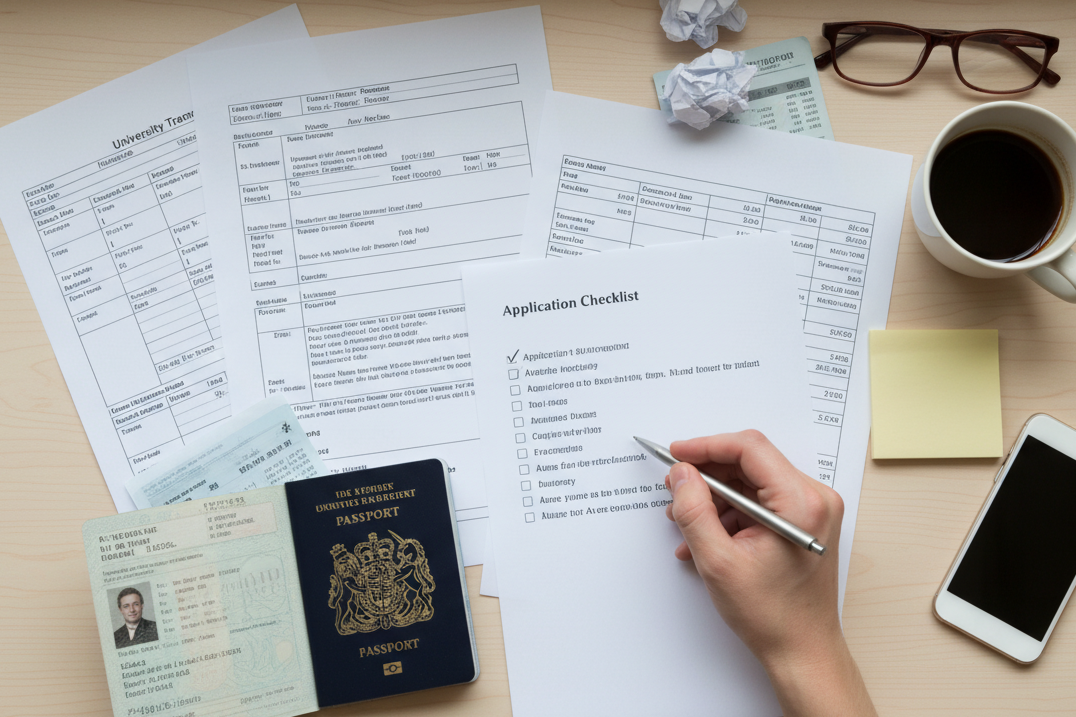
Got a degree in an unrelated field but want to switch careers? Some programmes welcome “conversion” students. Psychology, law, and certain business programmes specifically cater to graduates from different backgrounds. Have a look at psychology conversion courses if this sounds like you.
English Language Proficiency (Yes, They’re Serious About This)
Unless your undergraduate degree was taught entirely in English at a recognised institution, you’ll need to prove language proficiency. The usual suspects:
| Test | Minimum Overall Score | Section Requirements |
|---|---|---|
| IELTS | 6.5 – 7.0 | Typically no band below 6.0-6.5 |
| TOEFL iBT | 90 – 100 | Minimum 20-22 per section |
| PTE Academic | 62 – 70 | Minimum 55-60 per skill |
| Duolingo | 110-120 | Increasingly accepted |
Pro tip: some universities have slightly lower English requirements for pre-sessional English courses. You take a 6-12 week intensive English programme before your main course starts. It’s pricey, but it’s a backdoor if you’re just short of the required score.
The Documents That Make or Break Applications
Statement of Purpose (SOP) – This isn’t a creative writing exercise; it’s your chance to explain why you, this programme, at this university, makes perfect sense. Universities scan hundreds of these. Make yours specific, relevant, and honest. Generic waffle about “global perspectives” gets you nowhere.
Letters of Recommendation (LOR) – Two is standard, sometimes three. Academic referees work best, but if you’ve been working for a few years, professional references carry weight. Choose people who actually know your work, not someone impressive who’ll write something generic.
CV/Resume – British CVs differ from American resumes. Keep it concise (2 pages maximum), focus on achievements rather than duties, and for heaven’s sake, spell-check it.
For certain programmes—MBAs, executive masters—work experience isn’t optional. MBA, MPA, Executive Masters typically need 1-3 years of experience, whilst MSc/MA taught programmes usually don’t ask for work experience.
Design students need portfolios. Architecture, animation, digital design—these applications live or die on the quality of your portfolio work.
Feeling overwhelmed by the application process? You’re not alone. Navigating university requirements, preparing documents, and meeting deadlines while managing work or studies back home gets complicated fast. GCRD HUB specialises in end-to-end admissions support for students pursuing postgraduate degrees in the UK. From university shortlisting to visa guidance and pre-departure orientation, they handle the complexity so you can focus on preparing for your programme. Located at 107 Fleet St, London EC4A 2AB, you can reach them at +44(0)20 39839001-9002-9003 for personalised guidance on your Masters in UK journey.
The Application Timeline (Or: When to Actually Start This Whole Thing)
Universities for a Masters in UK operate on rolling admissions, which sounds flexible until you realise that funding, accommodation, and visa processing all have rigid deadlines.
Most programmes accept applications from September/October for courses starting the following September. Popular programmes fill up fast—by February or March, many courses are already full. Early bird genuinely gets the worm here, along with better scholarship consideration and housing options.
October-December: Prime application season. Scholarship deadlines cluster here. If you’re applying for competitive programmes at universities like Durham, Leeds, or Strathclyde, aim for this window.
January-March: Still viable, but scholarship pickings get slim. Some programmes, particularly research-based ones, remain open.
April onwards: Late applications. Some universities continue accepting applications through summer (clearing), but this is typically for less competitive programmes or courses with unfilled spaces.
Actually Living There: What Nobody Mentions About Student Life
The academic side gets all the attention, but here’s what’ll actually define your experience: Can you handle British weather? (The answer is no, but you adapt.) Do you cook, or will you subsist on meal deals from Tesco? Can you navigate the bizarre intersection of politeness and directness that characterises British communication?
Student cities vary wildly. London offers everything but costs everything. Manchester and Birmingham give you city life at more reasonable prices. Edinburgh is gorgeous but cold. Bangor and similar smaller cities provide tight-knit communities and lower costs but limited nightlife.
International students can work 20 hours weekly during term time, full-time during breaks. Typical student jobs—retail, hospitality, tutoring—pay £8-12 per hour. It won’t make you rich, but it covers some expenses and, importantly, gives you British work experience.
The Graduate Route Visa: Your Two-Year Golden Ticket
Here’s what makes the Masters in UK particularly attractive: upon graduating, international students can apply for the Graduate Route visa, which allows you to stay and work for two years (three if you complete a PhD) without requiring a job offer beforehand.
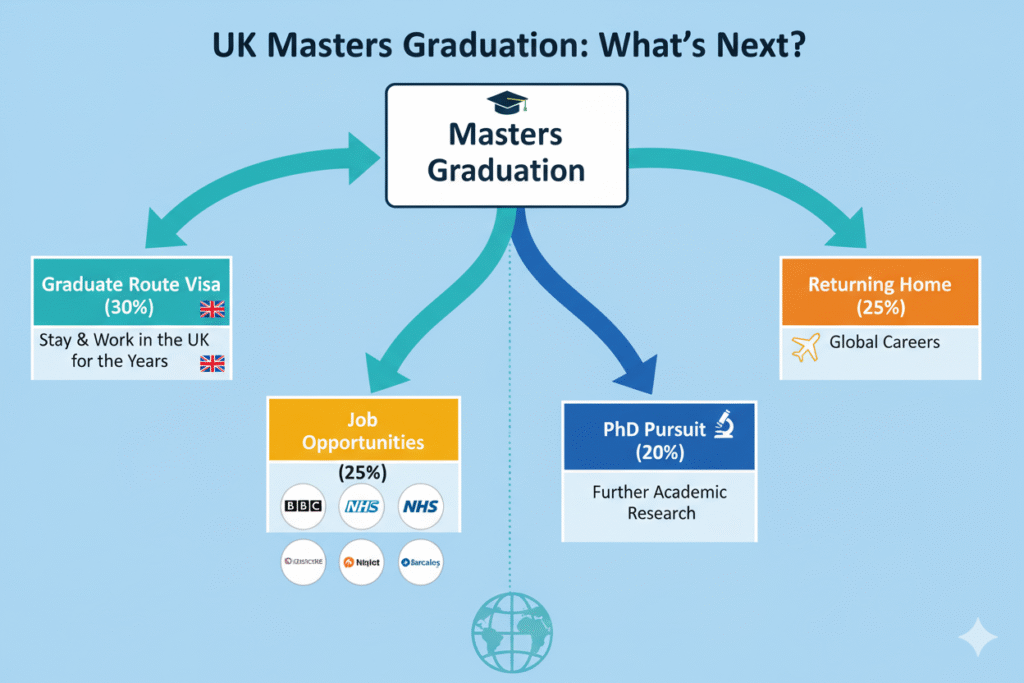
This is huge. You can job hunt, gain experience, explore different industries, and potentially transition to a Skilled Worker visa if you find a role. Tech continues to be one of the fastest-growing sectors, with roles such as software developers, data analysts, AI researchers, and cybersecurity experts in high demand across the UK, especially in London, Cambridge, and Manchester.
Finance, consulting, healthcare, education—UK employers actively recruit international graduates. The key is positioning yourself correctly, networking early (universities have career services that actually help), and understanding how UK hiring works.
The Universities Worth Considering (Beyond the Obvious Ones)
Everyone knows Oxford and Cambridge. Let’s talk about universities that don’t dominate marketing budgets but deliver exceptional value:
University of Sunderland – Particularly strong in pharmacy, nursing, and healthcare programmes. Tuition fees run lower than Russell Group institutions, and the city’s cost of living is remarkably affordable.
Northumbria University – Newcastle-based, excellent for business and law. The city itself is brilliant—friendly, affordable, with a thriving cultural scene.
University of Central Lancashire (UCLan) – Preston doesn’t have the glamour of London, but UCLan’s journalism, nursing, and business programmes punch well above their ranking.
Teesside University – Strong industry links, particularly in engineering and computing. Their digital and creative industries programmes work closely with regional employers.
Canterbury Christ Church University – If you’re looking at education, social work, or health programmes, this institution offers personalised teaching and strong pastoral care.
For those targeting Russell Group institutions, Leeds Beckett, Liverpool John Moores, and Royal Holloway offer that sweet spot of strong academics without the impossible entry requirements of Oxbridge.
The Honest Truth About Whether It’s Worth It
Is pursuing a Masters in UK worth the investment? The frustratingly accurate answer: it depends.
If you’re entering a field where a UK qualification significantly boosts employability—data science, engineering, certain healthcare roles—then yes, probably. Or If you want to work internationally and need a credential that opens doors everywhere, British degrees deliver.
If you’re doing it because “everyone else is” or because you’re not sure what else to do post-graduation, pump the brakes. A masters degree, anywhere, should be purposeful. It’s a year of your life and a substantial financial commitment. That should drive you towards something, not just away from uncertainty.
The one-year structure means you’ll learn intensively. Some students thrive on this; others find it overwhelming. You won’t have the luxury of easing into things or taking light semesters. It’s full-on from day one.
But if you’re ready? If you’ve researched programmes, understand the requirements, sorted the finances (or have a realistic plan to), and genuinely want what a Masters in UK offers? It can be transformative. You’ll gain not just academic credentials but cross-cultural competence, professional networks, and the confidence that comes from succeeding in a challenging environment.
Frequently Asked Questions About Masters in UK
How long is a Masters degree in the UK?
Most taught masters programmes run for one year full-time. Some research-based programmes (MRes, MPhil) can take 18-24 months. Part-time options typically span two to three years.
Can I work whilst studying for a Masters in UK?
Yes. International students on Tier 4/Student visas can work up to 20 hours per week during term time and full-time during holidays. This doesn’t include work placements that are part of your course.
Is GRE required for Masters in UK?
Generally, no. Unlike US universities, most UK institutions don’t require GRE scores. Some competitive MBA programmes or highly ranked economics/business programmes might request GMAT scores, but it’s not universal.
What’s the difference between MA, MSc, and MRes?
MA (Master of Arts) typically covers humanities and social sciences. MSc (Master of Science) focuses on scientific and technical subjects. MRes (Master of Research) is research-intensive, often serving as preparation for a PhD. All are postgraduate degrees.
Do UK universities accept three-year bachelor’s degrees?
Yes, especially after the 2022 UK-India agreement recognising India’s 10+2+3 education system. Most universities now accept three-year degrees, though some competitive programmes might prefer four-year degrees or additional qualifications.
How competitive is admission for a Masters in UK?
It varies enormously. Top programmes at Russell Group universities in popular fields like computer science, business, or medicine are highly competitive. Less popular programmes or institutions outside the Russell Group have more relaxed entry requirements. Apply strategically to a mix of reach and realistic options.
Can I switch fields for my postgraduate degree?
Absolutely. Many programmes explicitly welcome “conversion” students. Business schools, psychology departments, and law faculties commonly offer programmes designed for graduates from different academic backgrounds. You might need to demonstrate relevant interest or complete pre-sessional courses.
Final Thought: The Masters in UK isn’t a magic solution or a guaranteed success formula. It’s a tool—a powerful one—but like any tool, its value depends entirely on how and why you use it. Choose wisely, prepare thoroughly, and approach it as the beginning of something rather than the end goal itself.