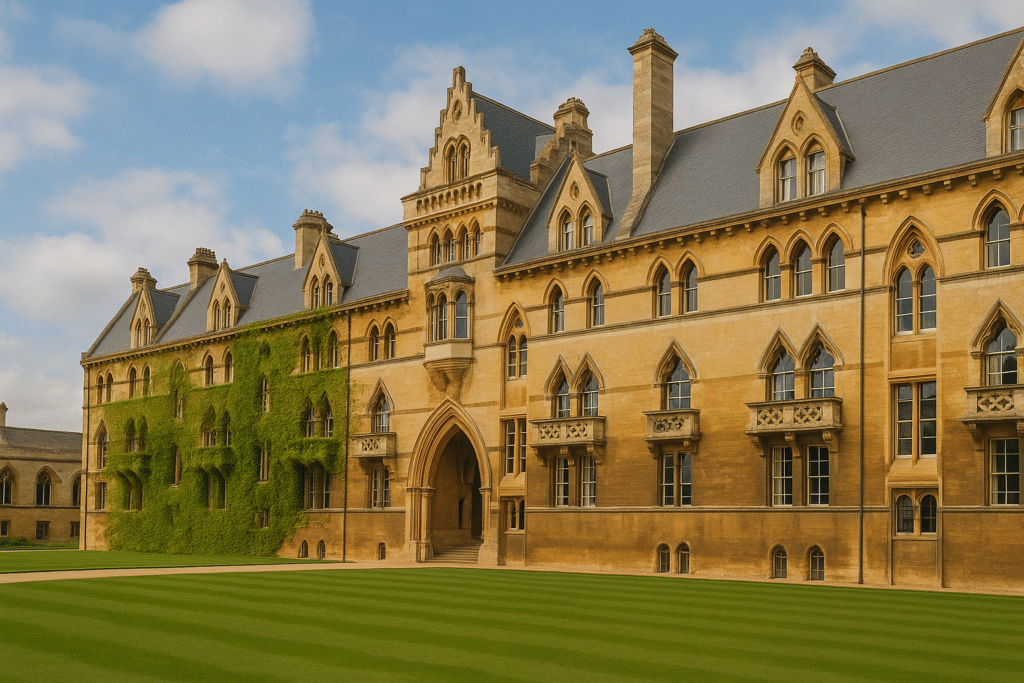
Here’s something nobody tells you about hunting for the perfect UK university: the British don’t actually have an Ivy League. What they have is somehow both simpler and infinitely more complicated.
Americans obsess over eight schools draped in ivy and tradition. The British? They’ve got Oxford and Cambridge (obviously), but then there’s this whole constellation of Russell Group universities, red brick institutions, and newer powerhouses that’ll leave you wondering why anyone bothers with league tables at all. Spoiler: everyone bothers with league tables.
I’ve spent embarrassing amounts of time researching Ivy League universities UK equivalents, and what struck me most wasn’t the prestige—it was how differently the UK system operates. There’s no single “elite eight.” Instead, imagine a tiered wedding cake where even the bottom layer is pretty damn impressive, just maybe not chocolate.
What Actually Counts as Britain’s Ivy League?
Let’s tackle the elephant wearing a mortarboard: when people search for Ivy League universities UK, they’re usually asking two different questions without realizing it.
The first question: Which UK universities match Harvard’s reputation globally? Answer: Oxford and Cambridge. Full stop. These two have been trading academic punches since 1209 (Oxford) and 1231 (Cambridge). Their alumni lists read like a “Who’s Who” of everyone who ever mattered in British history, plus a shocking number of international leaders, Nobel laureates, and that guy who invented the World Wide Web.
The Russell Group (24 research-intensive universities) is the nearest British equivalent of an Ivy League. However, this is where it becomes odd, not all members of the Russell Group receive one and the same amount of respect. Durham and Exeter? Absolutely stellar. But even when you pit them against Imperial College London, in engineering, then you are comparing apples with rocket ships.
The Golden Triangle (Yes, It’s Actually Called That).
This is because geographically, power in UK academia is concentrated around a triangle of Oxford, Cambridge, and London. It is in this triangle that is the most concentrated cluster of world class universities that you will have found anywhere out of Boston.
Oxford is fond of tutorials, those one or two hour-long one-on-one or two-on-one sessions with real professors, as opposed to teaching assistants. You cannot go behind the scenes in a lecture hall of 300 people. You are going to read out that essay. You will argue out your arguments. It is intellectual savagery and metamorphosis.
Cambridge is this way but somehow more… scientific. Or maybe it is the ghost of Isaac Newton in the physics department. The university had created more Nobel Prize awardees than most states, and they take weird pride in the fact that they split the atom there. (As they should be, honestly.)
The university life in London is a category in itself since it is neither Imperial College (the British MIT), UCL (University College London), LSE (London School of Economics) or King College London, but a mix of all of them vying against each other to be the best on the same over-crowded, over-priced and yet electric city.
Reality Check: It does not take flawless grades to be accepted into Oxford or Cambridge. You require a perfect girls and boys grades, personal statements that have caused admissions tutors to tear with their brilliance, interviews that have shown that you can think on your feet, and, occasionally, subject-specific entrance exams. Oh, you may only apply to Oxford or Cambridge but not both. Choose wisely, I guess?
The Full Landscape: Beyond the Obvious Names
When we talk about Ivy League universities UK style institutions, we’re really discussing several overlapping categories. Let me break down what actually matters:
The Ancient Universities (Founded Before 1600)
These schools literally predate the scientific method:
- Oxford (1096) – Technically, nobody knows exactly when it started, which is very on-brand
- Cambridge (1209) – Founded by Oxford scholars who got kicked out after riots
- St Andrews (1413) – Scotland’s oldest, where William met Kate, if you care about that sort of thing
- Glasgow (1451) – Fourth oldest in the English-speaking world
- Aberdeen (1495) – Two universities merged into one, because Scotland does things differently
- Edinburgh (1582) – Technically younger but punches way above its weight in reputation
The Red Brick Universities
Built during the Victorian industrial boom, these universities were literally constructed with red bricks. The name stuck. They focus on practical, research-driven education and don’t have quite the same snobbery as Oxbridge:
- University of Birmingham
- University of Bristol
- University of Leeds
- University of Liverpool
- University of Manchester
- University of Sheffield
Manchester, in particular, has become an absolute powerhouse. Split your atom there and nobody bats an eye—they’ve seen it before.

The Modern Elites (20th Century Game-Changers)
Some universities achieved world-class status despite relative youth:
- Imperial College London (1907) – Science, engineering, medicine, business. That’s it. No dilution with humanities.
- Warwick (1965) – Went from farmland to top-10 institution in one generation
- York (1963) – Beautiful campus, strong across multiple disciplines
Your Comprehensive UK University List (The Good, The Great, The Legendary)
Rankings fluctuate like stock prices, but here’s a brutally honest breakdown of Ivy League universities UK equivalents and strong alternatives, organized by rough prestige tiers. Remember: tier doesn’t mean quality of teaching or student experience—it means global brand recognition and research output.
| Prestige Tier | Universities | Known For | Notable Quirk |
|---|---|---|---|
| Tier 1 (Global Elite) | Oxford, Cambridge | Everything, really | You’ll wear a gown to dinner. Yes, seriously. |
| Tier 1.5 (London Powerhouses) | Imperial, UCL, LSE | Imperial: STEM UCL: Multidisciplinary LSE: Economics/Politics |
Imperial students sometimes forget non-STEM subjects exist |
| Tier 2 (World Class) | Edinburgh, King’s College London, Manchester, Bristol | Strong research, international reputation | Edinburgh owns half the city’s historic buildings |
| Tier 2.5 (Excellent Specialists) | Durham, Warwick, St Andrews, Bath | Durham: Collegiate system (mini-Oxbridge) Warwick: Business/Economics Bath: Engineering |
St Andrews makes you wear red gowns for academic family bonding |
| Tier 3 (Strong Russell Group) | Glasgow, Birmingham, Leeds, Southampton, Nottingham, Sheffield | Research-intensive, subject-specific strengths | Nottingham has campuses in China and Malaysia |
The Second Wave: Still Excellent, Different Strengths
| University | Location | Best Known For |
|---|---|---|
| Lancaster | Northwest England | Business, Environmental Science |
| York | North Yorkshire | Psychology, History, English |
| Exeter | Southwest England | Climate Research, Sports Science |
| Sussex | Brighton | Development Studies, International Relations |
| Queen Mary University of London | East London | Law, Medicine, Dentistry |
| Newcastle | Northeast England | Architecture, Marine Engineering |
| Cardiff | Wales Capital | Journalism, Psychology |
| Leicester | East Midlands | Space Research, Genetics |
| Aberdeen | Northeast Scotland | Petroleum Engineering, Medicine |
Insider Knowledge: Subject rankings matter MORE than overall university rankings. Lancaster might not crack the top 10 overall, but its business school absolutely slaps. Loughborough dominates sports science. If you know your field, target the specialists.

What the Rankings Won’t Show You (But I Will).
Each and every September, international students in the UK arrive in the high-ranking universities anticipating Hogwarts. What they get is… complicated.
The quality of teaching is all over the place even in the same university. The professor of your Economics could be a Nobel laureate who cannot tell you the supply and demand without stumbling over his foot, and the professor of Medieval History could turn the history of trade routes in the 12th century into a thriller novel.
The collegiate system of Oxford, Cambridge, and Durham implies that you are actually submitting applicant to a university and college. Your college is what defines your dorm, social life, and who you are. There are those colleges that are rich and have beautiful facilities; and those that are a character-building.
The experience of London universities is totally different as compared with the campus universities. At Warwick it is like a bubble that has it all. At UCL, your campus is spread all over Bloomsbury and your student experience involves waiting at the Northern Line during the rush hour. Both are valid. One is not an objectively better one.
The Ivy League university counterparts in the UK do not promise joy, prosperity, and even a job. What they provide is discipline, fame and absurd quantities of reading. And whether it is justified at £9,250/yr (UK based students) or at 20,000-40,000 (international based students) is all a matter of what you want.

How to Choose (Actually) (Because Prestige Isn’t Everything).
What I am going to tell you now is a bit controversial: there is a chance that you will be happier in a less prestigious university.
Seriously. Should you prefer small classes, and professors who know you by name, Loughborough or Bath might be a better place to attend than Cambridge, where you are competing with 30 fellow overachievers to absorb the lecturers’ attention.
The unglamorous questions to ask yourself are:
- Can you handle the weather? Aberdeen and Edinburgh are beautiful. It is also dark at 3.30pm during winter and the rains always rain. In case seasonal affective disorder is your bane, perhaps you should think about Scotland.
- What is your rating towards nightlife? Bristol and Manchester are unbelievable musical and cultural locations. At 11pm Cambridge rolls up the sidewalks, no one is in the library.
- Would you rather be a conformist or an outcast? You are one of the thousands of brilliant STEM students at Imperial. In a smaller university you may very well be the star of a department.
- What do you propose to do in case you fail to enter Oxbridge? None of the eligible applicants do (80-90 percent). Have a solid Plan B that you’d actually be excited about.
This is where organizations like GCRD Hub earn their keep. Based at 107-111 Fleet Street in London, they specialize in Tailored Academic Placement—matching students not just to prestigious universities, but to the right universities for their specific profiles and goals. Their Scholarship & Financial Aid Support helps navigate the labyrinth of funding options that can make an expensive UK education suddenly feasible.
The Money Conversation Nobody Wants to Have
Let’s talk brass tacks. UK universities for international students aren’t cheap:
- Humanities/Social Sciences: £15,000-£25,000 per year
- STEM subjects: £20,000-£35,000 per year
- Medicine: £30,000-£50,000 per year
- Plus living costs: £12,000-£18,000 per year (more in London)
That’s £100,000+ for a three-year degree. American students might scoff because they’re used to worse, but for most international students, this represents a massive investment.
Scholarships exist but they’re competitive. The Chevening Scholarships, and Commonwealth Scholarships, and scheme awards provided by individual universities may or may not cover all or part of tutition fees, but the competition is worldwide. Start applying a year early.
There are universities that provide financial aid more than others. Oxford and Cambridge are vastly endowed, and are remarkably generous. The newer universities may be providing international scholarships as a way of luring the best talent. Do not think that cost goes with prestige.
Application Insider Track: What Works.
UCAS (Universities and Colleges Admissions Service) is where the applications to the UK universities are made. You get five choices. That’s it. Choose wisely because you can’t apply to Oxford AND Cambridge—it’s one or the other.
Your personal statement matters enormously. But here’s what admissions tutors actually want to read about:
NOT THIS: “I have always been passionate about physics since I was a young child…”
THIS: “Reading Carlo Rovelli’s Seven Brief Lessons on Physics fundamentally changed how I understand time, particularly the concept of loop quantum gravity’s challenge to spacetime as a fixed stage…”
See the difference? Specificity. Engagement with actual ideas. Proof you’ve thought deeply about your subject beyond AP Physics homework.

The Interview Trap:
Oxford and Cambridge conduct interviews designed to see how you think under pressure. They’ll ask impossible questions. “Why are there no three-legged animals?” or “Should we have laws?” The point isn’t to get the “right” answer—it’s to demonstrate intellectual curiosity and logical reasoning. Practice thinking aloud. Get comfortable being uncomfortable.
This is precisely where comprehensive End-to-End Admissions Support becomes invaluable. GCRD Hub’s approach includes interview preparation that goes beyond generic advice, helping you develop the kind of critical thinking that UK admissions tutors actually value. They’re reachable at +44 7756 428968 if you want humans who’ve navigated this process hundreds of times walking you through it.
Subject-Specific Guidance (Because “Ivy League Universities UK” Means Different Things for Different Fields)
- Engineering? Imperial, Cambridge, Oxford, Bath. In that order, fight me.
- Economics? LSE dominates, but Cambridge and Oxford produce more diverse economists. Warwick’s sneaky good too.
- Computer Science? Cambridge (hello, ARM processors), Imperial, Edinburgh, Oxford. Manchester’s underrated here.
- Medicine? Everyone’s brilliant at medicine because UK medical training is standardized and brutal. Imperial, Oxford, Cambridge, Edinburgh, and UCL lead research, but honestly, Manchester or Bristol will train you just as well clinically.
- Law? Oxbridge, LSE, UCL, Durham. However, keep in mind that legally, training in the UK is a post-graduate course and therefore, before going to school, prestige does not have a significant role in the UK as in the US.
- Arts and Humanities? Oxford and Cambridge are leading the pack in English Literature, History and Languages. But Edinburgh, Durham and St Andrews provide amazing courses with a weaker level of competition.
- Business? Warwick, Bath, and Imperial’s business schools rival the London Business School for undergrad teaching. LSE focuses more on economics theory than practical business skills.

Beyond the Russell Group: Hidden Gems Worth Your Time
Not everyone needs a globally recognized name. Some universities excel in specific niches:
- Loughborough – Sports science and sports management are world-leading. If you want to work in athletics, this is your place.
- Royal Holloway – Information security research rivals anywhere globally. Gorgeous campus too.
- Surrey – Hospitality and tourism management plus strong engineering. Great industry connections.
- East Anglia (UEA) – Creative writing program produced multiple Booker Prize winners. Climate research is top-tier.
- Kent – European politics and law, particularly strong for international relations.
These won’t wow Americans the way “Oxford” does, but British employers know their value. And they’re often easier to get into while providing excellent education.
The Pre-Departure Reality Check
You got in. Congratulations!Now the real panic begins.
The culture of British university is based on the premise that you are an adult, and have to manage your time on your own. No one sees whether you are attending lectures (mostly). Nobody tells you about deadlines. You will have a reading-list which will delight a horse to a standstill and about as little hand-holding as you will probably get about it yourself.
The language is brief, eight weeks in Oxford and Cambridge, ten to twelve weeks in other places. One term will see you complete what American universities cover in a semester. The violence is appalling.
British students also experienced a ritual called Freshers Week which seems to be the cream of American orientation. Anticipate much drinking culture though it is now more accommodating to non-drinkers. You make friends in clubs and societies and you do all the things that look remotely interesting during Freshers.
Pre-Departure Orientation programs (like those GCRD Hub offers) address practical stuff that’ll seem obvious until it isn’t: how UK bank accounts work, NHS registration, what “reading week” actually means (spoiler: it’s not a break), and why your American electrical plugs won’t work without adapters.
Final Thoughts: Is the British Ivy League Worth It?
The concept of Ivy League universities UK style is simultaneously marketing nonsense and genuinely meaningful. These institutions have produced world-changers for centuries. The network you’ll build, the intellectual rigor you’ll experience, and the confidence that comes from surviving a British university education—these have real value.
But they’re not magical. Plenty of mediocre students coast through Cambridge. Plenty of brilliant students thrive at universities you’ve never heard of. It is the opportunity that counts and not the institution.
Provided you are ambitious (which you have to be reading this), aim at the topmost university where you will do more than just survive. Apply strategically. Get professional advice of those who have gone through it. And take to mind: the best universities in the UK are not good because they are old, they are just great because they have centuries to learn how to teach critical thinking, self-education and intellectual modesty.
That last one’s crucial. British academics will demolish your arguments with surgical precision while offering you tea. They’ll push you harder than you’ve ever been pushed academically. And if you can handle it, you’ll emerge transformed—not just educated.
The UK university application process favors preparation, planning and insider information. The difference between aiming at Oxbridge, Russell Group universities, or individual programmes is vast when you get a full package of expert advice which will be sensitive to the system and to the particulars of the universities concerned.
GCRD Hub provides Tailored Academic Placement, Scholarship and Financial Aid, End to End Admissions, and Pre Departure Orientation to students who are planning to join UK universities. In 107-111 Fleet Street, London, they can be accessed at +44 7756 428968.
It should not be a matter of reading ancient runes all by yourself since maneuvering through the British version of the Ivy League is not something you want to go through.
Frequently Asked Questions
What does the UK have in terms of the Ivy league?
The closest equivalent is the Russell Group (24 research-intensive universities), but Oxford and Cambridge in particular would be a perfect match to an Ivy League prestige when it comes to the international system. The top extreme is the so-called Golden Triangle (Oxford, Cambridge and universities such as Imperial, UCL, and LSE) of the UK.
Is it more difficult to enter Oxbridge or Ivy League school?
The rate of admission is also very rough (Oxford and Cambridge admit approximately 17-18 out of applications), however, the process is rather different. UK universities pay almost all of their attention to the academic excellence in the chosen subject whereas Ivy League schools pay more attention to extracurriculars, sports, and holistic considerations.
Are there any financial aid opportunities available to international students in UK universities?
Yes, but it is not as liberal as in the US. There are scholarships such as Chevening, Commonwealth Scholarships and university-specific ones. Oxford and Cambridge also have a great rate of financial aid to students who are admitted and show that they have a need. Apply early -a year ahead when you can.
Which is the number of universities that I need to apply in the UK?
UCAS does not permit more than five options. You can not apply to Oxford and to Cambridge. Majority of strategic applicants select: 1-2 ambitious reach, 2-3 realistic reach, and 1 safe reach that they would be really happy to attend.
Are the employers in the UK as concerned with university rankings as the American employers?
A little less, and Oxbridge still doors open themselves. Russell Group brand has a weight in finance, law and consulting. In technical majors, the reputations of your particular program are more important than the reputation of the university. Employers in the region are not as much interested in London prestige as you might imagine.