GCRD

Blog

Master Degree in UK: Cost, Duration & Entry Criteria in 2026

Here’s something nobody tells you when you’re browsing those glossy university websites at 2 AM: the master degree in UK journey isn’t just about meeting the entry requirements. It’s about understanding a financial ecosystem that can swing from £10,000 to £45,000 depending on factors you haven’t even considered yet.

I’ve watched hundreds of students stumble through this process, and honestly? Most of them got blindsided by costs they never saw coming. The university brochure says one thing. Your bank account will tell you quite another story six months in.

Whether you’re eyeing a престиж MBA at Imperial, a specialised MSc in data science, or just trying to figure out if a master degree in UK makes financial sense in 2026—you’re in the right place. No fluff, no outdated 2019 stats, just what’s actually happening right now.

Why Everyone’s Still Chasing UK Master’s Degrees (Despite Everything)

The UK higher education market is weird right now. Brexit happened. Visa rules changed. Student loans got complicated. And yet international applications for a master degree in UK programmes are up 12% year-on-year.

Why?

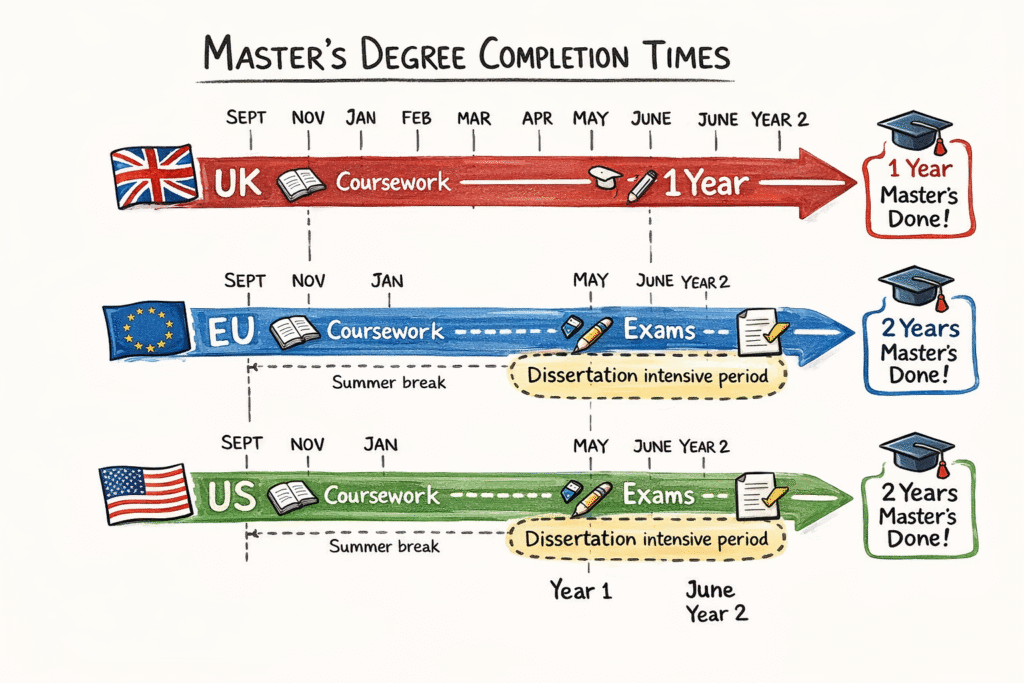
Simple: one year gets you the same qualification that takes two years almost everywhere else. That’s not just marketing speak—it’s a legitimate time advantage. You’re back in the workforce faster, you spend less on accommodation, and you’re earning a full salary while your mates in other countries are still attending seminars.

But (there’s always a but) that compressed timeline means intensity. I’m talking 60-hour weeks during dissertation season. If you’re the type who needs to ease into academic work, the UK postgraduate system will feel like being thrown into the deep end.

Visual timeline comparing one-year UK master's degree duration with two-year programmes in EU and US universities showing coursework and dissertation periods

The Money Talk Nobody Wants to Have (But You Absolutely Must)

Let me break something to you gently: when a university lists “£15,000 tuition,” they’re giving you roughly 35% of your actual costs.

Shocked? You shouldn’t be. Universities don’t typically include accommodation, food, transport, course materials, visa fees, health surcharges, flights home, and that mysterious “student life” category where money just… evaporates.

Tuition Fees: The Only Number They Actually Advertise

For a master degree in UK, you’re looking at:

Programme TypeUK/EU StudentsInternational StudentsWhat Drives the Cost
Arts & Humanities£8,500 – £13,000£14,000 – £22,000Mostly lecture-based, fewer lab costs
Business & MBA£12,000 – £25,000£18,000 – £45,000Networking events, industry speakers, career services
STEM (Lab-based)£10,000 – £18,000£20,000 – £35,000Equipment, lab materials, specialised software
Medicine/Clinical£15,000 – £30,000£25,000 – £45,000Clinical placements, insurance, specialist equipment

Notice that massive range in MBA fees? That’s not a typo. A master degree in UK business schools varies wildly based on reputation. London Business School or Oxford’s Saïd will cost you £40k+. A solid programme at Bradford or Bolton might run £15-18k for internationals.

Living Costs: Where Your Money Actually Goes

The UK government officially says you need £1,023/month outside London or £1,334/month in London for living expenses. That’s their visa requirement baseline.

Is it realistic? Depends entirely on your definition of “living.”

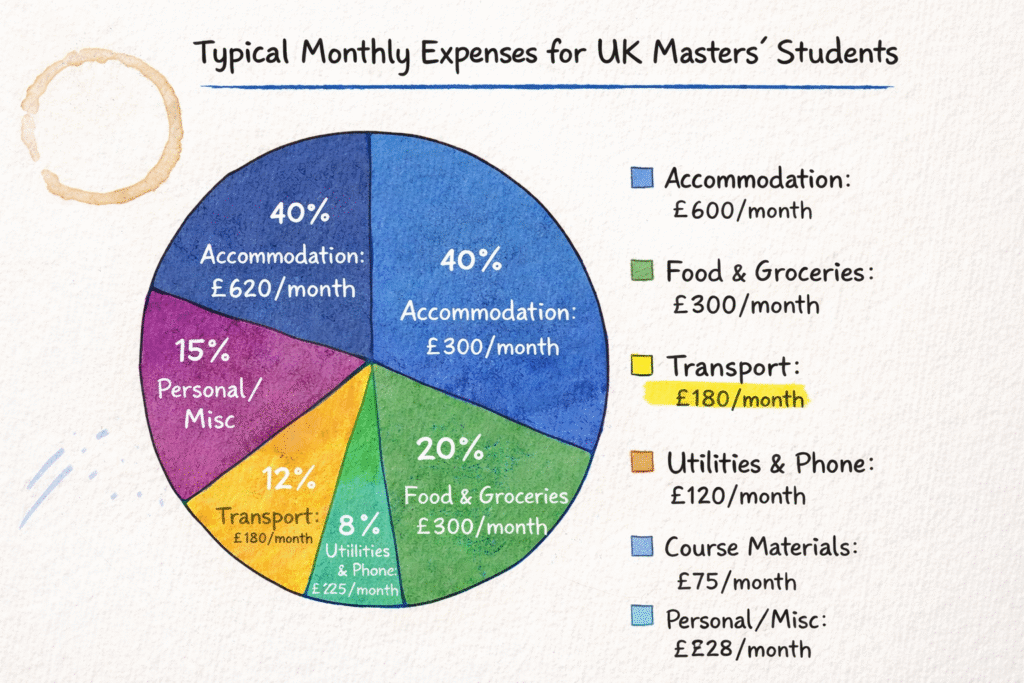
If you’re cool with a house share in Zone 3, cooking every meal, and treating the pub as an annual event—maybe you’ll hit that number. But here’s what actually happens to most students:

  • Accommodation: £400-900/month depending on city and whether you choose university halls or private rent
  • Food: £150-250/month (£200-350 if you eat out occasionally like a normal human)
  • Transport: £50-180/month (London rail zones are highway robbery; smaller cities are cheaper)
  • Course materials & printing: £30-100 across the year
  • Phone & internet: £25-40/month
  • The “life happens” fund: £100-200/month for clothes, toiletries, emergency Uber at 2 AM, birthday gifts…

Total annual living costs? You’re realistically looking at £9,000-15,000 outside London, and £12,000-20,000+ in the capital.

Realistic monthly budget breakdown for international students pursuing master degree in UK showing accommodation food and living expenses with percentage allocations

The Costs Nobody Warns You About

This is where it gets painful:

Visa & Immigration
Student visa application: £490
Immigration Health Surcharge: £776/year (yes, even though you still pay for some NHS services)
Tuberculosis test (required for many countries): £65-120
Biometric residence permit: Usually included, but delays cost extra

Pre-Arrival Expenses
Flight to UK: £300-1,200 depending on origin
Initial accommodation deposit: Usually one month’s rent (£400-900)
Welcome week “essentials” you’ll absolutely buy: £200-400
Setting up a UK bank account: Free, but you’ll need proof of address which creates a catch-22 situation that’s incredibly annoying

Oh, and if you’re doing a clinical or nursing master’s, add DBS checks (£44) and potentially mandatory uniforms or equipment.

How Long This Journey Actually Takes

The typical master degree in UK runs for 12 months. But that’s like saying a marathon is 26.2 miles—technically true, but missing all the important context.

The Three-Term Structure (Most Common)

Term 1 (Sept/Oct – Dec): You’re drinking from a firehose. New city, new academic system, lectures running four per day sometimes. Assessments start immediately—no gentle “settling in” period like undergrad.

Term 2 (Jan – March): Assessment heavy. Essays, presentations, group projects all colliding. This is where people either find their rhythm or start quietly panicking.

Term 3 (April – Sept): Dissertation time. Some programmes front-load all teaching into Terms 1-2, leaving you completely alone for six months with a 15,000-word monster to wrestle. Others offer supervision throughout.

Submission deadline? Usually late August or early September. Then you wait 6-8 weeks for results. So you’re not actually “done” done until October/November.

Part-Time Routes (The Secret Escape Hatch)

Can’t handle the full-time intensity? Many universities offer 2-year part-time options for their postgraduate programmes. You attend evening seminars, spread assignments across 24 months, and maintain your sanity.

Downside? Student visa restrictions make this difficult for international students. You’ll likely need a work visa or settled status first.

Distance Learning: The Pandemic’s Lasting Gift

Post-COVID, way more institutions now offer legitimate online master degree in UK. LeedsDurham, and Edinburgh Napier have decent programmes with weekly online seminars and occasional in-person intensive weekends.

Completion time? Usually 2-3 years part-time. Tuition often runs 60-70% of the on-campus equivalent.

Study ModeTypical DurationWeekly CommitmentBest For
Full-time on-campus12 months40-50 hoursCareer changers, recent graduates, international students
Part-time on-campus24 months20-25 hoursWorking professionals, UK residents
Distance/online24-36 months15-20 hoursInternational students staying home, UK workers balancing career
MRes/PhD track12-24 months50+ hoursFuture academics, research-focused careers

Entry Requirements: What Universities Actually Want (Not What They Say They Want)

Every university website lists the same bland requirements: “2:1 honours degree or equivalent, English language proficiency, two references.”

But here’s what they’re really assessing when you apply for a master degree in UK:

Your Undergraduate Degree Classification

The official line? You need a 2:1 (60%+ average in UK terms).

The reality? It’s more flexible than you think.

Got a 2:2 (50-59%) but have three years of relevant work experience? Many universities—especially outside the Russell Group—will consider you for their business analyticsproject management, or digital marketing programmes. They want the tuition money, and they know professional experience counts.

Graduated with a First? That’ll strengthen scholarship applications, but don’t expect it to waive other requirements.

International degree from a system that doesn’t use UK classifications? Universities use UK ENIC (formerly NARIC) for equivalency assessments. If you’re from India, you’ll generally need 55-60% from a recognised university. China requires 75-80% (because grade inflation is acknowledged). US students need a 3.0 GPA minimum, 3.3+ for competitive programmes.

English Language Requirements: The IELTS/TOEFL Reality

Non-native speakers need proof of English proficiency. The standard ask:

  • IELTS Academic: Overall 6.5, no component below 6.0 (most programmes) or 7.0+ (for clinical, law, journalism)
  • TOEFL iBT: 90+ total, component minimums vary
  • PTE Academic: 62+ overall (increasingly accepted as an alternative)
  • Cambridge English: C1 Advanced or C2 Proficiency

Pro tip that admissions tutors quietly share: Some universities offer pre-sessional English courses (4-12 weeks before term starts). If you’re 0.5 points below the requirement, you can sometimes gain conditional admission, then do the pre-sessional to make up the gap. It’s expensive (£1,500-4,000) but gets you in the door.

Exemptions? If you did your bachelor’s entirely in English at a recognised institution, many universities waive the test requirement. But “recognised” is subjective—they decide case by case.

Personal Statement: Stop Writing Like a Robot

This 500-1000 word essay makes or breaks borderline applications.

What universities claim they want: “Your motivation for studying this programme and how it aligns with your career goals.”

What actually impresses admissions tutors: Specificity and self-awareness.

Don’t write: “I am passionate about data science and believe this programme will enhance my analytical capabilities.”

Instead: “During my internship at [Company], I built a predictive model that reduced customer churn by 18%, but I hit a wall with deep learning applications. Your module on neural networks taught by Dr. [Specific Professor] directly addresses this gap.”

See the difference? The second version proves you’ve researched the specific programme, you have relevant experience, and you know exactly what you need to learn.

For career changers applying to programmes like psychology conversion courses or software engineering, address the elephant: why the switch? Be honest. “I spent three years in finance and realised I was solving the wrong problems” is infinitely better than vague platitudes about “following your passion.”

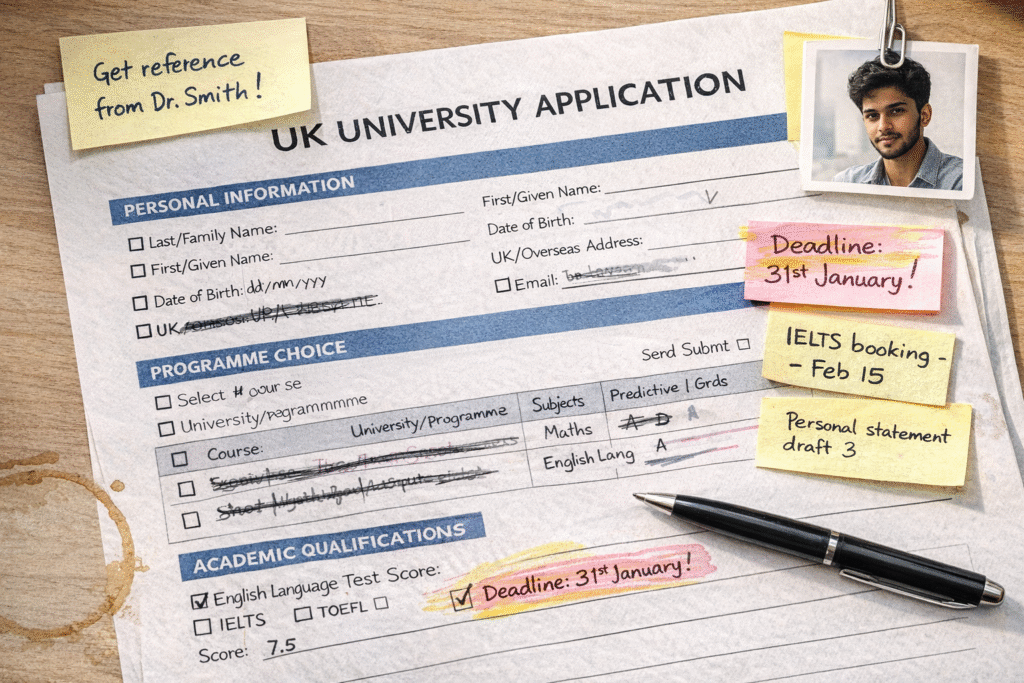
Realistic UK master's degree application materials showing entry requirements checklist and student notes for postgraduate admission with sticky note reminders

References: Who Should Actually Write Them

You need two academic references ideally. But what if you graduated five years ago and haven’t spoken to a professor since?

Options, in order of preference:

  1. Recent academic tutors who taught you (gold standard)
  2. Dissertation supervisor (if recent and they remember you)
  3. One academic + one professional reference from a manager who can speak to your analytical/research abilities (widely accepted)
  4. Two professional references if you’ve been working 5+ years (some universities allow this, especially for MBA and professional master’s)

Never, ever ask someone who’ll write a generic “to whom it may concern” letter. A lukewarm reference kills applications. If you think someone might be unenthusiastic, politely ask if they feel comfortable providing a “strong” reference. Good academics will be honest—they’d rather decline than damn you with faint praise.

Work Experience: When It Matters and When It Doesn’t

For most taught master’s programmes in fields like artificial intelligencecyber security, or public health, work experience is a “nice to have,” not essential.

But for MBAs and executive programmes? Minimum 2-3 years required, 5+ years preferred. Top MBA programmes average 5-7 years work experience in their cohorts.

The sweet spot? Enough experience to contribute to class discussions but not so much that you’ve ossified in your thinking. That’s usually the 3-6 year range.

Subject-Specific Requirements Nobody Mentions Upfront

Applying for a master degree in UK in certain fields? Here’s what else you’ll need:

Architecture: Portfolio of design work, often 15-20 pages. Some institutions like these architecture programmes require an interview or design task.

Medicine/Healthcare: DBS check, occupational health clearance, sometimes volunteer hours. Programmes in physiotherapy and occupational therapy need clinical observation hours as evidence of commitment.

Creative Arts: Portfolios for animationdigital design, showreels for film/media, writing samples for journalism or creative writing courses.

Law conversion (GDL/SQE prep): No prior law degree needed (that’s the point), but you’ll face a gruelling academic year covering what undergrads learn in three years.

Research-based MRes or MPhil: Research proposal (1,500-3,000 words) outlining your intended project. This needs to demonstrate methodological understanding and feasibility.

The Application Timeline That Actually Works

Most universities operate on rolling admissions for master degree in UK programmes—no hard deadlines like undergrad UCAS.

But here’s the strategic timeline:

12-18 months before: Start researching programmes, attend virtual open days, contact potential supervisors if doing research master degree in UK

10-12 months before: Take English tests if needed (IELTS results valid for 2 years), request transcripts, line up referees

6-10 months before: Submit applications (earlier is genuinely better for scholarships and accommodation)

2-6 months before: Receive offers (usually 4-8 weeks after applying), apply for scholarships, apply for student visa

1-2 months before: Sort accommodation, book flights, attend pre-departure orientations

International students need visa processing time—allow 3-4 weeks minimum, though it can take 8+ weeks during peak summer months. Miss the visa deadline and you’ll have to defer a full year.

Scholarships & Funding: Actually Attainable Options

Full-ride scholarships are rarer than lecturers who enjoy marking. But partial funding? More available than you’d think.

University-Specific Scholarships

Almost every institution offers some form of postgraduate funding:

  • Merit-based: £1,000-5,000 off tuition for First class degrees or equivalent
  • Regional scholarships: Many universities offer specific funding for students from Commonwealth countries, China, India, or Africa
  • Alumni discounts: Studied your undergrad there? Often 10-20% off master’s tuition
  • Early application rewards: Some institutions discount tuition by £1,000-2,000 if you accept your offer by February/March

Check individual university pages like SheffieldCardiff, or Liverpool John Moores for current opportunities.

External Funding Bodies

Chevening Scholarships: Fully-funded for international students with leadership potential. Brutally competitive (3% acceptance rate) but covers everything including monthly stipend.

Commonwealth Scholarships: For students from eligible Commonwealth countries. Covers tuition and living costs.

British Council GREAT Scholarships: £10,000 towards tuition, available for students from specific countries including India, China, Pakistan, Bangladesh, and several others.

Employer sponsorship: More common than you’d think for professional master’s. If your employer benefits from your qualification, they might cover part or all of it in exchange for a return-of-service obligation.

Student Finance (UK/EU Students)

UK and some EU students can access Postgraduate Loans up to £12,167 for master’s courses. It’s not means-tested, repayment starts at 6% of income over £21,000 annually.

International students? You’re generally self-funding or scholarship-hunting. UK student finance doesn’t apply unless you have settled/pre-settled status.

Is a Master Degree in UK Worth It in 2026?

Let’s be brutally honest: it depends entirely on your field and career goals.

Fields where it’s almost essential: Clinical psychology, architecture, physiotherapy, engineering specialisations, data science (increasingly), academic/research careers

Fields where it’s valuable but not mandatory: Business, finance, marketing, HR, project management, international relations

Fields where experience matters more: Most of creative industries, sales, certain tech roles (though this is changing)

The real calculation isn’t “can I afford this?” It’s “what’s my ROI?”

If you’re investing £30,000 total (tuition + living) into a master’s that increases your starting salary by £8,000 and accelerates your career progression, you’ll break even in about 4 years. That’s reasonable.

If you’re spending £45,000 on a master’s in a field where experience trumps credentials and you’d earn the same without it? That’s a questionable investment unless you genuinely love the subject.

How GCRD HUB Actually Helps (Without the Sales Pitch)

Look, I could write you a glowing paragraph about GCRD HUB‘s services, but you’re smart enough to know when you’re being marketed to.

Here’s the practical bit: navigating the master degree in UK application process while juggling IELTS prep, visa paperwork, university research, and personal statements is genuinely overwhelming. I’ve seen confident students completely freeze when faced with the financial planning alone.

Education consultants exist because the process has genuine complexity. GCRD HUB offers end-to-end admissions support—from shortlisting universities that match your profile to reviewing your personal statement, prepping for interviews, and navigating scholarship applications.

The value? Avoiding costly mistakes. Like applying to programmes you’re not qualified for (wasted application fees), missing scholarship deadlines, or choosing a university-course combination that doesn’t align with your visa goals.

Their consultants work out of 107 Fleet St, London EC4A 2AB but support students globally. You can reach them at +44(0)20 39839001-9003 for initial guidance.

Use them or don’t—but definitely talk to current students in your target programmes before committing. Facebook groups, LinkedIn, even Reddit. Real experiences beat glossy brochures every time.

Final Thoughts: Making the Decision That’s Right for You

master degree in UK isn’t right for everyone, and that’s okay.

If you’re 22, just finished undergrad, and unsure what you want? Maybe work for 2-3 years first. You’ll get more from the programme with professional context.

If you’re 35 and worried you’re “too old”? You’re not. Mature students often perform better—they’re focused, they know why they’re there, and they don’t waste time.

If the finances genuinely don’t stack up? Consider part-time or distance learning. Or look at countries with lower costs like Germany or France (though language requirements apply).

But if you’ve read this far, you’re clearly serious about this. Do the research, run the numbers honestly, talk to people who’ve done it, and trust your gut.

The UK postgraduate system has plenty of flaws—it’s expensive, it’s intense, and it’s not a guaranteed ticket to anything. But it’s also rigorous, well-respected globally, and genuinely transformative if you choose the right programme for the right reasons.

Your move.

Frequently Asked Questions

Can I work while studying for a master degree in UK?

Yes, Student visa holders can work up to 20 hours per week during term time and full-time during holidays. Most students find part-time work in retail, hospitality, or campus roles like library assistant or student ambassador. Realistically, the intensive nature of most programmes makes working more than 10-15 hours challenging.

What’s the difference between MA, MSc, MRes, and MBA?

MA (Master of Arts) is for humanities and social sciences subjects. MSc (Master of Science) is for science, technology, engineering, and maths fields. MRes (Master of Research) is research-intensive, often a stepping stone to PhD. MBA (Master of Business Administration) is a professional business degree requiring work experience. They’re all master’s level qualifications (Level 7 on the UK framework).

Do I need to choose my master’s programme related to my bachelor’s degree?

Not always. Many programmes accept students from different undergraduate backgrounds, especially conversion courses designed for career changers. However, STEM master’s usually require relevant undergraduate foundation, while business, humanities, and social science programmes are often more flexible.

How do I know if a UK university is legitimate and recognised?

Check if the institution holds a Royal Charter or is listed on the UK government’s official register of higher education providers. Degree-awarding powers are tightly regulated in the UK. Avoid “universities” that aren’t on the official list—diploma mills do exist.

Can I stay in the UK after completing my master’s degree?

Yes, through the Graduate visa route (formerly Post-Study Work visa). This allows you to stay and work in the UK for 2 years after completing your master’s (3 years for PhD). You’ll need to apply before your Student visa expires and meet the eligibility requirements.

What’s the typical class size for a master degree in UK?

Varies dramatically by subject and institution. Popular programmes like business or psychology might have 50-200 students in lectures, with seminar groups of 15-25. Specialised programmes in niche subjects might have cohorts of only 10-20 total students. Research-intensive courses offer more individual supervision.

Are online UK master’s degrees viewed the same as on-campus ones by employers?

Increasingly yes, especially post-pandemic. The key is accreditation—if it’s from a recognised UK university and leads to the same qualification, most employers don’t distinguish. However, you miss networking opportunities and the in-person university experience. Check if the certificate specifies “distance learning” or not (many don’t).

How difficult is it to get into a Russell Group university for master’s?

More achievable than undergraduate admission. Russell Group universities need postgraduate students for teaching and research. If you meet the entry requirements (usually 2:1 or equivalent, English proficiency), have a strong personal statement, and apply to suitable programmes, acceptance rates are fairly reasonable—often 40-60% depending on programme popularity.

Cheapest University in UK for International Students in 2026

If you’ve ever Googled cheapest university in UK at 2:17 am, half‑convinced the answer would be “none anymore”, you’re not alone. Tuition fees creep up. Rent in student cities has opinions. Visa rules feel like a moving target. Yet here we are, in 2026, and the UK is still quietly offering real opportunities for international students who know where to look.

I see this daily at GCRD HUB. Students walk in stressed, convinced the UK dream is financially reckless. Then we open the right doors. Suddenly, it looks… manageable. Sometimes even sensible.

This guide is not a glossy brochure fantasy. It’s a grounded, slightly opinionated walk through the cheapest university in UK options that actually make sense for international students right now.


What “cheap” really means when you’re studying in the UK

Let’s get one thing straight. Cheap does not mean low quality. In the UK system, tuition fees are capped and regulated, which creates something interesting. Some universities quietly deliver strong outcomes without Ivy League‑style price tags.

When students ask me for the cheapest university in UK, I always ask back:

• Cheapest tuition? • Cheapest city? • Cheapest total cost including living?

Because those are three different answers.

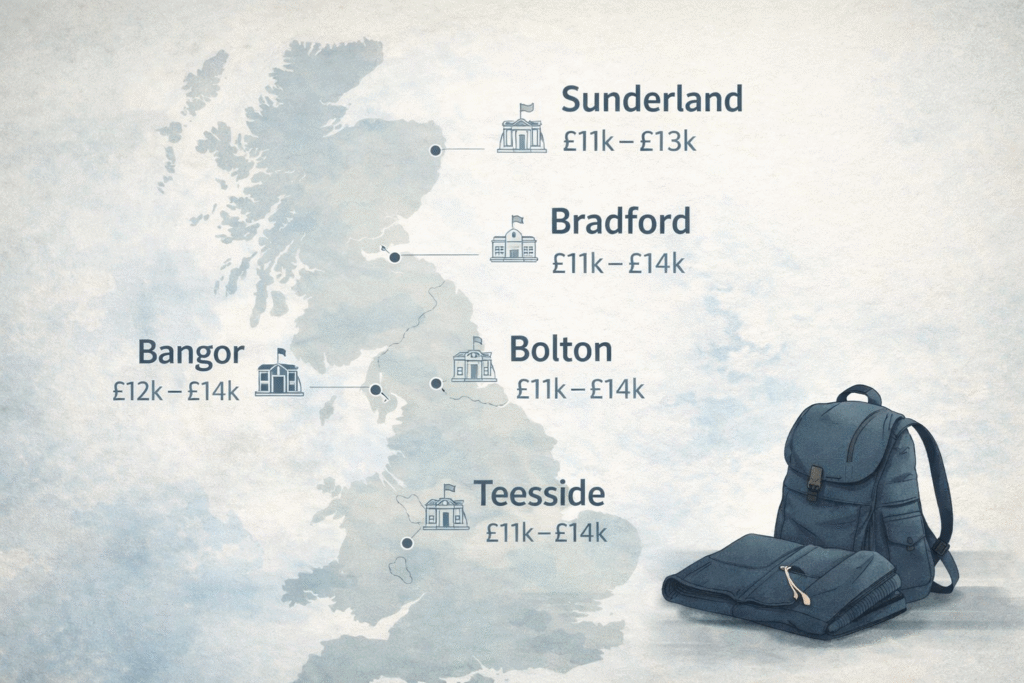
A £11,000 course in London can cost more overall than a £14,000 course in Sunderland. Geography matters. Rent matters. Bus fares matter more than most people admit.


Universities that consistently rank as the cheapest university in UK for 2026

Below are institutions that repeatedly come up when we shortlist the cheapest university in UK for international students across undergraduate, postgraduate, and Level 6 Top‑Up routes.

University of Sunderland

This one surprises people. Sunderland offers competitive tuition fees, strong employability‑focused courses, and one of the lowest student living costs in England.

Courses in business, computing, health, and social sciences remain popular. It’s often the first recommendation when students want the cheapest university in UK without cutting academic corners.

University of Bolton

Bolton has built a reputation around affordability and student support. Smaller class sizes, practical learning, and tuition fees that stay firmly on the lower end of the UK scale.

It’s a common choice for students entering via the foundation or Level 6 Top‑Up pathway.

Teesside University

Teesside balances cost and outcomes unusually well. Fees are reasonable, accommodation is affordable, and the university invests heavily in industry‑linked teaching.

For students looking at computing, digital technologies, and business, this is often the cheapest university in UK that still feels modern.

University of Bradford

Bradford has long been underrated. Tuition fees are competitive, and the city remains one of the more affordable places to live in the UK.

Students focused on engineering, management, or applied sciences often land here.

Bangor University

Wales quietly wins on cost. Bangor combines lower tuition fees with lower living expenses, plus a calmer pace of life that many international students prefer.

For students asking for the cheapest university in UK with space to breathe, Bangor comes up often.

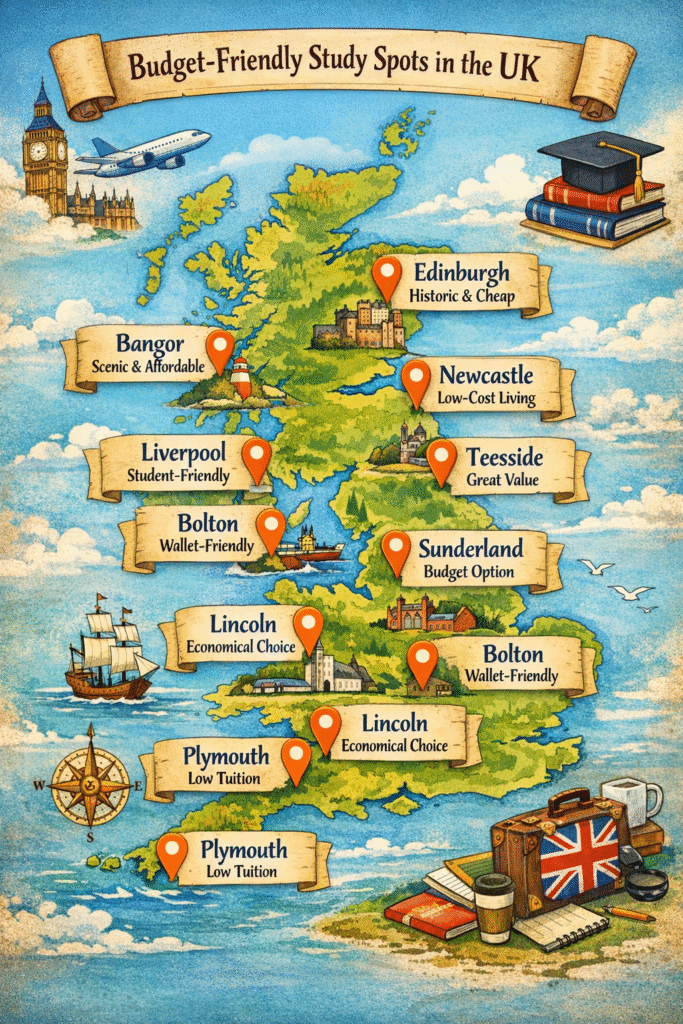
Cheapest university in UK cities for international students

Tuition fees vs real life costs (the table nobody shows you)

Notice how the cheapest university in UK isn’t always the lowest tuition alone. Cost of living quietly tips the scales.


Level 6 Top‑Up degrees: the UK’s best kept affordability secret

If you already hold a diploma or equivalent qualification, a Level 6 Top‑Up can cut both time and money.

One year. Full UK honours degree. Lower total spend.

This route often becomes the cheapest university in UK pathway rather than a single institution choice.

Popular options include:

• Business Management Top‑Up • Health & Social Care Top‑Up • Applied Computing Top‑Up

I’ve watched students save £10,000+ by choosing this route intelligently.


Scholarships, fee reductions, and the quiet discounts

Here’s a slightly uncomfortable truth. Many universities do not advertise how flexible they can be with international fees.

Early payment discounts. Merit‑based reductions. Country‑specific scholarships. These exist, but they’re rarely obvious.

This is where working with experienced education consultants matters. At GCRD HUB, our role isn’t selling dreams. It’s knowing where flexibility actually lives inside admissions offices.

Services like scholarship advisory, interview preparation, and end‑to‑end admissions support often pay for themselves in saved fees.


A small warning (read this twice)

The cheapest university in UK is useless if your visa is refused.

Low fees won’t save a weak application, inconsistent documents, or poor interview performance. Cost strategy and credibility must move together.


Frequently asked questions

What is the cheapest university in UK for international students in 2026?
There isn’t one single answer, but Sunderland, Bolton, Bradford, and Bangor consistently rank among the cheapest university in UK options when total cost is considered.

Can international students really afford the UK in 2026?
Yes, with planning. Choosing the right university, city, and course pathway makes a significant difference.

Is London ever cheap for students?
Rarely. Even when tuition is reasonable, living costs usually cancel out the savings.

Are UK degrees from cheaper universities respected?
Absolutely. UK degrees are regulated nationally. Employers care more about skills and outcomes than fee levels.

Do education consultants actually help reduce costs?
When experienced, yes. Proper guidance can unlock fee reductions, scholarships, and safer admissions outcomes.


Diverse international graduates outdoors, informal, relieved.

Final thought (and practical next step)

The cheapest university in UK isn’t about chasing the lowest number. It’s about building a plan that survives real life. Rent. Food. Visa rules. Graduation.

If you want clarity without pressure, speaking to a grounded advisor helps. GCRD HUB, based at 107 Fleet St, London EC4A 2AB, supports international students with study in UK planning, university placement services, interview preparation, and pre‑departure guidance.

Sometimes the smartest move is simply asking the right questions early.

Contact: +44(0)20 39839001 – 9002 – 9003

How Education Consultants Help You Study in the UK

Here’s something they don’t mention in those glossy university brochures: getting into a UK university isn’t the hard part anymore. It’s everything else—the visa nightmares at 2 AM, the scholarship applications that seem written in ancient Greek, the haunting question of whether you’ve just spent £12,000 on the wrong course.

I’ve watched brilliant students fumble spectacular opportunities simply because they didn’t know which boxes to tick (literally and figuratively). And I’ve seen average applicants waltz into Russell Group universities because they had someone in their corner who knew the game.

That someone? An education consultant. Not a magic wand. Not a shortcut. Just… someone who’s done this 500 times before whilst you’re doing it for the first (and probably only) time.

What Actually Makes Someone an Education Consultant?

Let’s dispel some myths straight away.

Education consultants aren’t some shadowy figures who secretly bribe admissions officers. (That would be illegal, obviously, and also wildly ineffective given how UK universities actually work.) They’re professionals who’ve built relationships with universities over years—sometimes decades. They understand the shifting sands of immigration policy. They know which UK universities are genuinely strong in your field versus which ones just have clever marketing.

The good ones, anyway.

At places like GCRD HUB, located at 107 Fleet St in London, the team has spent years building these connections. They’re not just pushing papers—they’re offering end-to-end admissions support that covers everything from your first anxious email to the moment you’re unpacking in your university accommodation.

Quick Reality Check: The UK welcomed nearly 680,000 international students in recent academic years. That’s not a typo. Competition is fierce, documentation requirements change faster than British weather, and one tiny error in your visa application can derail months of planning. Education consultants exist because this process is genuinely complicated—not because you’re incapable.

The Brutally Honest Guide to What Education Consultants Actually Do

University Selection (Or: Why You Shouldn’t Just Pick Names You Recognise)

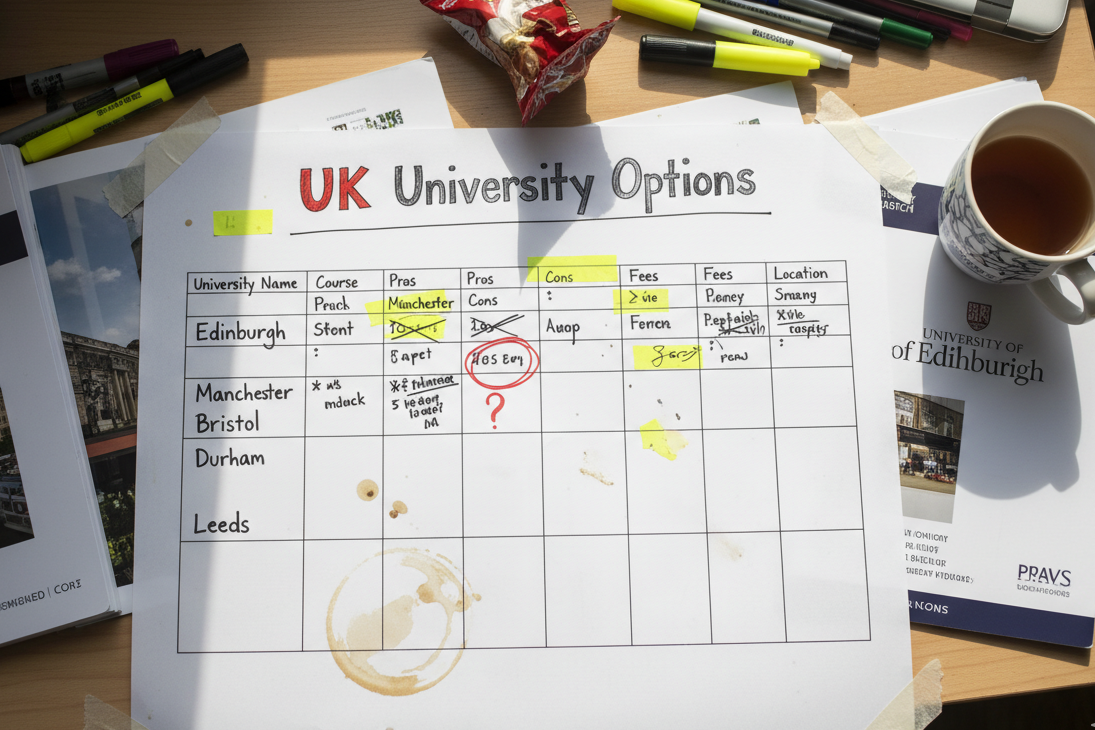
Handwritten comparison chart showing UK university options with pros and cons for education decision making

Most students approach university selection like they’re choosing a holiday destination. “Oxford sounds prestigious!” or “I saw Manchester on telly once!”

Here’s what education consultants do instead: they sit down with you and ask uncomfortable questions. What’s your actual career goal? (Not what your parents want—what you want.) What’s your budget beyond tuition fees? Can you handle a tiny village campus or do you need the chaos of a major city to function?

They’ll match you with programmes based on:

  • Teaching style – Some UK universities are lecture-heavy, others seminar-focused. If you learn better through discussion rather than sitting in a 200-person auditorium, this matters enormously.
  • Industry connections and placement opportunities in your field
  • Actual graduate employment rates (not the marketing fluff on university websites)
  • Cost of living differences – London versus, say, Sunderland can mean an extra £6,000-8,000 per year

GCRD HUB offers university placement services that go beyond “here’s a list of schools.” They’re looking at whether you’d actually thrive there, whether the programme aligns with your visa timeline, whether the city has the support networks you’ll need.

The Application Labyrinth

UK university applications aren’t difficult in the way a maths problem is difficult. They’re difficult in the way assembling IKEA furniture in the dark is difficult—theoretically possible, extremely frustrating, and you’ll probably miss something crucial.

Personal statements. References. Portfolio requirements for some programmes. UCAS deadlines that vary by course. Then there’s the whole separate circus for postgraduate applications which don’t even use UCAS.

Application ComponentWhat It Actually RequiresCommon Mistakes
Personal StatementDemonstrating genuine interest in your subject (not listing achievements)Generic statements, over-emphasising extracurriculars, copying examples online
Academic ReferencesSpecific examples of your academic capability from recent instructorsUsing family friends, getting vague character references instead
English Language TestsMeeting specific IELTS/PTE scores (usually 6.5-7.0 overall for undergrad)Taking wrong test type, missing validity dates, assuming exemption incorrectly
Supporting DocumentsCertified translations, proper degree equivalency certificatesUncertified translations, missing apostilles, wrong document formats

Study consultants handle the coordination of all this chaos. They’ll review your personal statement seven times (the good ones will, anyway) and also they’ll tell you when your reference is too generic. They’ll make sure your English test is actually the right type for your chosen programme.

More importantly? They know which universities want which tone in applications. Durham’s admissions team looks for different qualities than London Met. Education consultants who’ve placed hundreds of students know these unwritten rules.

Interview Preparation: The Part Everyone Underestimates

Not all UK programmes require interviews. But the competitive ones do—especially for subjects like Medicine, Law, or Nursing.

And here’s the thing: UK university interviews aren’t like job interviews. They’re testing how you think, not what you know. An interviewer might ask you to solve a problem you’ve never seen before, just to watch your reasoning process.

Places like GCRD HUB provide interview and admission preparation that simulates this environment. They’ll throw curveball questions at you, and they’ll point out when you’re rambling or when you’ve gone too defensive. They’ll teach you the difference between confidence and arrogance—a line many international students accidentally cross because interview culture varies so much globally.

Insider Tip: The best education consultants don’t just do mock interviews—they explain why certain answers work better. It’s the difference between memorising responses and actually understanding what admissions tutors are looking for.

The Money Conversation (Because Let’s Be Real)

UK education is expensive. Like, genuinely, eye-wateringly expensive for international students. Tuition alone ranges from £10,000 to £38,000 per year depending on the programme and institution. Then add living costs—the UK government says you need to show £1,483 per month for London, £1,136 for elsewhere.

Multiply that out and you’re looking at serious money.

This is where scholarship and financial aid advisory becomes crucial. Most students don’t realise how many funding opportunities exist beyond the big-name scholarships everyone applies for (and almost nobody gets).

There are:

  • University-specific bursaries for students from certain countries
  • Subject-specific scholarships (particularly in STEM fields and shortage areas like Nursing)
  • Government-sponsored schemes from your home country
  • Charity and foundation grants that most students never hear about

Education consultants know which deadlines are approaching, which scholarships you actually have a shot at based on your profile, and how to position your application to maximise funding chances. GCRD HUB’s scholarship and financial aid advisory includes helping you build a realistic budget and identify multiple funding sources rather than putting all your eggs in one scholarship basket.

The Visa Gauntlet (Where Dreams Go to Die Without Proper Guidance)

Let me tell you about visa applications.

An international student completing a UK student visa application and looking for Education Consultants late at night with documents and a passport

The UK Student Visa (which costs £524 as of 2025, plus the Immigration Health Surcharge of £776 per year) has approximately 847 ways to mess it up. Okay, I’m exaggerating—but not by much.

You need:

  1. A Confirmation of Acceptance for Studies (CAS) from your university
  2. Proof you can afford tuition AND living costs (which must be in your bank account for 28 consecutive days before applying)
  3. English language proof (unless you’re from certain countries)
  4. A valid passport (with at least 6 months validity remaining)
  5. Tuberculosis test results (if you’re from certain countries)
  6. Consent forms (if you’re under 18)

Miss one document? Delayed. Submit bank statements dated 29 days before your application? Rejected. Use the wrong type of English test? Start again.

The processing time is typically 3 weeks, but that assumes everything’s perfect. One error can add months to your timeline, potentially causing you to miss your course start date entirely.

“I thought I could handle the visa application myself. I’m a straight-A student, right? How hard could it be? Turns out, very hard when you accidentally submit bank statements showing your balance on day 27 instead of day 28. Lost my spot for September intake, had to defer to January, and spent three months in limbo.”
— Former DIY applicant (who eventually hired GCRD HUB)

This is precisely why education guidance from experienced consultants makes such a difference. They’ve seen every possible error. They know when UKVI rules change (which happens more often than you’d think). They can spot a problem in your documentation before you submit it.

Visa RequirementWhy Students Get This WrongHow Consultants Help
Financial EvidenceMoney not in account for full 28 days, using wrong currency conversion, including non-liquid assetsReview bank statements before submission, advise on timing of application, explain exactly what counts as “available funds”
CAS DetailsInformation on visa application doesn’t match CAS exactlyCross-check every detail, catch discrepancies before submission
English Language ProofTaking wrong test version, test results expired, assuming exemption when not eligibleVerify test requirements specific to your programme and nationality
Supporting DocumentsMissing translations, uncertified copies, documents not in correct formatProvide checklist for your specific situation, review all documents before submission

What Happens After You Get Accepted (The Part Most Services Ignore)

Getting your acceptance letter is brilliant. It’s also just the beginning.

Now you need to:

  • Find accommodation (which in cities like London or Edinburgh gets snapped up months in advance)
  • Sort out money transfer and UK bank accounts
  • Understand how the NHS works with your student visa
  • Figure out what you can actually bring versus what you should buy there
  • Navigate the cultural adjustments that nobody warns you about

This is where pre-departure orientation and support becomes invaluable. The mediocre education consultants consider their job done once you’re accepted. The excellent ones—like the team at GCRD HUB—walk you through this transition period.

They’ll tell you which UK banks are friendliest to international students. They’ll explain why you absolutely should get travel insurance even though it seems like an unnecessary expense and also, they’ll prepare you for the reality that British people will say “sorry” when you bump into them.

The “Nobody Told Me” List (Actual Things Students Wish They’d Known):

  • UK power sockets are different—you need an adapter, and buying one at Heathrow Airport costs 3x as much
  • British “autumn” starts in August and it rains. A lot. Pack accordingly.
  • Your student railcard saves you 1/3 on train tickets—get it immediately upon arrival
  • The NHS is free but dentist appointments aren’t fully covered and optician visits definitely aren’t
  • Council tax exemption for students isn’t automatic—you have to apply for it

The Different Flavours of Education Consultants

Not all study consultants are created equal. Let’s talk about the landscape.

The Free-But-Not-Really Model

Some agencies claim to offer completely free services. They’re not lying, exactly—but they’re getting paid by universities for successful placements. Which creates an interesting incentive structure.

Will they recommend the best programme for you, or the programme that pays them the highest commission? Sometimes those align. Sometimes they don’t.

The Premium Everything Model

At the other end, you’ve got consultants who charge thousands upfront and promise white-glove service. Some deliver brilliantly. Others are selling you the same basic support you could get elsewhere, just with fancier branding.

The Specialist Model

Then there are consultants who focus on specific fields—say, only MBA programmes or only health sciences courses. They know their niche incredibly well but can’t help if you change your mind about your career path.

The Comprehensive Model (Where GCRD HUB Sits)

Comprehensive services cover the full journey—from initial career counselling through university selection, applications, visa support, and pre-departure preparation. The advantage? One point of contact who understands your entire situation. The disadvantage? These tend to cost more than à la carte services.

GCRD HUB offers this complete package with specialists in different areas. So you’re getting expert guidance whether you’re applying for an undergraduate degree, a Level 6 top-up, or a postgraduate programme.

When You Definitely Need an Education Consultant

Let’s be practical. Not everyone needs to hire an education consultant. If you’re applying to a few non-competitive programmes, you speak perfect English, you understand visa requirements thoroughly, and you enjoy reading dense government documentation, maybe you can DIY this.

But you probably should work with education consultants if:

  • Your academic background is complicated – gaps in education, degree from a system UK universities don’t understand well, grades that need explanation
  • You’re applying to highly competitive programmes – anything in Medicine, Law, Oxbridge, or programmes with 10+ applicants per space
  • You need significant financial aid – navigating scholarship applications whilst juggling university applications is genuinely overwhelming
  • Visa issues keep you awake at night – one mistake can cost you thousands and months of time; professional help is worth it
  • You’re the first in your family to study abroad – there’s zero shame in needing guidance through unfamiliar territory
  • The administrative overhead is preventing you from actually preparing academically – sometimes paying for help is about buying back your time and sanity

Red Flags: When to Run From an Education Consultant

Unfortunately, this industry has its share of charlatans. Here’s what should make you immediately suspicious:

Warning Signs of Dodgy Consultants:

  • Guarantees of admission – Nobody can guarantee this. Universities make the final decisions, always.
  • Pressuring you to apply to specific universities only – Especially if those happen to be the ones nobody’s heard of
  • Requiring full payment upfront before any services – Legitimate consultants work in stages
  • Cannot provide evidence of successful placements – Ask for testimonials, success rates, university partnerships
  • Unclear about their fee structure – If they’re vague about costs, that’s intentional
  • Offering to “write your personal statement for you” – This is unethical and universities can detect purchased essays

The ROI Question: Is It Actually Worth the Money?

Education consultancy services typically cost anywhere from £500 to £5,000+ depending on the package and provider. That’s not pocket change.

So is it worth it?

Consider this: A rejected visa application costs you £524 in visa fees plus the Immigration Health Surcharge (£776 per year of study) that you won’t get back. If you have to reapply, that’s another £524+ pounds. Missing your start date might mean deferring for months, which could cost you job opportunities, time, and potentially housing deposits.

One scholarship that a consultant helps you secure could cover their fees ten times over. Applying to the right programme the first time (instead of realising halfway through that you chose wrong and wanting to transfer) saves both money and emotional energy.

The return on investment isn’t always purely financial—it’s also about reduced stress, better decision-making, and actually enjoying the process rather than dreading it.

The GCRD HUB Approach to Education Consultancy

Let me talk specifics about what makes GCRD HUB’s approach different. (Because at this point you’re probably wondering whether this entire article is just an advertisement. It’s not—but I do think their model addresses a lot of the problems I’ve outlined.)

First, they’re based in London at 107 Fleet St, which means they’re literally down the road from many major UK universities and have direct relationships with admissions teams. Those relationships matter when you need a quick answer about whether your qualifications meet entry requirements or when there’s confusion about your application.

Second, their services genuinely cover the end-to-end journey. From the initial “I think I want to study in the UK but I’m not sure where or what” conversation through to “I’ve arrived in the UK and need help setting up my bank account.” They offer:

  • Study in UK consultancy specific to your field and goals
  • Education guidance that’s personalised, not cookie-cutter
  • University admissions support for undergraduate, postgraduate, and foundation programmes
  • Interview and admission preparation tailored to your specific universities
  • Scholarship and financial aid advisory including lesser-known funding sources
  • University placement services based on fit, not commissions
  • Pre-departure orientation covering practical and cultural preparation

Third—and this is important—they’re transparent about what they can and cannot do. They won’t promise you a spot at Oxford. They will promise to present your application in the strongest possible light and help you navigate the process with minimum stress.

Ready to Start Your UK Education Journey?

Whether you’re eyeing a spot at a Russell Group university or looking for the perfect programme match, GCRD HUB’s team has guided hundreds of students through this exact process.

Get In Touch:

📍 107 Fleet St, London EC4A 2AB

📞 +44(0)20 39839001 / 9002 / 9003

🌐 Book Your Free Initial Consultation

What a Typical Timeline Looks Like With Education Consultants

Just so you know what to expect, here’s roughly how the process unfolds when working with education consultants:

12-18 Months Before Intended Start Date:

  • Initial consultation – discussing goals, budget, preferences
  • English language testing (if needed)
  • University shortlisting based on your profile
  • Beginning scholarship research

9-12 Months Before:

  • Finalising university choices
  • Drafting personal statements and securing references
  • Submitting applications (UCAS deadlines vary; some are as early as October for medicine)
  • Applying for scholarships

6-9 Months Before:

  • Interview preparation (if applicable)
  • Receiving offers and making decisions
  • Securing accommodation

3-6 Months Before:

  • CAS document received from university
  • Visa application submitted
  • Financial arrangements finalised
  • Pre-departure preparations

1-3 Months Before:

  • Visa (hopefully) approved
  • Final preparations and packing
  • Travel arrangements
  • Arriving in the UK and settling in

Notice something? This is nearly a year-and-a-half process in many cases. People who think “I’ll just handle this in a couple of months” severely underestimate the timeline.

The Cultural Side of Education Consultancy

Here’s something most people don’t realise education consultants help with: cultural translation.

UK academic culture is different. The way you’re expected to engage in seminars, the level of independence expected in your studies, even the way you address your professors—it varies dramatically from other education systems.

In some countries, challenging your professor’s viewpoint is considered disrespectful. In UK universities, it’s often expected. Some international students struggle with this adjustment because nobody prepared them for it.

Good study consultants explain these differences upfront. They’ll tell you that British people use understatement constantly (“That’s quite interesting” might actually mean “That’s brilliant”). They’ll prepare you for the fact that feedback on your work might be less effusive than you’re used to—a UK professor saying “This shows promise” is actually giving you a compliment.

These cultural nuances affect everything from how you write your personal statement to how you’ll experience university life. Understanding them beforehand prevents a lot of unnecessary stress.

Specialist Programmes: When Generic Advice Doesn’t Cut It

Some programmes have such specific requirements that you really need consultants who specialise in that field.

Medicine and Healthcare Programmes – These have additional hurdles like the UCAT (University Clinical Aptitude Test) or BMAT, work experience requirements, and incredibly competitive interview processes. If you’re applying for Clinical NutritionPhysiotherapy, or Occupational Therapy, you need guidance from people who understand healthcare education specifically.

MBA and Business Programmes – These often require GMAT scores, relevant work experience, and very different application approaches. The personal statement for an MBA looks nothing like one for an undergraduate engineering programme.

Art and Design Portfolios – Programmes in ArchitectureAnimation, or Digital Design require portfolios that meet very specific criteria. What impresses one university might be completely wrong for another.

Law Programmes – The LLB route versus the GDL (Graduate Diploma in Law) route, understanding the Solicitors Qualifying Examination (SQE), knowing which universities have the strongest connections to City law firms—this requires specialist knowledge.

GCRD HUB maintains specialists across these different areas precisely because a one-size-fits-all approach fails when programmes have vastly different requirements.

The Digital Transformation of Education Consultancy

Something’s shifted in recent years. You don’t necessarily need to meet your education consultant face-to-face anymore (though it’s certainly still an option if you’re in London near GCRD HUB’s Fleet Street offices).

The pandemic accelerated what was already happening—consultancy services going digital. Video consultations, shared document platforms, digital application tracking. This has made quality education consultancy accessible to students anywhere in the world.

But here’s the catch: whilst digital tools have improved access, they’ve also enabled a flood of low-quality services. Anyone with a website can claim to be an education consultant now. This makes vetting consultants even more important.

Look for consultants who:

  • Have a physical office (GCRD HUB’s London location is verifiable)
  • Offer both digital and in-person options
  • Use professional document management systems
  • Provide clear, written agreements about services and fees
  • Have established relationships with universities that you can verify

Beyond the Obvious: Hidden Benefits of Education Consultants

We’ve covered the main services, but there are secondary benefits that don’t appear in service descriptions:

Network Access – Good consultants have connections with current students and recent graduates who can provide real insights. Want to know what it’s actually like studying Software Engineering at a particular university? They can often connect you with someone who’s doing it right now.

Crisis Management – What happens if your chosen university suddenly changes its course structure? Or if your visa gets delayed and you might miss orientation? Education consultants handle these emergencies regularly and know exactly what to do.

Negotiation Power – Sometimes universities have flexibility on entry requirements or deadlines—particularly for international students. A consultant with an established relationship can sometimes secure considerations that you couldn’t access directly.

Mental Health Support (Indirectly) – Having someone who’s guided hundreds of students through this process and can reassure you that what you’re feeling is completely normal? That’s genuinely valuable. The application process is stressful; having an experienced guide reduces that stress considerably.

Questions Everyone Asks About Education Consultants

Do education consultants actually improve my chances of admission?

They don’t change your qualifications, but they absolutely help you present them more effectively. A well-crafted personal statement, properly prepared interview responses, and strategically chosen university selections can make a significant difference. Think of it like having a professional CV writer versus writing your own—the content is the same, but the presentation matters.

Can I trust education consultants who offer “free” services?

Some are legitimate and earn commission from universities for successful placements. The question is whether their recommendations are genuinely in your best interest or biased towards universities paying higher commissions. Always ask how they’re compensated and whether they work with a broad range of institutions or just select partners.

How early should I engage an education consultant?

Ideally 12-18 months before your intended start date. This gives enough time for English language testing (if needed), thorough university research, scholarship applications, and avoiding rushed visa applications. That said, consultants can help even if you’re on a tighter timeline—it just limits your options somewhat.

What’s the difference between education consultants and university agents?

University agents typically represent specific institutions and are paid by those universities to recruit students. Education consultants should be independent, representing your interests rather than any particular university’s recruitment goals. GCRD HUB operates as an independent consultant, offering objective advice across the full range of UK universities.

Will universities know I used a consultant?

It depends. If a consultant writes your personal statement for you (which is unethical), universities can often detect this. But legitimate consultant services—reviewing your statement, advising on structure, helping you articulate your ideas more clearly—are perfectly acceptable. Universities understand that students get help with applications; they object to dishonest representation.

Can education consultants help with student finance and loans?

Many can provide guidance on student finance options, scholarship applications, and budgeting. However, they’re not financial advisors in the regulated sense. They can explain what’s available and help you apply, but won’t (and legally can’t) provide formal financial advice.

What if I’m not satisfied with my consultant’s service?

Reputable consultants should have clear terms of service including what happens if you’re unsatisfied. Ask about this upfront. Do they offer refunds? Can you terminate the agreement? What recourse do you have if they miss deadlines? Get this in writing before committing.

Do I need a consultant if I’m only applying to one or two universities?

Not necessarily—if your application is straightforward and you’re confident handling visa requirements independently. But remember that consultants often help you discover better-fit programmes you hadn’t considered. Sometimes the value is in the initial university selection conversation rather than just application support.

The Uncomfortable Truths About UK Study That Consultants Should Tell You

Honest education consultants will share things that aren’t particularly good for their business but are important for you to know:

The UK might not be the right choice for everyone. If you want extensive campus facilities, warm weather, or a culture that feels more similar to home, other countries might suit you better. Education consultants worth their fees will have this conversation with you honestly.

The post-study work situation has improved but remains competitive. The Graduate Route visa (allowing 2-3 years of post-study work) is brilliant, but finding employment still requires effort. Don’t assume a UK degree automatically leads to a UK job.

Some universities are better than their rankings suggest; others worse. League tables measure research output and don’t necessarily correlate with teaching quality or student satisfaction. A consultant who blindly recommends based on rankings isn’t doing their job properly.

Living costs in the UK can shock students who budgeted only for the official requirements. Yes, you need to show £1,136-1,483 per month for your visa. But actually living comfortably—socialising, occasional travel, dealing with unexpected expenses—often costs more.

If your education consultant isn’t mentioning these realities, they’re not being entirely honest with you.

Measuring Success: What Good Outcomes Actually Look Like

How do you know if your education consultant has actually helped you?

It’s not just about getting admitted (although that’s obviously important). Good outcomes include:

  • You’re at a university that actually fits you – Not just a prestigious name, but somewhere you’re genuinely thriving
  • You secured funding – Whether scholarships, bursaries, or financial aid that makes the degree affordable
  • Your visa process was relatively painless – No rejections, minimal delays, clear understanding of requirements
  • You felt prepared upon arrival – Culturally, academically, practically
  • You avoided costly mistakes – Wrong programme choices, missed deadlines, visa errors

GCRD HUB measures their success not just by placement numbers but by student satisfaction surveys after the first term. Are students happy with their university choice? Do they feel they were adequately prepared? Would they recommend the service to others?

That’s a more meaningful metric than “we placed 500 students last year.”

The Future of Education Consultancy

Where’s this industry heading?

Increasingly personalised services using data analytics to match students with programmes. AI-assisted application review (though human expertise remains crucial). Virtual reality university tours. Blockchain-verified credentials to streamline applications.

But fundamentally, the core value proposition remains unchanged: experienced guidance through a complex, high-stakes process that you’re navigating for the first (and probably only) time.

As UK universities become more internationally competitive and visa requirements continue evolving, the need for expert education consultancy isn’t decreasing—it’s intensifying.

Making Your Decision: Questions to Ask Potential Consultants

Before hiring any education consultant, ask them:

  1. “How many students have you placed at universities I’m interested in?” – Generic experience is less valuable than specific, relevant experience.
  2. “What’s your success rate with visa applications?” – Anything below 95% should make you ask why.
  3. “Can you provide references from recent students?” – Actual testimonials, not just marketing copy.
  4. “What happens if I don’t get into any of my chosen universities?” – Do they help you with clearing? Reapplication? Or is their involvement finished?
  5. “How do you stay current with changing visa and admission requirements?” – This should be an ongoing process, not something they learned five years ago.
  6. “What exactly is included in your fee?” – Get this itemised in writing.
  7. “Who will actually be working on my application?” – Will you work with the person you’re talking to, or will they hand you off to junior staff?
  8. “What’s your refund policy?” – What happens if they don’t deliver promised services?

The consultant’s answers to these questions will tell you a lot about their professionalism and suitability for your needs.

Final Thoughts: Is Professional Help Worth It?

Look, I can’t make this decision for you.

Some students successfully navigate the entire UK university application process independently. They’re organised, detail-oriented, enjoy research, and have the time to invest in figuring everything out. If that’s you, brilliant—save your money.

But most students benefit enormously from experienced guidance. The application process is complicated enough that even small errors can have expensive consequences. The emotional reassurance of having an expert guide is worth something (even if it’s hard to quantify). And the time you save by not having to research every single detail yourself allows you to focus on actually preparing for university.

Education consultants like those at GCRD HUB aren’t magicians. They can’t transform mediocre grades into Oxford admissions. What they can do is ensure that every advantage you have is properly leveraged, every requirement is met correctly, and every opportunity is explored thoroughly.

Whether that’s worth the cost depends on your specific situation, budget, and comfort level with complexity.

What I will say is this: if you decide to work with education consultants, choose carefully. Ask questions. Verify credentials. Get everything in writing. And remember that no consultant can want your success more than you do—they’re a valuable tool, but you remain the most important factor in your own educational journey.

Still Deciding Whether You Need Professional Support?

GCRD HUB offers free initial consultations where you can discuss your situation, ask questions, and get honest advice about whether their services would benefit you specifically. No pressure, no obligations—just expert insights to help you make an informed decision.

Schedule Your Free Consultation:

📞 Call: +44(0)20 39839001 / 9002 / 9003

📧 Register Your Interest Online

📍 Visit: 107 Fleet St, London EC4A 2AB

Whether you’re just starting to explore UK study options or you’re ready to submit applications, expert guidance is available when you need it.

Masters in UK: Unfiltered Guide to Courses, Universities & What Actually Matters

Here’s something nobody tells you when you’re googling “Masters in UK” at 2 AM: the hardest part isn’t getting in—it’s figuring out if you’re even looking at the right thing.

I mean, should you trust a university ranking that puts Imperial above Cambridge for engineering, or the one that doesn’t? Does a 2:1 classification actually translate to your 3.2 GPA, or are you setting yourself up for disappointment? And why does every website make it sound like studying for a Masters in UK is simultaneously the easiest and most impossible thing you’ll ever do?

The truth? Getting a postgraduate degree in Britain is genuinely brilliant for some people and a spectacularly expensive mistake for others. The difference often comes down to knowing what you’re actually signing up for—not the glossy brochure version, but the reality of condensed one-year programmes, eye-watering tuition fees, and a job market that’s… well, let’s just say it’s complicated.

This isn’t going to be one of those articles that lists university names you already know and calls it a day. Whether you’re considering a Master in Business Administration, looking into data science programmes, or eyeing psychology conversion courses, we’re diving into what actually makes UK postgraduate education tick—and whether it deserves the hype.

Why Everyone’s Suddenly Obsessed with a Masters in UK (and Why That Might Be a Problem)

Let’s address the elephant in the lecture hall: pursuing a Masters in UK has become almost fashionable. Over 185,000 Indian students alone were studying in Britain as of 2024, with the majority enrolled in master’s programmes. That’s not including students from Nigeria, Pakistan, Bangladesh, China—the list goes on.

But here’s what’s wild: while everyone’s clamouring to get in, the UK government keeps tightening visa regulations and hiking financial requirements. It’s a bit like queuing for hours outside a club that keeps raising the cover charge.

So what’s the actual appeal?

The one-year structure is genuinely revolutionary if you think about it. While your friends pursuing postgraduate degrees in North America are settling in for a two-year commitment, you could theoretically be done, graduated, and working (thanks to the Graduate Route visa) in the time it takes them to finish their coursework. Time is money, as they say, though we’ll get to exactly how much money in a minute.

Then there’s the prestige factor. Four UK universities sit in the global top ten. Oxford. Cambridge. Imperial. UCL. These names carry weight everywhere from Silicon Valley to Singapore. But—and this is crucial—so do universities you’ve probably never heard of, at least in your specific field.

The Russell Group: Britain’s Answer to the Ivy League (Sort Of)

If you’re researching universities for a Masters in UK, you’ve definitely stumbled across the term “Russell Group.” These 24 research-intensive universities (think Oxford, Cambridge, Manchester, Edinburgh, Warwick) receive two-thirds of all UK research funding and produce over half the country’s research output.

Should you only apply to Russell Group institutions? Absolutely not.

Here’s the thing nobody mentions: Russell Group graduates don’t just get jobs—over 95% find employment or further study within six months, but that statistic glosses over an important detail. Non-Russell Group universities like St Andrews, Bath, and Loughborough consistently outrank some Russell Group members in specific subjects. Your future university matters less than your specific programme and how it aligns with your career goals.

Reality Check: The “Russell Group or bust” mentality has created artificial scarcity. Some phenomenal programmes at universities like SunderlandSolent, or De Montfort offer better value, more personalised attention, and stronger industry connections than their more famous counterparts. Don’t let rankings think for you.

The Money Talk Nobody Wants to Have (But We’re Having It Anyway)

Right. Let’s talk about what pursuing a Masters in UK actually costs, because the figures thrown around online range from “surprisingly affordable!” to “you’ll need to sell a kidney.”

Tuition fees for international students typically sit between £10,000 and £35,000 per year. That’s roughly ₹10.4 lakhs to ₹36.4 lakhs annually. MBA programmes and medicine? You’re looking at fees that can breach £55,000.

But wait—there’s more! (As they say in those infomercials nobody asked for.)

Expense CategoryLondon (Annual)Outside London (Annual)
Accommodation£9,600 – £15,000£6,000 – £9,600
Food & Groceries£2,400 – £3,600£1,800 – £2,800
Transport£1,500 – £2,000£600 – £1,200
Books & Materials£500 – £800£500 – £800
Personal & Social£1,500 – £3,000£1,200 – £2,400
Total Living Costs£15,500 – £24,400£10,100 – £16,800

Add your tuition to your living expenses, and you’re looking at a total investment of roughly £25,000 to £60,000 for your entire programme. That’s assuming you don’t develop a sudden obsession with West End theatre or decide Edinburgh’s whisky scene requires thorough investigation.

Can you work whilst studying? Yes—up to 20 hours per week during term time. Will that cover your expenses? Probably not entirely, but it helps. And crucially, it gives you UK work experience, which UK employers value far more than you’d expect.

Scholarships: The Bit That Actually Gives You Hope

Before you close this tab in despair, know this: there’s scholarship money floating around if you know where to look. Russell Group universities offer multiple scholarships to attract talented Indian students, with most scholarship deadlines closing between December 2024 and February 2025.

The Chevening Scholarship, GREAT Scholarships, Commonwealth Scholarships—these aren’t mythical creatures. They’re real, they’re substantial, and yes, the competition is fierce. But someone has to win them. Why not you?

Many universities also offer their own funding, particularly for research-based programmes. If you’re pursuing a public health degree or clinical nutrition programme, sector-specific scholarships might be available too.

What You’ll Actually Study: The Most Popular Masters Programmes Right Now

The landscape of postgraduate education shifts faster than British weather. What was cutting-edge three years ago might be oversaturated now. What seemed niche could be tomorrow’s gold rush.

Currently? These programmes dominate applications for a Masters in UK:

Business & Management remains the heavyweight champion. MBAs, naturally, but also specialised programmes in financemarketinghuman resource management, and project management. The London Metropolitan University and University of Greenwich offer particularly strong business programmes with solid industry connections.

Data Science, AI, and Computer Science have exploded. Although Data Science & Big Data is still extremely popular, student interest is more moderate than it used to be. Artificial Intelligence is quickly becoming one of the most popular degrees, with interest continuing to grow significantly. If you’re eyeing artificial intelligence or cyber security programmes, you’re riding a wave that shows no signs of breaking.

Healthcare and Psychology programmes, from nursing to physiotherapyoccupational therapy to forensic psychology, attract students who want direct patient care experience alongside academic rigour. Fair warning: these programmes are intense. Genuinely, properly intense.

Engineering remains rock-solid. Whether it’s civil engineeringarchitectural engineering, or specialised fields, UK engineering degrees command respect globally. Institutions like University of Leeds and University of Sheffield have particularly strong engineering faculties.

The Programmes Nobody Talks About (But Maybe Should)

Here’s where it gets interesting. Whilst everyone’s fighting for spots in computer science, some brilliant programmes fly under the radar:

  • Supply Chain Management and Logistics – Post-pandemic, these fields have become unexpectedly hot. Companies are desperate for people who understand global supply networks.
  • Digital Health – The intersection of healthcare and technology. Small cohorts, massive industry demand.
  • Neuroscience & Mental Health – Mental health has moved from stigmatised to centre-stage. Programmes are expanding rapidly.
  • Architecture – Yes, it’s a five-year commitment (typically Part 1, then Part 2), but UK-trained architects are recognised internationally. Cardiff University and others offer exceptional programmes.

The Requirements: What You Actually Need to Get In

Applying for a Masters in UK isn’t rocket science, but it’s also not as straightforward as uploading your CV and crossing your fingers. Let’s break down what universities actually want to see.

Academic Qualifications (The Foundation)

Most UK universities ask for the equivalent of a 2:1 or 2:2 honours degree. For Indian students, this usually means you’ll need a 60-65% minimum in your bachelor’s degree, though competitive programmes might demand 70% or higher. That CGPA of 6.5-7.0 everyone mentions? It’s real, and it matters.

Essential documents required for Masters in UK application including academic transcripts, English test scores, passport and financial statements

Got a degree in an unrelated field but want to switch careers? Some programmes welcome “conversion” students. Psychology, law, and certain business programmes specifically cater to graduates from different backgrounds. Have a look at psychology conversion courses if this sounds like you.

English Language Proficiency (Yes, They’re Serious About This)

Unless your undergraduate degree was taught entirely in English at a recognised institution, you’ll need to prove language proficiency. The usual suspects:

TestMinimum Overall ScoreSection Requirements
IELTS6.5 – 7.0Typically no band below 6.0-6.5
TOEFL iBT90 – 100Minimum 20-22 per section
PTE Academic62 – 70Minimum 55-60 per skill
Duolingo110-120Increasingly accepted

Pro tip: some universities have slightly lower English requirements for pre-sessional English courses. You take a 6-12 week intensive English programme before your main course starts. It’s pricey, but it’s a backdoor if you’re just short of the required score.

The Documents That Make or Break Applications

Statement of Purpose (SOP) – This isn’t a creative writing exercise; it’s your chance to explain why you, this programme, at this university, makes perfect sense. Universities scan hundreds of these. Make yours specific, relevant, and honest. Generic waffle about “global perspectives” gets you nowhere.

Letters of Recommendation (LOR) – Two is standard, sometimes three. Academic referees work best, but if you’ve been working for a few years, professional references carry weight. Choose people who actually know your work, not someone impressive who’ll write something generic.

CV/Resume – British CVs differ from American resumes. Keep it concise (2 pages maximum), focus on achievements rather than duties, and for heaven’s sake, spell-check it.

For certain programmes—MBAs, executive masters—work experience isn’t optional. MBA, MPA, Executive Masters typically need 1-3 years of experience, whilst MSc/MA taught programmes usually don’t ask for work experience.

Design students need portfolios. Architecture, animation, digital design—these applications live or die on the quality of your portfolio work.

Feeling overwhelmed by the application process? You’re not alone. Navigating university requirements, preparing documents, and meeting deadlines while managing work or studies back home gets complicated fast. GCRD HUB specialises in end-to-end admissions support for students pursuing postgraduate degrees in the UK. From university shortlisting to visa guidance and pre-departure orientation, they handle the complexity so you can focus on preparing for your programme. Located at 107 Fleet St, London EC4A 2AB, you can reach them at +44(0)20 39839001-9002-9003 for personalised guidance on your Masters in UK journey.

The Application Timeline (Or: When to Actually Start This Whole Thing)

Universities for a Masters in UK operate on rolling admissions, which sounds flexible until you realise that funding, accommodation, and visa processing all have rigid deadlines.

Most programmes accept applications from September/October for courses starting the following September. Popular programmes fill up fast—by February or March, many courses are already full. Early bird genuinely gets the worm here, along with better scholarship consideration and housing options.

October-December: Prime application season. Scholarship deadlines cluster here. If you’re applying for competitive programmes at universities like DurhamLeeds, or Strathclyde, aim for this window.

January-March: Still viable, but scholarship pickings get slim. Some programmes, particularly research-based ones, remain open.

April onwards: Late applications. Some universities continue accepting applications through summer (clearing), but this is typically for less competitive programmes or courses with unfilled spaces.

Actually Living There: What Nobody Mentions About Student Life

The academic side gets all the attention, but here’s what’ll actually define your experience: Can you handle British weather? (The answer is no, but you adapt.) Do you cook, or will you subsist on meal deals from Tesco? Can you navigate the bizarre intersection of politeness and directness that characterises British communication?

Student cities vary wildly. London offers everything but costs everything. Manchester and Birmingham give you city life at more reasonable prices. Edinburgh is gorgeous but cold. Bangor and similar smaller cities provide tight-knit communities and lower costs but limited nightlife.

International students can work 20 hours weekly during term time, full-time during breaks. Typical student jobs—retail, hospitality, tutoring—pay £8-12 per hour. It won’t make you rich, but it covers some expenses and, importantly, gives you British work experience.

The Graduate Route Visa: Your Two-Year Golden Ticket

Here’s what makes the Masters in UK particularly attractive: upon graduating, international students can apply for the Graduate Route visa, which allows you to stay and work for two years (three if you complete a PhD) without requiring a job offer beforehand.

This is huge. You can job hunt, gain experience, explore different industries, and potentially transition to a Skilled Worker visa if you find a role. Tech continues to be one of the fastest-growing sectors, with roles such as software developers, data analysts, AI researchers, and cybersecurity experts in high demand across the UK, especially in London, Cambridge, and Manchester.

Finance, consulting, healthcare, education—UK employers actively recruit international graduates. The key is positioning yourself correctly, networking early (universities have career services that actually help), and understanding how UK hiring works.

The Universities Worth Considering (Beyond the Obvious Ones)

Everyone knows Oxford and Cambridge. Let’s talk about universities that don’t dominate marketing budgets but deliver exceptional value:

University of Sunderland – Particularly strong in pharmacy, nursing, and healthcare programmes. Tuition fees run lower than Russell Group institutions, and the city’s cost of living is remarkably affordable.

Northumbria University – Newcastle-based, excellent for business and law. The city itself is brilliant—friendly, affordable, with a thriving cultural scene.

University of Central Lancashire (UCLan) – Preston doesn’t have the glamour of London, but UCLan’s journalism, nursing, and business programmes punch well above their ranking.

Teesside University – Strong industry links, particularly in engineering and computing. Their digital and creative industries programmes work closely with regional employers.

Canterbury Christ Church University – If you’re looking at education, social work, or health programmes, this institution offers personalised teaching and strong pastoral care.

For those targeting Russell Group institutions, Leeds BeckettLiverpool John Moores, and Royal Holloway offer that sweet spot of strong academics without the impossible entry requirements of Oxbridge.

The Honest Truth About Whether It’s Worth It

Is pursuing a Masters in UK worth the investment? The frustratingly accurate answer: it depends.

If you’re entering a field where a UK qualification significantly boosts employability—data science, engineering, certain healthcare roles—then yes, probably. Or If you want to work internationally and need a credential that opens doors everywhere, British degrees deliver.

If you’re doing it because “everyone else is” or because you’re not sure what else to do post-graduation, pump the brakes. A masters degree, anywhere, should be purposeful. It’s a year of your life and a substantial financial commitment. That should drive you towards something, not just away from uncertainty.

The one-year structure means you’ll learn intensively. Some students thrive on this; others find it overwhelming. You won’t have the luxury of easing into things or taking light semesters. It’s full-on from day one.

But if you’re ready? If you’ve researched programmes, understand the requirements, sorted the finances (or have a realistic plan to), and genuinely want what a Masters in UK offers? It can be transformative. You’ll gain not just academic credentials but cross-cultural competence, professional networks, and the confidence that comes from succeeding in a challenging environment.

Frequently Asked Questions About Masters in UK

How long is a Masters degree in the UK?
Most taught masters programmes run for one year full-time. Some research-based programmes (MRes, MPhil) can take 18-24 months. Part-time options typically span two to three years.

Can I work whilst studying for a Masters in UK?
Yes. International students on Tier 4/Student visas can work up to 20 hours per week during term time and full-time during holidays. This doesn’t include work placements that are part of your course.

Is GRE required for Masters in UK?
Generally, no. Unlike US universities, most UK institutions don’t require GRE scores. Some competitive MBA programmes or highly ranked economics/business programmes might request GMAT scores, but it’s not universal.

What’s the difference between MA, MSc, and MRes?
MA (Master of Arts) typically covers humanities and social sciences. MSc (Master of Science) focuses on scientific and technical subjects. MRes (Master of Research) is research-intensive, often serving as preparation for a PhD. All are postgraduate degrees.

Do UK universities accept three-year bachelor’s degrees?
Yes, especially after the 2022 UK-India agreement recognising India’s 10+2+3 education system. Most universities now accept three-year degrees, though some competitive programmes might prefer four-year degrees or additional qualifications.

How competitive is admission for a Masters in UK?
It varies enormously. Top programmes at Russell Group universities in popular fields like computer science, business, or medicine are highly competitive. Less popular programmes or institutions outside the Russell Group have more relaxed entry requirements. Apply strategically to a mix of reach and realistic options.

Can I switch fields for my postgraduate degree?
Absolutely. Many programmes explicitly welcome “conversion” students. Business schools, psychology departments, and law faculties commonly offer programmes designed for graduates from different academic backgrounds. You might need to demonstrate relevant interest or complete pre-sessional courses.

Final Thought: The Masters in UK isn’t a magic solution or a guaranteed success formula. It’s a tool—a powerful one—but like any tool, its value depends entirely on how and why you use it. Choose wisely, prepare thoroughly, and approach it as the beginning of something rather than the end goal itself.

Discover the UK’s Ivy League: Full United Kingdom University List for Ambitious Students

Here’s something nobody tells you about hunting for the perfect UK university: the British don’t actually have an Ivy League. What they have is somehow both simpler and infinitely more complicated.

Americans obsess over eight schools draped in ivy and tradition. The British? They’ve got Oxford and Cambridge (obviously), but then there’s this whole constellation of Russell Group universities, red brick institutions, and newer powerhouses that’ll leave you wondering why anyone bothers with league tables at all. Spoiler: everyone bothers with league tables.

I’ve spent embarrassing amounts of time researching Ivy League universities UK equivalents, and what struck me most wasn’t the prestige—it was how differently the UK system operates. There’s no single “elite eight.” Instead, imagine a tiered wedding cake where even the bottom layer is pretty damn impressive, just maybe not chocolate.

What Actually Counts as Britain’s Ivy League?

Let’s tackle the elephant wearing a mortarboard: when people search for Ivy League universities UK, they’re usually asking two different questions without realizing it.

The first question: Which UK universities match Harvard’s reputation globally? Answer: Oxford and Cambridge. Full stop. These two have been trading academic punches since 1209 (Oxford) and 1231 (Cambridge). Their alumni lists read like a “Who’s Who” of everyone who ever mattered in British history, plus a shocking number of international leaders, Nobel laureates, and that guy who invented the World Wide Web.

The Russell Group (24 research-intensive universities) is the nearest British equivalent of an Ivy League. However, this is where it becomes odd, not all members of the Russell Group receive one and the same amount of respect. Durham and Exeter? Absolutely stellar. But even when you pit them against Imperial College London, in engineering, then you are comparing apples with rocket ships.

The Golden Triangle (Yes, It’s Actually Called That).

This is because geographically, power in UK academia is concentrated around a triangle of Oxford, Cambridge, and London. It is in this triangle that is the most concentrated cluster of world class universities that you will have found anywhere out of Boston.

Oxford is fond of tutorials, those one or two hour-long one-on-one or two-on-one sessions with real professors, as opposed to teaching assistants. You cannot go behind the scenes in a lecture hall of 300 people. You are going to read out that essay. You will argue out your arguments. It is intellectual savagery and metamorphosis.

Cambridge is this way but somehow more… scientific. Or maybe it is the ghost of Isaac Newton in the physics department. The university had created more Nobel Prize awardees than most states, and they take weird pride in the fact that they split the atom there. (As they should be, honestly.)

The university life in London is a category in itself since it is neither Imperial College (the British MIT), UCL (University College London)LSE (London School of Economics) or King College London, but a mix of all of them vying against each other to be the best on the same over-crowded, over-priced and yet electric city.

Reality Check: It does not take flawless grades to be accepted into Oxford or Cambridge. You require a perfect girls and boys grades, personal statements that have caused admissions tutors to tear with their brilliance, interviews that have shown that you can think on your feet, and, occasionally, subject-specific entrance exams. Oh, you may only apply to Oxford or Cambridge but not both. Choose wisely, I guess?

The Full Landscape: Beyond the Obvious Names

When we talk about Ivy League universities UK style institutions, we’re really discussing several overlapping categories. Let me break down what actually matters:

The Ancient Universities (Founded Before 1600)

These schools literally predate the scientific method:

  • Oxford (1096) – Technically, nobody knows exactly when it started, which is very on-brand
  • Cambridge (1209) – Founded by Oxford scholars who got kicked out after riots
  • St Andrews (1413) – Scotland’s oldest, where William met Kate, if you care about that sort of thing
  • Glasgow (1451) – Fourth oldest in the English-speaking world
  • Aberdeen (1495) – Two universities merged into one, because Scotland does things differently
  • Edinburgh (1582) – Technically younger but punches way above its weight in reputation

The Red Brick Universities

Built during the Victorian industrial boom, these universities were literally constructed with red bricks. The name stuck. They focus on practical, research-driven education and don’t have quite the same snobbery as Oxbridge:

Manchester, in particular, has become an absolute powerhouse. Split your atom there and nobody bats an eye—they’ve seen it before.

Modern engineering laboratory equipment inside Victorian red brick building at University of Manchester, showing blend of historical architecture and contemporary STEM research facilities

The Modern Elites (20th Century Game-Changers)

Some universities achieved world-class status despite relative youth:

  • Imperial College London (1907) – Science, engineering, medicine, business. That’s it. No dilution with humanities.
  • Warwick (1965) – Went from farmland to top-10 institution in one generation
  • York (1963) – Beautiful campus, strong across multiple disciplines

Your Comprehensive UK University List (The Good, The Great, The Legendary)

Rankings fluctuate like stock prices, but here’s a brutally honest breakdown of Ivy League universities UK equivalents and strong alternatives, organized by rough prestige tiers. Remember: tier doesn’t mean quality of teaching or student experience—it means global brand recognition and research output.

Prestige Tier Universities Known For Notable Quirk
Tier 1 (Global Elite) Oxford, Cambridge Everything, really You’ll wear a gown to dinner. Yes, seriously.
Tier 1.5 (London Powerhouses) Imperial, UCL, LSE Imperial: STEM
UCL: Multidisciplinary
LSE: Economics/Politics
Imperial students sometimes forget non-STEM subjects exist
Tier 2 (World Class) Edinburgh, King’s College London, Manchester, Bristol Strong research, international reputation Edinburgh owns half the city’s historic buildings
Tier 2.5 (Excellent Specialists) Durham, Warwick, St Andrews, Bath Durham: Collegiate system (mini-Oxbridge)
Warwick: Business/Economics
Bath: Engineering
St Andrews makes you wear red gowns for academic family bonding
Tier 3 (Strong Russell Group) Glasgow, Birmingham, Leeds, SouthamptonNottingham, Sheffield Research-intensive, subject-specific strengths Nottingham has campuses in China and Malaysia

The Second Wave: Still Excellent, Different Strengths

University Location Best Known For
Lancaster Northwest England Business, Environmental Science
York North Yorkshire Psychology, History, English
Exeter Southwest England Climate Research, Sports Science
Sussex Brighton Development Studies, International Relations
Queen Mary University of London East London Law, Medicine, Dentistry
Newcastle Northeast England Architecture, Marine Engineering
Cardiff Wales Capital Journalism, Psychology
Leicester East Midlands Space Research, Genetics
Aberdeen Northeast Scotland Petroleum Engineering, Medicine

Insider Knowledge: Subject rankings matter MORE than overall university rankings. Lancaster might not crack the top 10 overall, but its business school absolutely slaps. Loughborough dominates sports science. If you know your field, target the specialists.

UCL university students studying lecture notes while commuting on crowded London Underground Northern Line during morning rush hour, depicting urban campus experience

What the Rankings Won’t Show You (But I Will).

Each and every September, international students in the UK arrive in the high-ranking universities anticipating Hogwarts. What they get is… complicated.

The quality of teaching is all over the place even in the same university. The professor of your Economics could be a Nobel laureate who cannot tell you the supply and demand without stumbling over his foot, and the professor of Medieval History could turn the history of trade routes in the 12th century into a thriller novel.

The collegiate system of Oxford, Cambridge, and Durham implies that you are actually submitting applicant to a university and college. Your college is what defines your dorm, social life, and who you are. There are those colleges that are rich and have beautiful facilities; and those that are a character-building.

The experience of London universities is totally different as compared with the campus universities. At Warwick it is like a bubble that has it all. At UCL, your campus is spread all over Bloomsbury and your student experience involves waiting at the Northern Line during the rush hour. Both are valid. One is not an objectively better one.

The Ivy League university counterparts in the UK do not promise joy, prosperity, and even a job. What they provide is discipline, fame and absurd quantities of reading. And whether it is justified at £9,250/yr (UK based students) or at 20,000-40,000 (international based students) is all a matter of what you want.

Cambridge University students entering historic Gothic library during late afternoon golden hour, carrying backpacks and coffee cups, illustrating daily academic life at UK's top universities


How to Choose (Actually) (Because Prestige Isn’t Everything).

What I am going to tell you now is a bit controversial: there is a chance that you will be happier in a less prestigious university.

Seriously. Should you prefer small classes, and professors who know you by name, Loughborough or Bath might be a better place to attend than Cambridge, where you are competing with 30 fellow overachievers to absorb the lecturers’ attention.

The unglamorous questions to ask yourself are:

  • Can you handle the weather? Aberdeen and Edinburgh are beautiful. It is also dark at 3.30pm during winter and the rains always rain. In case seasonal affective disorder is your bane, perhaps you should think about Scotland.
  • What is your rating towards nightlife? Bristol and Manchester are unbelievable musical and cultural locations. At 11pm Cambridge rolls up the sidewalks, no one is in the library.
  • Would you rather be a conformist or an outcast? You are one of the thousands of brilliant STEM students at Imperial. In a smaller university you may very well be the star of a department.
  • What do you propose to do in case you fail to enter Oxbridge? None of the eligible applicants do (80-90 percent). Have a solid Plan B that you’d actually be excited about.

This is where organizations like GCRD Hub earn their keep. Based at 107-111 Fleet Street in London, they specialize in Tailored Academic Placement—matching students not just to prestigious universities, but to the right universities for their specific profiles and goals. Their Scholarship & Financial Aid Support helps navigate the labyrinth of funding options that can make an expensive UK education suddenly feasible.

The Money Conversation Nobody Wants to Have

Let’s talk brass tacks. UK universities for international students aren’t cheap:

  • Humanities/Social Sciences: £15,000-£25,000 per year
  • STEM subjects: £20,000-£35,000 per year
  • Medicine: £30,000-£50,000 per year
  • Plus living costs: £12,000-£18,000 per year (more in London)

That’s £100,000+ for a three-year degree. American students might scoff because they’re used to worse, but for most international students, this represents a massive investment.

Scholarships exist but they’re competitive. The Chevening Scholarships, and Commonwealth Scholarships, and scheme awards provided by individual universities may or may not cover all or part of tutition fees, but the competition is worldwide. Start applying a year early.

There are universities that provide financial aid more than others. Oxford and Cambridge are vastly endowed, and are remarkably generous. The newer universities may be providing international scholarships as a way of luring the best talent. Do not think that cost goes with prestige.

Application Insider Track: What Works.

UCAS (Universities and Colleges Admissions Service) is where the applications to the UK universities are made. You get five choices. That’s it. Choose wisely because you can’t apply to Oxford AND Cambridge—it’s one or the other.

Your personal statement matters enormously. But here’s what admissions tutors actually want to read about:

NOT THIS: “I have always been passionate about physics since I was a young child…”
THIS: “Reading Carlo Rovelli’s Seven Brief Lessons on Physics fundamentally changed how I understand time, particularly the concept of loop quantum gravity’s challenge to spacetime as a fixed stage…”

See the difference? Specificity. Engagement with actual ideas. Proof you’ve thought deeply about your subject beyond AP Physics homework.

Oxford or Cambridge tutorial room with two chairs facing each other across small table surrounded by floor-to-ceiling books, professor reviewing notes, illustrating Oxbridge interview atmosphere

The Interview Trap:

Oxford and Cambridge conduct interviews designed to see how you think under pressure. They’ll ask impossible questions. “Why are there no three-legged animals?” or “Should we have laws?” The point isn’t to get the “right” answer—it’s to demonstrate intellectual curiosity and logical reasoning. Practice thinking aloud. Get comfortable being uncomfortable.

This is precisely where comprehensive End-to-End Admissions Support becomes invaluable. GCRD Hub’s approach includes interview preparation that goes beyond generic advice, helping you develop the kind of critical thinking that UK admissions tutors actually value. They’re reachable at +44 7756 428968 if you want humans who’ve navigated this process hundreds of times walking you through it.

Subject-Specific Guidance (Because “Ivy League Universities UK” Means Different Things for Different Fields)

  • Engineering? Imperial, Cambridge, Oxford, Bath. In that order, fight me.
  • Economics? LSE dominates, but Cambridge and Oxford produce more diverse economists. Warwick’s sneaky good too.
  • Computer Science? Cambridge (hello, ARM processors), Imperial, Edinburgh, Oxford. Manchester’s underrated here.
  • Medicine? Everyone’s brilliant at medicine because UK medical training is standardized and brutal. Imperial, Oxford, Cambridge, Edinburgh, and UCL lead research, but honestly, Manchester or Bristol will train you just as well clinically.
  • Law? Oxbridge, LSE, UCL, Durham. However, keep in mind that legally, training in the UK is a post-graduate course and therefore, before going to school, prestige does not have a significant role in the UK as in the US.
  • Arts and Humanities? Oxford and Cambridge are leading the pack in English Literature, History and Languages. But Edinburgh, Durham and St Andrews provide amazing courses with a weaker level of competition.
  • Business? Warwick, Bath, and Imperial’s business schools rival the London Business School for undergrad teaching. LSE focuses more on economics theory than practical business skills.

Imperial College London engineering students working on advanced robotics projects with computer screens displaying code, demonstrating specialized STEM education at UK's top technical universities

Beyond the Russell Group: Hidden Gems Worth Your Time

Not everyone needs a globally recognized name. Some universities excel in specific niches:

  • Loughborough – Sports science and sports management are world-leading. If you want to work in athletics, this is your place.
  • Royal Holloway – Information security research rivals anywhere globally. Gorgeous campus too.
  • Surrey – Hospitality and tourism management plus strong engineering. Great industry connections.
  • East Anglia (UEA) – Creative writing program produced multiple Booker Prize winners. Climate research is top-tier.
  • Kent – European politics and law, particularly strong for international relations.

These won’t wow Americans the way “Oxford” does, but British employers know their value. And they’re often easier to get into while providing excellent education.

The Pre-Departure Reality Check

You got in. Congratulations!Now the real panic begins.

The culture of British university is based on the premise that you are an adult, and have to manage your time on your own. No one sees whether you are attending lectures (mostly). Nobody tells you about deadlines. You will have a reading-list which will delight a horse to a standstill and about as little hand-holding as you will probably get about it yourself.

The language is brief, eight weeks in Oxford and Cambridge, ten to twelve weeks in other places. One term will see you complete what American universities cover in a semester. The violence is appalling.

British students also experienced a ritual called Freshers Week which seems to be the cream of American orientation. Anticipate much drinking culture though it is now more accommodating to non-drinkers. You make friends in clubs and societies and you do all the things that look remotely interesting during Freshers.

Pre-Departure Orientation programs (like those GCRD Hub offers) address practical stuff that’ll seem obvious until it isn’t: how UK bank accounts work, NHS registration, what “reading week” actually means (spoiler: it’s not a break), and why your American electrical plugs won’t work without adapters.

Final Thoughts: Is the British Ivy League Worth It?

The concept of Ivy League universities UK style is simultaneously marketing nonsense and genuinely meaningful. These institutions have produced world-changers for centuries. The network you’ll build, the intellectual rigor you’ll experience, and the confidence that comes from surviving a British university education—these have real value.

But they’re not magical. Plenty of mediocre students coast through Cambridge. Plenty of brilliant students thrive at universities you’ve never heard of. It is the opportunity that counts and not the institution.

Provided you are ambitious (which you have to be reading this), aim at the topmost university where you will do more than just survive. Apply strategically. Get professional advice of those who have gone through it. And take to mind: the best universities in the UK are not good because they are old, they are just great because they have centuries to learn how to teach critical thinking, self-education and intellectual modesty.

That last one’s crucial. British academics will demolish your arguments with surgical precision while offering you tea. They’ll push you harder than you’ve ever been pushed academically. And if you can handle it, you’ll emerge transformed—not just educated.

The UK university application process favors preparation, planning and insider information. The difference between aiming at Oxbridge, Russell Group universities, or individual programmes is vast when you get a full package of expert advice which will be sensitive to the system and to the particulars of the universities concerned.

GCRD Hub provides Tailored Academic PlacementScholarship and Financial AidEnd to End Admissions, and Pre Departure Orientation to students who are planning to join UK universities. In 107-111 Fleet Street, London, they can be accessed at +44 7756 428968.

It should not be a matter of reading ancient runes all by yourself since maneuvering through the British version of the Ivy League is not something you want to go through.

Frequently Asked Questions

What does the UK have in terms of the Ivy league?

The closest equivalent is the Russell Group (24 research-intensive universities), but Oxford and Cambridge in particular would be a perfect match to an Ivy League prestige when it comes to the international system. The top extreme is the so-called Golden Triangle (Oxford, Cambridge and universities such as Imperial, UCL, and LSE) of the UK.

Is it more difficult to enter Oxbridge or Ivy League school?

The rate of admission is also very rough (Oxford and Cambridge admit approximately 17-18 out of applications), however, the process is rather different. UK universities pay almost all of their attention to the academic excellence in the chosen subject whereas Ivy League schools pay more attention to extracurriculars, sports, and holistic considerations.

Are there any financial aid opportunities available to international students in UK universities?

Yes, but it is not as liberal as in the US. There are scholarships such as Chevening, Commonwealth Scholarships and university-specific ones. Oxford and Cambridge also have a great rate of financial aid to students who are admitted and show that they have a need. Apply early -a year ahead when you can.

Which is the number of universities that I need to apply in the UK?

UCAS does not permit more than five options. You can not apply to Oxford and to Cambridge. Majority of strategic applicants select: 1-2 ambitious reach, 2-3 realistic reach, and 1 safe reach that they would be really happy to attend.

Are the employers in the UK as concerned with university rankings as the American employers?

A little less, and Oxbridge still doors open themselves. Russell Group brand has a weight in finance, law and consulting. In technical majors, the reputations of your particular program are more important than the reputation of the university. Employers in the region are not as much interested in London prestige as you might imagine.

United Kingdom University List: Find Your Ideal UK University Today

Here’s something they don’t tell you straight away: picking a UK university isn’t really about finding the “best” one. It’s about finding your one. I have seen so many of my classmates so stress about the league tables only to find half a term into their first term that the ranking does not reflect what really counts such as whether you will flourish in the large campus at London or whether you will be better suited to the small town atmosphere of a cathedral city.

The list of the United Kingdom universities has more than 160 universities, and each of them has its personality. Others can be traced to the 12th century. Others have been spawned of polytechnics during the 1990s and have that pragmatic industry DNA. And honestly? Both approaches work brilliantly for different people.

So let’s cut through the noise. This guide will help you navigate the actual landscape of UK higher education – not the glossy brochure version, but the real one where choosing the right fit determines whether you spend three years genuinely engaged or just going through the motions.

Why Everyone’s Rushing to UK Campuses

British universities currently host around 730,000 international students – roughly a quarter of all UK higher education students. That’s not hype – it’s the result of centuries building academic reputations that employers worldwide recognize instantly. Oxford, Cambridge, Imperial, LSE… these names carry weight in Tokyo, Toronto, and everywhere between.

But here’s where it gets interesting. The united kingdom university list extends far beyond those household names. Places like Loughborough absolutely dominate sports science. Warwick rivals London schools for business. Durham offers that Oxford tutorial system without the Oxford stress culture. Yet students laser-focus on the Russell Group and miss incredible opportunities elsewhere.

Reality Check: A 2:1 from a “lesser-known” UK university with relevant work placements beats a 2:2 from a famous one every single time in job interviews. I’ve seen this play out repeatedly in graduate recruitment.

Decoding Britain’s University Ecosystem

University of Birmingham Chamberlain Clock Tower with students walking between classes showing red brick university architecture

UK universities fall into unofficial tribes. Understanding these helps you avoid mismatched expectations:

H3: The Ancient Powerhouses

Oxford and Cambridge dominate here, obviously. But St Andrews (founded 1413) and the four ancient Scottish universities carry similar prestige in certain fields. These places invented the modern university system. They’re intense – tutorial-based learning, fierce academic competition, traditions that perplex outsiders. Students here either flourish under pressure or burn out. No middle ground.

H3: Red Brick Institutions

Birmingham, Manchester, Liverpool, Leeds, Sheffield, Bristol – these Victorian-era universities built Britain’s industrial revolution. They blend research excellence with urban grit. Massive student populations (30,000+), diverse subjects, genuine city integration. Perfect if you want serious academics without the bubble-wrapped college life.

H3: Plate Glass Universities

The 1960s expansion created York, Warwick, Lancaster, Essex. Purpose-built campuses, modernist architecture, interdisciplinary approaches. They’re the rebels that became establishment – now ranking alongside much older institutions.

H3: Post-1992 Universities

Former polytechnics that gained university status. Places like Kingston, Westminster, Portsmouth excel at vocational training and industry connections. Smaller research budgets, bigger focus on employability. Often underrated by students who later realize practical skills matter more than lab prestige.

University Type Founded Typical Strengths Student Experience
Ancient Pre-1600s Humanities, Law, Medicine Traditional, tutorial-heavy, collegiate
Red Brick 1800s-1900s Engineering, Sciences, Business Urban, research-focused, large cohorts
Plate Glass 1960s Social Sciences, Interdisciplinary Campus-based, modern facilities
Post-1992 1990s+ Creative Arts, Applied Sciences, Business Practical, industry links, diverse
Specialist Various Niche excellence (arts, agriculture, etc) Intense, close-knit, career-specific

Students studying and relaxing on grass in front of Durham Cathedral on autumn day showing typical UK university campus life

The Regional Question Nobody Asks (But Absolutely Should)

Where you study shapes your entire experience more than which subject you pick. Controversial? Maybe. True? Absolutely.

Side by side comparison of student accommodation in Manchester versus London showing price difference for UK university housing


London: High Cost, High Opportunity

London universities offer unmatched cultural access and internship opportunities. They also cost £200-300 weekly in rent alone. You’ll spend three years broke, working part-time, possibly stressed about money.

Scotland & The North: Value and Vibrant Student Life

Scottish universities run four-year degrees (except for English students doing three). That’s an extra year of fees… or an extra year to explore and mature. Northern cities – Newcastle, Sheffield, Leeds – deliver proper student experiences. Less expensive, colorful scenes, and a culture centered on students. Friends at Manchester or Leeds often live comfortably on the same budget that gets stretched in London.

Something to Think about: Go to campus neighborhoods at 8pm on a Tuesday. Are students around? Are shops/cafes open? This tells you more about daily life than any official campus tour.

2025 Reality Check: The UK government announced plans to introduce a levy on international student tuition fees and reduce the post-study work visa from 24 to 18 months (effective January 2027). These changes reflect shifting immigration policies, but the UK remains competitive globally.

Subject Strengths That Surprise People

The united kingdom university list contains unexpected pockets of excellence. Rankings tell one story; industry reputation tells another.

Niche Excellence: Beyond the Obvious

Want fashion? Royal College of Art and Central Saint Martins dominate globally. Agriculture? Harper Adams is a leader. Marine biology? Plymouth and Bangor outperform bigger names because of location advantages.

The Big Hitters: Business, Engineering, and Computer Science

For business and finance, London Business School, Warwick, and Bath compete with Oxbridge. For engineering, Imperial and Southampton lead research, but Loughborough and Strathclyde have superior industry placement rates. For computer science, Manchester and Bristol balance theory with practical application well.

Here’s what matters: speak to people working in your target field. They know which universities their companies actually recruit from. It’s rarely what prospectuses claim.

The Russell Group Trap

Twenty-four universities formed this research-focused group. It’s basically Britain’s Ivy League equivalent – except membership depends on research output, not undergraduate teaching quality. Students obsess over Russell Group status. Employers… don’t really care as much as you’d think. They care about your degree classification, relevant experience, and interview performance. A 2:1 from Exeter carries similar weight to one from Edinburgh or Bristol in most industries.

The trap? Attending a Russell group university when a specialist institution would be more beneficial to you. Attending St Andrews, not Plymouth, on the basis of rankings to study marine biology only to discover that Plymouth students spend months at sea in research ships when you are languishing in Scottish libraries.

University Location Notable Strengths Annual Tuition (Int’l)
Oxford Oxford Humanities, Law, PPE £28,950 – £44,240
Cambridge Cambridge Sciences, Mathematics, Engineering £24,507 – £63,990
Imperial College London Engineering, Medicine, Business £36,200 – £48,500
LSE London Economics, Politics, Sociology £25,000 – £35,000
Edinburgh Edinburgh Medicine, AI, Creative Arts £26,500 – £54,200
Manchester Manchester Sciences, Engineering, Business £28,000 – £51,000
Warwick Coventry Business, Economics, Politics £25,770 – £49,830
Bristol Bristol Aerospace, Film, Veterinary £27,200 – £52,600
Bath Bath Architecture, Engineering, Management £23,500 – £28,000
Durham Durham Theology, Law, Sciences £27,900 – £40,250
Loughborough Loughborough Sports Science, Engineering, Design £27,250 – £29,750
St Andrews St Andrews International Relations, Classics £30,160 – £32,910

Application Requirements Nobody Explains Properly

UK applications run through UCAS. You get five choices. That’s it. Choose wisely because you can’t apply to both Oxford and Cambridge in the same cycle (they’re petty like that). Entry requirements look straightforward: AAB at A-level, or equivalent international qualifications. But “equivalent” varies wildly. Some universities want specific subjects at specific grades. Others accept broader profiles.

Personal statements matter more for competitive courses. Your statement for Medicine at Imperial needs to demonstrate actual medical exposure – volunteer work, reading beyond curriculum, understanding of NHS challenges. Your statement for English Literature can afford more creativity and personal voice.

Foreign students are placed under more hurdles: English language tests (IELTS 6.5-7.0 required), credential evaluation, deadlines in visa applications were brought forward. Researching with a year to go before application is not too much of a problem with regard to the United Kingdom university list.

UCAS application interface showing five university choice limit for UK university applications with annotation highlights

Money Talk: The Financial Realities

Understanding Tuition and Living Costs

The UK universities demand £20,000-£50,000 annually depending on the course and university. Lab-based sciences are more expensive. Add to this the cost of living, which is between £12,000-£15,000 in most UK cities, and double that in London.

Finding Scholarships and Financial Aid

There are scholarships, and the competition is fierce. Chevening, Commonwealth and university-specific awards assist hundreds of students. Thousands of others are full freight. Part-time employment (20 hours per week on a student visa) will help but will not be sufficient to cover tuition. Budget realistically. I have seen students drop out midway through their degrees due to poor estimation of financial pressures. Don’t become that statistic.

Organizations like GCRD Hub specialize in navigating this complexity – helping students find appropriate scholarship opportunities and understand the true cost of different university choices. Their offices at 107-111 Fleet Street in London assist students with everything from application strategy to pre-departure planning.

What Really Happens After You Graduate

The Graduate Route visa permits international students to remain in the UK for two years (three for PhD holders) after graduation to find work. This has changed everything for career planning. Previously, you needed a job offer before graduating. Now you have breathing room to build experience, network, and secure positions that sponsor work visas later. London’s finance sector, Manchester’s tech scene, and Cambridge’s biotech cluster all become accessible.

Employment rates vary significantly across the united kingdom university list. Some universities report 95%+ graduate employment within six months. Others hover around 70%. These statistics hide important context (what types of jobs? related to the degree? salary levels?) but they indicate how well universities connect students to opportunities.

The Overlooked Gems Worth Your Attention

Let me advocate for universities that deserve more recognition:

  • Heriot-Watt University – Edinburgh-based, exceptional engineering and petroleum programs, strong Middle East connections.
  • Aston University – Birmingham location, incredible placement year integration, underrated for business and sciences.
  • SurreyHospitality and tourism programs rival any globally. Incredible industry networks.
  • Lancaster – Consistently top-ten rankings, beautiful campus, strong across business and environmental sciences. Somehow still flies under the international radar.
  • Nottingham – Massive research output, gorgeous campus, excellent value relative to reputation.

These universities offer similar outcomes to more famous neighbors at lower stress levels and often better student satisfaction scores. Worth investigating if you’re building your personal united kingdom university list.

Honest Insight: University rejections sting less if you remember that UK admissions are ruthlessly competitive. Oxbridge rejects 80-90% of applicants. Imperial turns away students with perfect grades. It’s not personal; it’s mathematics.

Making Your Decision (Finally)

Create your shortlist based on:

  • Course content – Read actual module descriptions, not marketing fluff. Which aligns with your interests?
  • Location preference – Be honest about whether you’re a city person or prefer smaller communities.
  • Realistic entry requirements – Apply to reaches, matches, and safeties. Don’t waste choices on five ultra-competitive options.
  • Career outcomes – What are the career outcomes of your program? Request universities to provide employment statistics by course.
  • Money wise – Are you really financially able to stay here for three years? Factor in hidden costs.

Visit campuses if possible. Virtual tours are useful but not as good as going around, meeting the students who are currently there, and knowing whether a place suits you. Follow your hunch—it really works in terms of where you will fit.

And, in case you forget: there is no best university. The best university is where you and your unique set of interests, learning style, career goals, and personality can be put into the most conducive environment.

Getting Professional Help (When DIY Becomes Overwhelming)

Navigating the united kingdom university list solo works for some students. Others benefit from expert guidance, especially when dealing with complex scholarship applications, credential evaluation, or strategic course selection.

GCRD Hub offers tailored academic placement that goes beyond basic application support. Their scholarship and financial aid guidance helps identify funding opportunities students might miss independently. The end-to-end admissions support covers everything from UCAS strategy to interview preparation, while pre-departure orientation addresses practical concerns about accommodation, banking, and healthcare registration – the unglamorous logistics that derail students who arrive unprepared.

They are positioned in the center of the academic consultation district of Britain, in Fleet Street, which is 107-111. You may contact them on +44 7756 428968 to discuss whether professional support is appropriate in your case.

I will tend to recommend this path if you are applying to courses considered very competitive (Medicine, Dentistry, Veterinary Science), require generous scholarship amounts, or simply feel the application process is overwhelming. The investment usually pays for itself in terms of increased placement results and less stress.

Frequently Asked Questions of UK Universities

What is the number of universities in the UK?

Presently, the number of institutions that have degree-awarding powers in the United Kingdom is about 165. This consists of all the traditional universities, specialist institutions, and university colleges. This is subject to change because institutions become or merge to become institutions.

How is Russell Group different to other universities?

The Russell Group is an organisation of 24 research-intense universities. They get additional funding for research and they have higher rates of publishing academic papers. Yet, this does not necessarily mean an improved undergraduate teaching or employment performance. Numerous non-Russell Group universities are doing well in certain subjects and employability.

Are international or foreign students allowed to work in the UK?

Yes. During term time, a student visa holder can work not more than 20 hours a week, whereas on holidays it is possible to work full-time. This aids in living expenses but should not be used as a source of finances in order to attain tuition payments. Recently, there have been discussions about tightening working rights in the future, so it’s important to examine the existing regulations before applying.

What is the duration of a UK undergraduate degree?

Majority of English, Welsh, and Northern Ireland undergraduate degrees last three years. The Scottish universities usually take four years. Certain courses that include work placements or study abroad go to four years throughout the UK.

Am I required to select my major during application?

Yes. The applications in the UK do not allow you to apply for a general admission but to particular courses. You are committed to that subject area, but switching in the first year is sometimes permissible. This is very unlike the US-style liberal arts approaches.

Which cities in the UK are affordable for students?

Lower living costs are available in the Northern cities such as Newcastle, Sheffield, Leeds, and Liverpool. Good value is found in Wales and Scotland (except Edinburgh). London, Oxford, Cambridge, and Brighton are quite costly.

What is the significance of university rankings?

Rankings offer an approximate guide but should not be the deciding factor. Various tables apply various measures – some focus on research, others on teaching quality or graduate outcomes. Examine subject-specific rankings in your field, as opposed to overall institutional rankings.

Is it possible to visit UK universities before applying?

A large number of universities provide virtual tours and information to international students. Heading there on open days, if possible, is invaluable. Nevertheless, the majority of international students manage to select universities without visiting prior to that.

Your Next Steps

Start building your personalized united kingdom university list today. Research specific courses, not just institutions. Join university-specific online communities where current students share honest experiences. Watch video content from actual students, not admissions offices.

The UK higher education system offers extraordinary opportunities – world-class academics, global recognition, career pathways into virtually any field. However, success depends on being matched with the right institution.

The first step is to be honest with yourself. In which environment do you work best? What is more important: the university or the course content? Are you an individual who can withstand competition or do you work better with encouragement? Would you regret not applying to Oxford, or would you regret the stress if you were accepted?

These questions matter more than rankings.

The perfect UK university for you exists. It might not be the most famous one. It might surprise you. But finding it – really finding it, not just picking a prestigious name – determines whether you spend three years genuinely engaged in transformative education or just collecting a credential.

Choose wisely. The effort you invest now pays dividends for decades.

Top UK Universities for Computer Science Degrees: Complete Application Guide 2025

Here’s something they don’t tell you in university brochures: choosing where to study computer science isn’t about finding the “best” university. It’s about finding your university—the place where the teaching style clicks with how you learn, where the research interests align with what gets you excited at 2am, and honestly? Where you can actually see yourself living for three or four years without losing your mind.

I have been watching students torture themselves over university decisions and the ones who succeed are the students who do not necessarily go into the highest-ranked university. It is they that knew what they were really deciding upon. Then, we shall deconstruct the highest rated computer science universities in the UK with the background you actually require to know not only the ranking of the university in the league table category, but also the one that changes year in year out. Oxford is on top of the list of 2025 rankings, but the discussion is much more complex than the single number indicates.

Computer science students collaborating in university lab late at night with multiple monitors displaying code, coffee cups on desks, showing authentic study environment for UK CS degrees

Why UK Computer Science Programs Stand Out (And Why That Matters to You)

The UK has this weird advantage in computer science education that people don’t talk about enough. While American programs often force you through two years of general education before you touch advanced programming, British universities let you dive straight into the deep end. From day one, you’re wrestling with algorithms, not fulfilling humanities requirements.

Three years (four in Scotland) of concentrated computer science. That’s it. No fluff.

But here’s where it gets interesting—UK universities have incredibly tight relationships with tech companies. We’re not just talking about career fairs where Amazon and Google show up. I’m talking about research partnerships where your third-year project might involve actual problems these companies are trying to solve. Imperial College students have worked on machine learning projects with DeepMind. Cambridge researchers collaborate regularly with ARM. These aren’t internships—they’re genuine research contributions that occasionally show up in academic papers.

The Heavyweight Champions: Where Everyone Wants to Go

Comparison collage of top UK computer science university campuses showing Cambridge historic architecture, Imperial College London modern buildings, and Edinburgh Informatics Forum contemporary design

Cambridge – The Ancient Institution That Somehow Stays Cutting-Edge

Cambridge’s Computer Science department is ridiculously good, but not for the reasons you’d expect. Yes, they’ve produced Nobel laureates and Turing Award winners. Yes, their research output is phenomenal. But what actually makes Cambridge special for computer science is something more subtle: they teach you to think about computing, not just to code.

Their first-year students spend significant time on mathematical foundations—logic, proofs, discrete mathematics. Sounds boring? Maybe. But this is why Cambridge graduates can walk into any tech company and adapt to whatever framework or language that company uses. They understand the “why” beneath the “how.”

Entry requirements? Brutal. A*A*A typically, with the A* in Maths, Further Maths, or Computer Science. Their interview process is legendary—expect to solve problems on a whiteboard while professors poke holes in your reasoning. It’s not about getting the right answer; it’s about how you think when you’re wrong.

Oxford – Where Theory Meets Philosophy (Yes, Really)

Oxford does something fascinating with their computer science program—they offer it jointly with Mathematics or Philosophy. The Mathematics route is obvious enough, but Computer Science and Philosophy? That’s where things get weird and wonderful.

You find yourself learning computational theory and issues of consciousness and ethics of artificial intelligence. By 2025, as AI spreads out into all spheres of technology, the question of the philosophical implications of what we are creating is no longer an interesting one, but it is a necessary one to answer.

In Oxford you can not escape because of the tutorial system. You will be sitting in a group of one or two students and a professor, justifying your answers to problem sets. It’s intellectually intense. There are those students who do well in this environment. Others find it overwhelming. There’s no middle ground.

Requirements: A A A levels including Maths, A level Maths, further Maths or Computer science. Even when not a necessity, further Maths is highly recommended.

Reality Check: Oxford and Cambridge turn away phenomenal students annually. Unless you get in, you are not necessarily not brilliant, it is likely that they had six people who were equally qualified to fill one position. Never permit failure to mark your whole educational course.

Imperial College London – The STEM Powerhouse

Imperial doesn’t mess around. Everyone there is doing science, technology, engineering, or medicine. No humanities students to balance things out, no theatre productions to distract you (okay, they have some, but you know what I mean).

What this creates is an incredibly focused environment. Your friends are all in STEM fields. Late-night conversations drift toward technical topics. Study groups are naturally organised as people are studying the same mathematical issues.

Imperial computer science program is one which focuses on practical skills in addition to theory. The second and third year group projects are simulated versions of software development settings version control, agile processes, code reviews. It is not only that you are learning to program but that you are learning to be a software engineer.

The downside? Imperial is intense. The workload is heavy. The grading can be harsh. South Kensington is also not very cheap. Yet, employers are fond of Imperial graduates as they are sure that these students are able to cope with stress and produce the results.

The Excellence That Is Overly Ignored: Universities That Should Be More Noticed.

University of Edinburgh – Scotland Technology Hub.

Edinburgh does not have the due credit. Their AI and machine learning studies are the best in the world- they have been doing AI since it was cool (we are talking 1960s). The Informatics School takes up this purpose-built structure that resembles a sci-fi film.

This is what is unique about Edinburgh: the four-year degree system of Scotland provides greater freedom to experiment. Want to combine computer science with cognitive science? Linguistics? Data science? Edinburgh makes it easier than most universities.

Plus, Edinburgh as a city is genuinely wonderful. It’s a fraction of London’s cost, spectacularly beautiful, and has a growing tech scene. If you’re considering top computer science universities UK offers, don’t sleep on Edinburgh just because it’s not in England.

University College London (UCL)- The Power House of Research.

UCL is one of such universities that is literally on the peak of the world and somehow exists outside popular mind. Their computer science department is enormous- their research groups are diverse and include research on the fields of quantum computing to virtual reality to cybersecurity.

What I like about UCL: they allow you to tailor your degree to a considerable extent. Within a typical first year, you may major in, e.g. machine learning, software engineering, or computer graphics. It is not as strictly organized as Cambridge or Imperial which fits those students who are not certain what they want to specialize in.

Bloomsbury is located centrally, without being too expensive (at least, on the London scale). You can walk to the British Library and this is important than you may assume when you are in need of research materials.

What the Rankings Won’t Tell You: Comparing Experiences

University Teaching Style Best For Watch Out For
Cambridge Intensive supervision, theory-heavy Students who love mathematical rigor Can feel isolated; collegiate system is divisive
Oxford Tutorial system, conceptual focus Those wanting breadth with depth Less practical coding than some prefer
Imperial Lecture-based, project-focused Future software engineers Intense workload, expensive location
Edinburgh Flexible, research-oriented AI/ML enthusiasts, interdisciplinary thinkers Four years vs. three years (time & cost)
UCL Modular, customizable Students who know their specialization Large cohorts mean less individual attention
Warwick Balanced theory/practice Strong industry links, collaborative environment Campus can feel isolated from major cities

Beyond the Golden Triangle: Manchester, Bristol, and Warwick.

Now, can we discuss universities that are always able to generate good computer scientists but do not have the Oxbridge aura?

Warwick has also developed in silence one of the most powerful computer science departments in the UK. Their optional industry placement year is outstanding, the students serve as an intern in large tech firms, and, in many cases, they come back with a job offer in their final year. It is a contemporary, specially designed campus, and the computer science facilities are truly good.

Manchester has history (they created one of the first stored-program computers in the world) and a successful tech scene. The Northern Powerhouse initiative implies that the management of the cost of living in Manchester is affordable and at the same time it provides a decent city living. They are even strong in their cybersecurity and data science programs.

Bristol is located in one of the most liveable cities in UK with thriving technological industry. Their course in computer science focuses on innovation – end-year projects frequently become start up businesses. The department has been promoting entrepreneurship with running programs where they are able to match the students with investors and mentors.

The Money Question: Understanding What You’re Actually Paying For

Let’s be brutally honest about costs because university brochures certainly won’t be.

Overhead view of scholarship application materials for UK university computer science programs including laptop with forms, highlighted documents, calculator, and handwritten deadline notes

Tuition for UK/EU students is capped at £9,250 annually. For international students? Between £25,000-£40,000 per year depending on the university. That’s just tuition—you still need accommodation, food, transport, and the occasional moment of fun that keeps you sane.

Cost Category London (Annual) Other Cities (Annual)
Accommodation £8,000-£12,000 £5,000-£8,000
Food & Groceries £3,000-£4,000 £2,400-£3,200
Transport £1,400 £600-£900
Books & Equipment £500-£800 £500-£800
Social/Personal £2,000+ £1,500+
TOTAL (excluding tuition) £15,000-£20,000 £10,000-£14,000

Look at those numbers. Now understand why location matters almost as much as the course itself.

Scholarship Insider Tip: Most top computer science universities UK institutions offer merit-based scholarships specifically for computer science students. They don’t advertise these aggressively—you have to dig through department websites or contact admissions directly. Some cover £5,000-£10,000 annually. Others offer full tuition waivers. Apply for everything. It’s free money for filling out forms.

What Your Application Actually Needs (Beyond Perfect Grades)

The dirty secret about university admissions: grades get you through the door, but they don’t differentiate you once you’re in the pile of qualified applicants.

For top computer science universities UK programs, you need:

  1. Evidence You Actually Enjoy This Stuff
    Not “I took computer science class and got good grades.” I mean: Have you built anything? Contributed to open source? Participated in coding competitions? Created a ridiculous project just because you thought it would be interesting? Admissions tutors can spot genuine passion versus résumé-building instantly.
  2. Mathematical Competence That Goes Beyond Classwork
    You need A-level Maths at minimum—most top computer science universities UK programs require it at grade A or above. Many also want Further Maths or Computer Science A-level. Can you think algorithmically? Problem-solving matters more than memorized formulas.
  3. The Ability to Articulate Why Computer Science
    “Good job prospects” isn’t an answer. What problems fascinate you? What area of computer science makes you curious? Your personal statement should reveal how you think, not just list achievements.
  4. Strong References That Say Something Meaningful
    Generic references are useless. Your teachers should provide specific examples of how you approach problems, collaborate with others, or demonstrate intellectual curiosity. Talk to them early—a rushed reference helps nobody.

The Application Process: Navigating UCAS Without Losing Your Mind

UCAS lets you apply to five universities. Choose wisely.

Here is one of the strategies that really work; Select two reach schools (the competitive dream universities you have in mind and would love to be at), two target schools (strong programs where you are a strong candidate), and one safety school (excellent program where you have a high chance of getting an offer).

Do not bother to apply to five top ten ranked universities simply because you can. When you get five refusals, you have wasted all your application cycle. Be actualistic in your profile and at the same time be ambitious.

Most applicants will fall short in the personal statement. Four thousand characters (not words) long. You are attempting to sell five universities at the same time on how you are ideal in computer science. Don’t write it in one sitting. Write it, and keep it a week and revise it. Demonstrate it to instructors, to those who are familiar with you, to those in the profession.

Seeking Professional Assistance in a Way That Works.

Browsing university admissions in the United Kingdom, particularly on competitive fields such as computer science, may be stressful. I have heard a bright student lose a chance because he was not aware of the working of the system and what the university wanted to see.

This is the point where GCRD Hub enters. It is their business to get students to solve this very maze. Headquartered 107-111 Fleet Street, London, they provide custom academic placement services, not generic advice as to which universities will suit your actual learning style, career aspirations, but which universities will make you sound impressive.

Their financial aid and scholarship is of much value especially. In earnest, the amount of money that goes to waste daily and is not collected is immense because the students are not aware that the money exists and miss their application deadlines. GCRD Hub monitors these opportunities and makes sure you are applying to all the opportunities you are eligible in.

They also offer end- to- end admissions service (personal statements reviews, interview preparation, creating time tables) and pre-departure orientation to overseas students. You should call them at +44 7756 428968, in case you are serious in studying at one of the best University in computer science in UK. Sometimes paying for expertise saves you years of trial and error.

Life Beyond Lectures: What University Culture Actually Means

The technical education matters, obviously. But you’re also choosing where you’ll spend three or four formative years of your life. Culture matters more than you think.


  • Cambridge and Oxford have collegiate systems—you’re part of a college within the university, creating tight-knit communities but also potential insularity. Some people love this; others find it claustrophobic.
  • Imperial is relentlessly STEM-focused. If you want to exclusively surround yourself with future engineers and scientists, perfect. If you value interdisciplinary perspectives, it might feel narrow.
  • Edinburgh and Manchester offer big city experiences without London prices. Vibrant cultural scenes, music, art—life beyond computer science exists here.
  • Warwick and Bristol balance campus community with city access. You get the “university bubble” experience while still being able to escape into urban environments regularly.

Visit campuses if you possibly can. Talk to current students (not just official ambassadors). Ask uncomfortable questions about workload, mental health support, diversity, social life. These things matter.

Career Outcomes: What Happens After Graduation?

Let’s cut through the marketing nonsense and look at reality.

Graduates from top computer science universities UK programs have excellent employment prospects—typically 95%+ employment or further study within six months of graduation. Starting salaries for computer science graduates average £28,000-£35,000, but this varies wildly by location and company.

Tech companies recruit heavily from all the universities we’ve discussed. Google, Amazon, Microsoft, Meta—they all run campus recruitment programs at these institutions. The difference isn’t whether these companies recruit there (they do) but rather the density of opportunities and the networking advantages.

Cambridge and Imperial graduates might have slightly easier access to elite tech positions and quant finance roles. But Edinburgh, Manchester, or Warwick graduates who’ve built strong portfolios and gained practical experience through internships? They’re equally competitive.

Your degree gets you the interview. Your skills, projects, and ability to solve problems get you the job.

Split image showing algorithm diagrams on whiteboard next to computer screen displaying implemented code, illustrating connection between theoretical computer science education and practical programming

Frequently Asked Questions

Q: Should I make a decision between the London and other city universities?
A: Not literally, but think seriously of the consequences of the financial situation. The cost of living in London increases your expenditure by about 5000-8000 pounds every year. This is an increment of £15,000-24,000 in three years of degree. Is Imperial or UCL worth twenty thousand pounds higher than Edinburgh or Manchester? Maybe. That is an individual estimation touching on career planning, money and opportunity costs.

A: What is the rankings of the universities to the computer science?
A: They are important in terms of prestige and first time recruitment of graduates. Beyond that? Not as much as you’d think. A student with the top 20 university who develops projects, works on open source and has the experience of an internship will work better than a mediocre student on the top 5 university. Rankings determine the output and reputation of research- not the amount you are going to learn and how you will be in a position to get through your career.

Q: Are international students allowed to work during their study?
A: Yes, but with restrictions. According to the official UK government guidance, students can work no more than 20 hours in a week during term time and full-time during breaks. This is used to counter the cost of living. Most students of computer science get jobs in programming or technological support that pay between £12-18 an hour- very high compared to the usual student jobs.

Q: What will I do should I not join the university of my first choice?
A: Breathe. Your life isn’t over. Go to the best college that admits you, study diligently, make a great portfolio and your career path will be defined by what you do, not which college is located on your diploma certificate. Others of the most successful tech professionals I know of have attended universities that you have never heard of.

Q: Should I do a placement year?
A: If the option exists, yes. One year of experience in the industry can increase dramatically your workability on graduation. You make money (compensating the costs of the additional year), create professional contacts, and will understand what you really want to do with your degree. The majority of students who have done placement years report it to have been the richest experience in their educational life.

Concluding Remarks: Doing What is Right in Your Decision.

The UK has to offer the world the best computer science universities and they are all truly good. Any of them will provide you with a world-class education. It is not a question of what is best. but not what is best, but what is best to me?

Think about the style of learning. Your financial situation. Your career aspirations. The atmosphere in which you will be successful. Geography and culture and cost of living–they are not minor things.

Apply strategically. Get your application hard. Tell the truth of what you desire out of university other than a degree. And keep in mind–no matter where you go, whether you succeed or fail, it is the things you do with the opportunities you are provided with that mainly count, and not the opportunities themselves.

Choose wisely. Work hard. Build cool stuff. The rest will follow.

Final Thoughts: Making the Decision That’s Right for You

The top computer science degrees UK has to offer are all genuinely excellent. You can receive a world-class education at any of them. The question isn’t “which is best?” but rather “which is best for me?”

Consider your learning style. Your financial situation. Your career aspirations. The environment where you’ll thrive. Geography and culture and cost of living—these aren’t trivial concerns.

Apply strategically. Work hard on your application. Be honest about what you want from university beyond just a degree. And remember—wherever you end up, your success depends primarily on what you do with the opportunities you’re given, not which opportunities you’re given.

Choose wisely. Work hard. Build cool stuff. The rest will follow.

University Grading UK 2025: How Your Degree Classification Really Gets Calculated

Here’s something that’ll mess with your head if you’re fresh from A-Levels: getting 70% at university isn’t just “good enough”—it’s extraordinary.

I remember my first essay back. 62%. I’d worked on that thing for weeks. Read everything. Cited all the right people. And… 62%? My A-Level self would’ve been devastated. But my tutor smiled and said, “Well done—that’s a solid 2:1.” Welcome to university grading UK, where the rules you thought you knew get tossed out the window.

The British system doesn’t mess around. While American students chase that 4.0 GPA and a 90% feels standard, UK universities operate in a parallel universe where 40% lets you pass and anything above 70% marks you as genuinely exceptional. It’s not that the work’s easier (ha!). The goalposts just… moved. Dramatically.

Split-screen comparison: in a US classroom, a disappointed student holds a paper marked “72%,” while in a UK lecture hall, another student cheers while holding a paper with the same mark—illustrating cultural grading differences

The Magic Numbers That Actually Matter

Let’s cut through it. University grading UK comes down to five classifications that’ll determine everything from your job prospects to whether you can do that Master’s you’ve been eyeing:

First-Class Honours (70%+)

This is your golden ticket. Roughly 32% of students grabbed one in 2021/22, which sounds like a lot until you’re actually trying to get there. A First means you’ve shown original thinking, critical analysis that goes beyond regurgitating lectures, and work that’d make your professors nod approvingly. Think of it as the academic equivalent of “chef’s kiss.”

Upper Second-Class (2:1) – 60-69%

The sweet spot. About 46% of graduates land here, and honestly? It’s what most employers want to see as a minimum. A 2:1 proves you’ve got strong analytical skills, decent research chops, and can synthesize complex ideas without falling apart. Many graduate schemes won’t even look at applications without it.

Lower Second-Class (2:2) – 50-59%

Often called a “Desmond” after broadcaster Desmond Lynam (Brits love their rhyming slang), a 2:2 shows satisfactory performance. It’s not going to wow anyone, but paired with good work experience or a killer portfolio? You’re still in the game. Just expect some doors to need extra pushing.

Third-Class Honours (40-49%)

Rare as hen’s teeth these days—only 3-5% of students get Thirds. It’s the minimum for an honours degree, but realistically, if you’re heading this direction, something’s gone wrong. Health issues, personal crises, or just a terrible mismatch between you and your course.

Fail (Below 40%)

This isn’t “you’re stupid.” It might mean you didn’t submit enough work, missed deadlines without extensions, or genuinely didn’t grasp the material. Most universities let you resit, though your mark gets capped at 40%.

But here’s where it gets interesting (and by interesting, I mean complicated): not every university calculates your final grade the same way.

How Your Degree Actually Gets Calculated

This is where university grading UK stops being straightforward and starts being… well, British. Bureaucratic. Occasionally baffling.

Most universities use what’s called a weighted average system. Your first year? Often doesn’t count toward your final classification—it’s basically academic training wheels. You need to pass it (get 40% or above in 120 credits worth of modules), but whether you scrape by with 41% or smash it with 75%, it won’t affect your final degree.

Over-the-shoulder view of a laptop screen showing a student’s grade spreadsheet with modules, percentages, and weighted averages—one cell contains a formula error, making the scene relatable

Years two and three, though? Those count. And universities weight them differently:

University Calculation Method Year 2 Weight Year 3 Weight Notes
Most Common (Exit Velocity) 33% 66% Final year counts for twice as much
Final Year Only 0% 100% Only your best 90 credits from year 3
Alternative Weighting 40% 60% Less common, more evenly split
Best of Both Varies Varies University calculates using multiple methods, awards you the highest result

Some universities—bless them—calculate your degree using multiple methods and give you whichever produces the best result. University of Bedfordshire does this, for instance. They’ll work out your grade using just your final year, then again using a 33:66 split between years two and three, and award you the higher classification. It’s almost… generous?

Borderline Cases (Or: When 69% Becomes 70%)

Right. So you’ve worked out your weighted average and—gutting—you’ve got 68.7%. That’s a 2:1. But you really wanted that First.

Enter: borderline consideration.

Most universities have mercy rules for students who land within 1-2% of the next classification boundary. If you’re sitting on 68-69% and you’ve got at least 60 credits worth of First-class grades in your final year, many exam boards will bump you up. It’s discretionary, not automatic, but it happens more than you’d think.

The same applies for the 58-59% crowd hoping for a 2:1, or the 48-49% students praying for a 2:2.

Cynics might call this grade inflation. Between 2018 and 2022, the percentage of Firsts awarded shot up significantly—some call it “student-demanded grade inflation,” others point to COVID disruptions and improved teaching methods. Either way, if you’re borderline, you’ve got a shot.

Group of diverse students checking exam results on their phones, with mixed reactions—some relieved, others disappointed—capturing real emotional tension around borderline grades

Scottish Universities: Because Why Make It Simple?

Scotland, as always, does things differently. Scottish honours degrees take four years instead of three, largely because students there often start university at 17 after sitting their Highers.

The grading classifications remain the same (First, 2:1, 2:2, Third), but the structure shifts:

  • Year 1 and 2: Broader foundational study
  • Year 3 and 4: Honours-level work that counts toward your classification

Also, Scottish universities offer ordinary degrees (three years, no honours) as legitimate qualifications in their own right, not just as consolation prizes for students who didn’t make the honours cut. It’s an entirely different philosophy. For more on this, see the note on frameworks.

Postgraduate Grading: A Simpler Beast

Master’s degrees operate on a cleaner three-tier system:

  • Distinction (70%+): Outstanding work. Opens doors to PhD programs and competitive careers.
  • Merit (60-69%): Strong performance. Solid credential for most career paths.
  • Pass (50-59%): You met the requirements. Not glamorous, but it counts.

Anything below 50%? That’s a fail, and you typically can’t continue. Postgraduate study doesn’t mess about—the assumption is you’ve already proven yourself at undergraduate level, so the bar stays high.

Your dissertation usually carries massive weight here—often 60 credits out of 180 total. Nail that, and you’re golden. Botch it, and your taught module grades won’t save you.

What Employers Actually Care About

Let’s be real: outside certain sectors (law, medicine, consulting, investment banking), most employers don’t obsess over whether you got a 68% or a 72%. They care that you got the degree, ideally a 2:1 or better.

  • For competitive graduate schemes: A 2:1 minimum is basically universal. Some want a First. Very few will consider a 2:2.
  • For creative industries or startups: Your portfolio, work experience, and what you actually did at university often matter more than your classification.
  • For academia or research: A First (or at minimum a very strong 2:1) is essential if you want PhD funding or research positions.

Here’s something that’ll cheer you up if you’re not heading for a First: by five years into your career, most employers stop asking about your degree classification entirely. Your work experience takes over. That 2:2 you were mortified about? Ancient history once you’ve proven yourself professionally.

International Students: Converting the Unconvertible

If you’re used to the American GPA system or another international framework, university grading UK can feel like learning a new language. The conversions aren’t perfect, but here’s the rough guide:

UK Classification Percentage Range Approximate US GPA Letter Grade Equivalent
First-Class 70-100% 3.7-4.0 A/A+
Upper Second (2:1) 60-69% 3.3-3.6 B+
Lower Second (2:2) 50-59% 2.7-3.2 B/C+
Third-Class 40-49% 2.0-2.6 C

Important: these conversions are approximate. Universities and employers know that UK marking is harsher. A 68 percent by a university in Britain is a display of critical thinking and analysis that may receive a higher score in other places. Being under the percentage that you are accustomed to is not a cause to panic.

Students studying in Europe must remember that the ECTS grades (A through F) do have a direct relation to the UK system with Grade A being equivalent to First-class work and Grade E being in the 2:2/Third range.

Illustrated infographic showing multiple grading systems—UK percentages, US GPA, European ECTS, and Asian scales—all pointing toward a confused student in the middle, symbolizing challenges faced by international students

Credits, Mods and Why 40 Is Not a Pass Mark.

All the UK university courses are split into modules (also referred to as units), each with a specific number of credits. A single credit is approximately 10 hours of total educational hours (lectures, seminars, personal study, tests- all of it).

Standard setup:

  • Full academic year: 120 credits
  • Full honours degree: 360 credits in three years (480 in Scotland in four years)
  • Individual modules: Typically 10, 15, 20 or 30 credits.

You have to have enough credits to be able to move on to the next year. The majority of universities accept at least 100 out of 120, that is, you are allowed to fail up to 20 credits worth, and continue (but will probably have to repeat those modules).

The 40 percent magic number is everywhere as it is the minimum mark to pass a module at the undergraduate level. Get 39%? You failed. Get 40%? Congratulations, you passed. It’s binary. Brutal. Very British.

At postgraduate level, that pass mark jumps to 50%, reflecting higher expectations.

When Things Go Wrong: Resits, Extensions, and Extenuating Circumstances

Life happens. You get ill. Someone dies. Your mental health craters. A pandemic shuts down the world (cheers, 2020).

UK universities have systems for this—rigid systems, but systems nonetheless:

  • Extenuating Circumstances (ECs): If something genuinely awful affected your performance, you can submit an EC claim. Universities typically want evidence (doctor’s notes, death certificates, police reports). In case of approval, you may be given a deadline extension, an opportunity to resit without penalty, or even have the weights of some modules modified.
  • Resits/Referrals: Universities will permit one resit per course failed. Catch: they are capped at 40 percent (or 50 percent in the case of a postgrad), even when your resubmission warrants 70 percent. It is supposed to be just to those students that got it right initially but it feels like punishment when you are the one resubmitting.
  • Deferrals: Different from resits. A deferral means you postpone an assessment to the next available opportunity without penalty—your mark isn’t capped. You usually need a solid EC claim to get one approved.
  • Academic Misconduct: Plagiarism, collusion, buying essays—universities take this seriously. Penalties range from mark deductions to complete expulsion. The paranoia around Turnitin scores is real, and honestly? Justified. Don’t risk it.

How to Actually Get a Good Degree (Beyond “Study Harder”)

Everyone tells you to work hard. Wow. Groundbreaking. Here’s what actually helps:

  1. Understand the assessment criteria: Every assignment comes with a marking rubric. Read it. Then read it again. It tells you exactly what separates a 50% answer from a 70% one. Usually it’s: depth of analysis, quality of sources, originality of argument, and technical proficiency (referencing, structure, clarity).
  2. Read beyond the reading list: Want a First? You need to show you’ve engaged with the wider academic conversation. That means finding sources beyond what your lecturer spoon-feeds you. Google Scholar is your friend. So is asking your librarian for help (seriously—they’re basically academic wizards).
  3. Attend office hours: Lecturers hold office hours specifically so students can ask questions. Almost nobody goes. Be the nobody who goes. Ask about your assignment. Clarify concepts you don’t get. Build a relationship so when you’re borderline later, they remember you as the engaged student, not the one who ghosted all year.
  4. Manage your time like an adult: Sounds patronizing, but second-year students pulling all-nighters before deadlines is basically a meme for a reason. Start assignments early enough that you can draft, step away, redraft, and then submit. Your first draft is always rubbish. Everyone’s is. The difference between a 2:2 essay and a 2:1 essay often comes down to whether you gave yourself time to edit properly.
  5. Use feedback effectively: That essay you got back with comments all over it? Gold dust. Your markers are telling you exactly what you’re doing wrong. Read the feedback carefully—don’t just glance at the grade and move on. Identify patterns: are you always weak on structure? Critical analysis? Referencing? Fix those things for next time, and watch your marks climb.

A professor waits alone during office hours, sitting by an open door and glancing at their watch, emphasizing how rarely students use this academic resource

Getting Support Before Things Go Wrong

Here’s what nobody tells you: checking your results isn’t paranoid—it’s essential. Universities make administrative errors more often than you’d think. Students have discovered missing essay marks, incorrect classifications, even results that were never sent. One graduate found half her final-year essays marked as “NR” (not recorded), tanking her grade to a 2:2 when she’d actually earned a 2:1.

Always check the full breakdown, not just your final classification. If something looks off, query it immediately through your department or student services. There is only a certain amount of time during which you can appeal against results (as a rule, within two weeks), so do not procrastinate through embarrassment or fear.

It may seem like a minefield navigating university grading UK, particularly when you are foreign or your family has not attended university. That is where groups such as GCRD Hub can be useful because they provide End-to-End Admissions Support and Pre-Departure Orientation services, which guide students on what they are actually getting into before they become stressed and confused in third year.

When you are applying to UK universities and are confused about what you should expect in terms of grades prior to even trying to arrive in the country, a ten-minute talk with experts who have been inside the system will save you months of headache. Headquartered in 107-111 Fleet Street, London, GCRD Hub assists students with all aspects of Tailored Academic Placement to everything to Scholarship and Financial Aid Support, including overcoming the cultural and academic differences that tend to surprise most visitors.

You can reach them at +44 7756 428968 if you need that kind of support, particularly useful if you’re converting from a GPA system or completely different educational framework and want to know realistically what you’re working toward.

Scottish Qualifications vs. The Rest: A Note on Frameworks

Quick tangent because this confuses people: UK qualifications sit within something called the Regulated Qualifications Framework (RQF) in England, Wales, and Northern Ireland, or the Scottish Credit and Qualifications Framework (SCQF) in Scotland.

An honours degree is Level 6 on the RQF, or Level 10 on the SCQF. Both are equivalent—just numbered differently because… well, Scotland.

This matters for two reasons:

  1. When comparing international qualifications, employers and universities use these frameworks.
  2. If you’re doing something weird like a foundation degree (Level 5) before topping up to honours, understanding the levels helps you know where you stand.

Foundation degrees, HNDs, and HNCs are all Level 5 qualifications—they take two years and can be topped up with one additional year to become full honours degrees. Handy if you’re not sure about committing to three years upfront, or if you need to work while studying.

The Stuff Nobody Tells You

A few things that’ll surprise you about university grading UK:

  • Getting above 80% is practically mythical. Seriously. Marks in the 80s are so rare that when they happen, tutors sometimes double-check them. The system assumes perfection doesn’t exist, so 95%+ marks are essentially impossible unless you’ve literally written something publishable.
  • Your dissertation is weighted heavily. Final-year research projects often count for 30-40 credits—that’s a quarter to a third of your entire year. Some dissertations carry even more weight (up to 60 credits for certain Master’s programs). Mess up your dissertation, and your degree classification tanks, even if everything else was solid. The dissertation often separates students heading for Firsts from those settling for 2:1s.
  • First year still matters psychologically. Even though it doesn’t count toward most degrees, first year establishes your work habits, your understanding of academic expectations, and your stress management skills. Students who coast through first year often crash in second year when the marks suddenly count. Also, at some institutions, first-year performance can affect module choices or placement opportunities in later years, so treating it as “practice” has limits.
  • Universities sometimes change their calculation methods. COVID-19 led to multiple universities altering how they weight years or calculate borderline cases. Always check your institution’s current regulations—don’t rely on what someone two years ahead told you.
  • You can see your transcript anytime. Most universities have student portals where you can check your module marks, credit counts, and even get a projected degree classification. Use it. Regularly. Don’t wait until final year to discover you’re not on track for what you wanted.

Frequently Asked Questions

Is a 2:1 from a “lesser” university worth less than a 2:1 from Oxford?

Honestly? Sometimes, yes. Prestige matters in certain sectors—law, finance, some consultancies definitely favor Russell Group graduates. But for most employers, a 2:1 is a 2:1. Your work experience, skills, and interview performance matter more than your university’s league table position.

Can I improve my degree classification after graduating?

No. Once it’s awarded, it’s final. Some students do a second undergraduate degree or a Master’s to “make up” for a disappointing classification, but you can’t retroactively improve your first degree.

What if I get a grade that seems wrong?

Check your results breakdown immediately—don’t just look at the final classification. Universities make administrative errors (missing marks, miscalculations, incorrect module codes) more often than they admit. You typically have 10-20 working days to query results formally through your department. If you genuinely think there’s been a marking error, you can request a formal review, though this may cost a fee if your grade doesn’t change. Document everything and follow proper procedures.

Do employers check degree classifications?

For graduate schemes? Absolutely. They’ll want proof—usually your final transcript. For other roles, especially after your first job, they’re less likely to verify rigorously. But lying on your CV is grounds for dismissal if caught, so… don’t.

What is the difference between a degree with honors and a normal degree?

Honours degrees have a higher number of credits at Level 6 (final year), they have a dissertation or major project and are classified (First, 2:1, etc.). Ordinary degrees are not classified in any way–you pass or fail. Majority of students in UK do honours degrees, by default.

Are there as many opportunities to help international students as it is with UK students?

Yes- UK universities are bound by law to provide equal opportunities to all students who have been enrolled irrespective of their nationality. All available–student services, academic support, disability services, mental health resources. Language assistance (to non-native English speakers) differs according to the specific institution but typically exists.

So what would happen if I did not pass final year?

One resit chance usually is during summer. Once you pass enough post resit modules you graduate (with a lower classification). In case you just fall short of the required credits, you may be awarded a lesser diploma (such as Diploma of Higher Education, rather than a complete degree), according to what you successfully completed.

The Lesson (Unless You Read Another.)

It is strange university grading UK. It’s harsh. A 70 marks brilliant, 2:1 is really good and to get a first one has to perform all through very well, not hard work.

The system is biased towards critical thinking and original analysis and proving that you can work with complicated concepts yourself. It is not about fact memorization- it is what you do with those facts.

The last category counts when taking your first job and when applying to postgraduate. After that? The real skills and experience come in. Therefore, you should strive to achieve top grades possible but do not make a 2:2 into the end of the world. It’s not. It may have to be more inventive in what you do.

And should you still be confused as to how any of this works, bear in mind every college has academic advisors, student support, and (more and more) peer mentors who have gone through it. Use them. No one is asking you to work out this on your own.

The knowledge of university grading UK is not memorising percentages, but knowing what is expected, how it is measured and how to position oneself to whatever is forward. Be it a PhD, graduate scheme or even launching your own business, your degree is not a wall, it is a platform.

Now go actually read that marking rubric for your next assignment. Seriously. Do it.

Get Accepted to Top UK Campus Universities 2025 – Complete Application Guide Inside

Imagine the following: You are crossing green lawns leading to old edifices of stone, your laptop bag swinging on your hip, you are rushing to a lecture hall where once stood Nobel laureates. The coffee shop discussion is mixed with the far away thrum of a rugby game, and students can be found huddling along the edges of fountains, and discussing everything about quantum physics to the playlist at the party that night.

This isn’t some Hollywood movie set—it’s the daily reality at Britain’s best campus universities UK, where education meets community in ways that city universities simply can’t replicate. And with 2025 intakes now accepting applications, there’s never been a better time to discover why campus life might just change your entire trajectory.

Students studying outdoors at best campus universities UK during golden hour with historic buildings

What Makes a Campus University Actually Worth It?

Let me be brutally honest: campus universities aren’t for everyone. There are students who love the bustle of the London streets and make use of sandwiches that are overcharged by the shops in between lectures in different boroughs. However, when you are a person that likes to have everything in walking distance, be it state-of-the-art laboratories or nighttime kebab deliveries, then university campuses have a treat.

The magic lies in the ecosystem. Unlike city universities where students scatter to the four winds after lectures, campus universities create what I like to call “academic villages.” Your dormmate might study astrophysics while you’re knee-deep in medieval history, yet you’ll find yourselves bonding over terrible cafeteria food and shared Wi-Fi passwords.

Research consistently shows that students at best campus universities UK report higher satisfaction rates—not because the teaching is necessarily better (though often it is), but because of something harder to quantify: belonging.

The Power Players: Rankings That Actually Matter

Here’s where it gets interesting. Oxford retains its position as the best university in the UK, holding the top spot for the ninth consecutive year, but when we talk about campus experiences specifically, the landscape shifts dramatically.

Taking the number one spot this year is Queen’s University Belfast (QUB) in our Best UK Universities 2025 league table according to verified student reviews. That’s right—the university with the happiest students isn’t necessarily the most prestigious one.

But where students report the absolute highest satisfaction? At Birmingham Newman University, apparently. There, 83 percent of students are satisfied overall with their experiences, while traditional powerhouses like LSE rank much lower in student satisfaction surveys.

The Campus Satisfaction Champions

The most revealing insight? Student satisfaction ratings tell us whether or not students are actually having a good time at their unis, and spoiler alert, the ‘better’ universities tend not to do so well by this measure.

Here are the institutions where students are genuinely thriving:

Top Satisfaction Scorers:

The Campus Titans: Where Dreams Get Degrees

Let’s dive into the universities that consistently dominate both academic rankings and campus life satisfaction.

Loughborough University: The Sports Paradise

Consistently in our top ten unis, Loughborough is also known for its sporting prowess. This uni has come top of the British Universities and Colleges Sport league more than 40 times in a row!

What sets Loughborough apart isn’t just its academic reputation—it’s the fact that living on-site helps students to quickly feel at home. The uni’s sports facilities are also recommended as some of the best in the country. We’re talking about facilities that host Olympic training camps, not your typical university gym with three broken treadmills.

The campus sprawls across suburban Loughborough, creating a self-contained universe where everything from cutting-edge research labs to actual spas (yes, spas!) exists within walking distance. Students here don’t just study—they live, breathe, and occasionally sweat their way through one of the UK’s most comprehensive campus experiences.

Loughborough University Olympic-standard sports facilities best campus universities UK 2025

University of Bath: Academic Excellence Meets Roman Splendor

Bath is another regular in our top ten universities. Its main site is just outside the historic city, surrounded by green space.

Bath’s campus achievement is remarkable: The University of Bath earned a 92% rating for world-leading or internationally excellent submissions in the recent Research Excellence Framework (REF 2021). But here’s what makes it special—you’re not just getting world-class education, you’re getting it in a setting that feels like a UNESCO World Heritage Site decided to offer degrees.

The £35 million Sports Training Village isn’t just impressive marketing speak—it’s where Olympic athletes actually train. Imagine doing your morning jog on the same tracks where future gold medalists perfect their technique.

Lancaster University: The Collegiate Magic

Lancaster takes a unique approach that’s worth understanding. Lancaster isn’t just a campus uni; it’s a collegiate uni. Put simply, when you join Lancaster, you join a college – and you remain linked to that college until you graduate.

This system creates something remarkable: lifelong connections that extend far beyond your chosen subject. Your college becomes your anchor, organizing social events and creating communities that many students describe as the defining element of their university experience. It’s like having a built-in family within the larger university ecosystem.

University of Warwick: The Modern Marvel

The campus environment of the University of Warwick is wonderful and has wonderful facilities. It is an excellent education place, having contemporary buildings, study halls, and green space to unwind.

Warwick is a symbol of the new breed of campus universities, built in the 1960s in the forward-looking of educational planners, who were able to come up with intentionally designed academic communities. The massive location on the outskirts of Coventry blends the modern structures with commercialized designs, including the swimming pools, climbing walls among others.

The Hidden Gems: Colleges You Have Never Thought about.

University of Exeter: Multicultural Excellence.

University of Exeter- have a multicultural community, good accommodation and gigantic digital library. However, the secret weapon held by Exeter is that it has a dual-campus system, in which students can enjoy the small college environments and wider university resources.

The University of Exeter is a wonderful place to study having great academic support, beautiful campuses, and excellent student facilities. Students are also always complimentary not only about the facilities but also about the community that is formed through the campus floor plan.

University of Surrey: The Professional Edge

The town of Guildford is home to the University of Surrey that is a nurturing community with more than 16,000 students representing 140 countries, and an amazing academic experience. Only 35 minutes out of central London.

The genius of Surrey is that it is not too far away that it is nearer to London with opportunities of carrying out internships and career development, but at the same time distance enough to retain that essential campus ambiance. Surrey focuses more on learning through practice, having professional standard labs, workshops and simulation centres, which guarantee practical skills development.

Top Campus Universities UK – Quick Comparison

University Student Satisfaction Standout Features Campus Vibe
Loughborough 90%+ Olympic-level sports facilities Athletic excellence meets academic rigor
Bath 92% research excellence UNESCO-adjacent location Historic beauty with modern edge
Lancaster High community satisfaction Collegiate system Built-in social networks
Surrey 85.3% overall satisfaction 35 mins to London Professional focus with campus community
Exeter Outstanding teaching quality Multiple campus options International diversity hub

Modern campus university library with comfortable seating best campus universities UK

The Scottish Powerhouses

Aerial view best campus universities UK with students walking across green lawns

Let’s not forget that some of the best campus universities UK exist north of Hadrian’s Wall. Three Scottish universities are present in the top 25 – the University of Edinburgh, the University of Glasgow and the University of St Andrews.

University of St Andrews: The Prestige Paradise

According to the Times and Sunday Times Good University Guide 2025, the University of St Andrews has the highest student satisfaction, scoring 86%. This isn’t just about academic prestige—St Andrews offers something unique in British higher education.

University of St. Andrews – spectacular beaches, student traditions, and a sense of community are what make this campus so attractive. Where else can you study medieval philosophy in the morning, then walk along beaches that look like they belong in a romantic novel?

The traditions here aren’t just Instagram-worthy—they create genuine bonds. The academic family system, May Day celebrations, and Raisin Weekend create shared experiences that last lifetimes. It’s Harry Potter meets real academic excellence.

The Financial Reality: What You Need to Know

Here’s the part nobody wants to talk about but everyone needs to hear: money matters. Campus universities often offer better value than their city counterparts, particularly when you factor in accommodation and living costs.

Average costs breakdown for 2025:

  • Campus university accommodation: £4,000-£7,000/year
  • City university accommodation: £8,000-£15,000/year
  • Additional city living costs: £2,000-£4,000/year
  • Campus meal plans: £2,500-£3,500/year (optional but convenient)

The math is simple: choosing a campus university can save you thousands annually, money that stays in your pocket rather than disappearing into London landlords’ accounts. When you factor in reduced transport costs and the convenience of on-campus dining, the savings become even more significant.

Application Timeline: Don’t Miss Your Shot

The UCAS system operates on strict deadlines that can make or break your application. With 2025 entry applications now being processed, timing is everything.

Critical 2025 deadlines:

  • January 29, 2025: Deadline for most undergraduate courses (just months away!)
  • October 15, 2024: Oxford, Cambridge, medicine, dentistry, veterinary science (already passed)
  • June 30, 2025: Final deadline before automatic Clearing entry

Don’t leave it too late though, because once you secure your university offer letter you’ll still need to apply for your Student Visa and your University Accommodation.

The Support System That Changes Everything

This is where organizations like GCRD Hub become invaluable. They are located at 107-111 Fleet Street, London and provide customized academic placement services, which can help you to make your application not just generic but really powerful.

They have an all-inclusive admissions assistance which does not only involve filling forms. Since the identification of scholarship till the pre departure orientation, professional guidance can be what makes the difference between the acceptance and rejection letters. You can also contact them on +44 7756 428968 and be personally consulted on how to win a place in the best university campus UK.

The fact is that one has to be strategic when applying to these institutions and not only hopeful about it. The professional assistance is helpful in revealing the opportunities that you may overlook and the pitfalls that can destroy applications, especially when you are pursuing the existence of a few vacancies within the most desirable campus universities.

UCAS Application Deadlines 2025 – Critical Timeline

Deadline Type Date (2025) Affected Courses Status
Early Deadline October 15, 2024 Oxford, Cambridge, Medicine, Dentistry 🔴 PASSED
Main Deadline January 29, 2025 Most undergraduate programs 🟢 ACTIVE
Final Deadline June 30, 2025 Last chance before Clearing 🟡 Upcoming

Note: Applications received after June 30th automatically enter Clearing process

The Campus vs. City Decision Matrix

Before committing to campus life, honestly assess what you want from your university experience. Best campus universities UK excel in certain areas while city universities dominate others.

Choose campus if you:

  • Value tight-knit communities
  • Want everything within walking distance
  • Prefer focus over distraction
  • Enjoy organized social activities
  • Want guaranteed housing
  • Like green spaces and quiet study areas

Choose city if you:

  • Crave cultural diversity and options
  • Want internship/job opportunities
  • Prefer independence and exploration
  • Enjoy nightlife variety
  • Like mixing university life with “real world” experience

The International Student Advantage

Here’s something interesting: there is additional evidence that the generally positive experience of international students, and a better understanding of some of the key drivers of their choices.

Campus universities often provide better support systems for international students. The contained environment makes navigation easier, while dedicated international offices can offer more personalized attention. Language barriers are not that threatening as long as they are walking together in the same boat and experiencing the same route every day.

In addition, there is one more thing that the majority of people are not aware of living on campus is a plus in obtaining a visa. Being certain that you can be contacted in any case at a fixed location and with the assistance systems built-in, the administrative component of studying abroad is much less problematic.

International students socializing in campus café best campus universities UK 2025

Existing Problems and Visions.

Now, we will deal with the elephant. The findings of this year show that the student experience has changed to the less traditional model of having a large number of students living near campus, spending much time within the campus and only working during the holidays.

The cost-of-living crisis has altered the way students behave and more students are engaging in part-time employment and commuting further to the campus in order to save money. However, campus universities are adapting by offering more flexible arrangements and enhanced financial support.

While there is clear scope for improvement, it remains the case that markedly more students believe they receive good value (37%) than feel they receive poor value (29%). This suggests that despite challenges, students still see campus university education as worthwhile investment.

The Future is Now: Why 2025 is Your Year

The landscape of higher education is shifting rapidly, but best campus universities UK remain remarkably resilient. They provide a quality that cannot be experienced in online learning and in city universities: authentic community.

The human relationship that is created on the campuses with trees will be more valuable as we progress into the digital era, rather than less. Friendships that are built out of mutual dining hall time, late library hours are usually more valuable than any LinkedIn connection.

It is not only about getting to college that you will have a degree, but it is getting to be what you are supposed to be. The space, both literal and figurative, that allows such a transformation to take place is offered by campus universities.

Making Your Move

The 2025 intake application period is not going to last indefinitely. Anyday you procrastinate is a day nearer to the lost opportunities in institutions where students document the greatest satisfaction rates in the UK.

Whether you are attracted by the athletic excellence of Loughborough, the old-fashioned beauty of Bath, or the old traditions of St Andrews, the best campuses universities in the UK can provide you with memories that can last long after leaving.

Whether you can afford to apply or not is not the question, but whether you can afford not to. Your future self will appreciate the daring decision that you have made and not only to pursue education, but transformation.

Frequently Asked Questions

Q: What are the application dates of UK university intakes 2025?
A: Most courses have a major deadline of January 29, 2025 (being given fast!). Oxford, Cambridge, medicine, dentistry and veterinary science had a deadline of earlier October 15, 2024 however, this has passed. Incase you missed the deadline of October, then concentrate on other great best campus universities UK opportunities.

Q: How is campus universities different with city universities?
A: Campus Universities have it all within a walking distance in a specific location which forms close-knit communities and in many cases concursive support systems. City universities are incorporated into the city, which provides more cultural variety but demands increased traveling among facilities and in general increased living expenses.

Q: What are the most satisfied universities in the UK campus?
A: Recent surveys show that Birmingham Newman University (83%), University of St Andrews (83%), and Bishop Grosseteste University (82%) are in the top when it comes to student satisfaction.

Question: Do campus universities cost more than city universities?
A: No. Generally, no. Campus universities are cheaper, as there are low accommodation and living costs in contrast to high cost city centers, such as London.

Q: Are international students provided with sufficient support in campus universities?
A: Yes, international students tend to be better supported by campus universities since contained environments offer greater personalization through the international offices.

Complete Your 1-Year Top-Up Degree Online UK: Direct Path to Best MBA Programs 2025

Here’s something that might surprise you: the fastest route to a top-tier MBA in the UK isn’t always the traditional three-year bachelor’s degree. Sometimes, it’s a cleverly constructed academic detour that gets you there in half the time.

I’ve watched countless ambitious professionals get stuck in educational limbo—trapped between their current qualifications and their MBA dreams. They’ve got the work experience, the drive, and the vision, but they’re missing that crucial bachelor’s degree that opens MBA doors. Enter the 1 year top up degree in UK online—a brilliantly designed bridge that’s reshaping how we think about higher education pathways.

1-year top-up degree pathway bridge leading to MBA graduation cap showing educational shortcut versus traditional route

When Traditional Doesn’t Cut It

Let’s be honest: not everyone follows the neat, linear path from A-levels to bachelor’s to master’s. Real life is messier than that. Maybe you started a business instead of university. Perhaps you pursued professional certifications that employers value but universities don’t always recognize. Or you completed a diploma years ago and now find yourself needing more academic credentials to unlock the next level.

This is where the 1-year top-up degree becomes your secret weapon. It’s not just about collecting another certificate—it’s about strategic positioning for what comes next.

The Architecture of Acceleration

A 1 year top up degree in UK online works on a deceptively simple principle: you already have foundational knowledge, so why repeat it? These programs take your existing qualifications—whether that’s a Higher National Diploma (HND), Foundation Degree, or equivalent professional experience—and build on them directly.

The structure is refreshingly straightforward:

Infographic showing building blocks from HND Foundation Degree to bachelor's degree leading to best online MBA UK programs

  • Direct entry into final year: You skip the first two years of undergraduate study
  • Intensive focus: Concentrated learning in your chosen field
  • Flexible delivery: Online format that works around your existing commitments
  • Full bachelor’s degree: Same qualification as traditional three-year programs

But here’s what makes this particularly clever for MBA aspirants: you’re not just getting any bachelor’s degree. You’re strategically choosing one that complements your MBA goals.

The MBA Qualification Route

Qualification Route Time Investment MBA Readiness Cost Efficiency
Traditional 3-year degree 3 years full-time High (with work experience) Low
1-year top-up degree 12 months online Excellent (targeted preparation) Very high
Direct MBA entry (without degree) N/A Limited options Restricted access

Connection: More Than Just Meeting Requirements

The best 1 year top up degree in UK online programs don’t just tick boxes—they actively prepare you for MBA success. I’ve seen students choose business management top-ups that introduce them to case study methodology, or finance-focused programs that build the quantitative skills they’ll need in advanced business courses.

This isn’t accidental. The most forward-thinking universities design these programs with MBA pathways in mind. They understand that many students aren’t stopping at the bachelor’s level—they’re using it as a launching pad.

Strategic Subject Selection

Your choice of top-up subject matters more than you might think. If you’re eyeing a best online MBA UK program with a focus on:

  • Digital transformation: Consider a Business Information Systems top-up
  • International business: Look at Global Business Management options
  • Entrepreneurship: Business Enterprise programs offer excellent preparation
  • Finance leadership: Accounting and Finance top-ups build crucial foundation skills

The beauty lies in the synergy. Your top-up year becomes Year Zero of your MBA preparation, not just a qualification hurdle to clear.

Network diagram connecting 1 year top up degree UK online to various MBA specializations and career outcomes pathways

The Online Advantage: Flexibility Meets Rigor

Online delivery transforms the entire equation. Suddenly, geographical constraints disappear. You’re not limited to universities within commuting distance—you have access to the best online MBA UK programs regardless of where you live or work.

But flexibility doesn’t mean easy. The best programs maintain rigorous academic standards while accommodating working professionals’ schedules. Expect:

  • Synchronous elements: Live virtual seminars and group projects
  • Asynchronous study: Self-paced content consumption and assignment completion
  • Intensive blocks: Occasional weekend workshops or short residential components
  • Professional integration: Projects that connect directly to your current workplace

I particularly appreciate programs that blur the line between study and professional development. Why shouldn’t your dissertation address a real challenge in your current organization?

Professional studying 1 year top up degree online at home office with UK university materials and world map background

Quality Markers: Separating Excellence from Mediocrity

Not all 1 year top up degree in UK online programs are created equal. The difference between a qualification mill and a genuine academic achievement lies in specific markers:

  • Accreditation matters intensely. Look for programs recognized by professional bodies relevant to your field. For business-focused top-ups, AACSB, AMBA, or EQUIS accreditation signals serious academic credibility.
  • Faculty engagement distinguishes great programs from adequate ones. Are professors active researchers? Do they bring current industry experience into their teaching? Can you access them for genuine intellectual mentorship?
  • Assessment variety reveals program sophistication. The best courses combine traditional essays with case studies, presentations, practical projects, and peer collaboration. If everything’s a multiple-choice exam, look elsewhere.

The Admissions Reality Check

Let’s address the elephant in the room: not everyone qualifies for direct entry into top-up programs. Universities maintain specific requirements, typically:

  • HND or equivalent diploma with strong grades
  • Relevant work experience (usually 2+ years)
  • English language proficiency for international students
  • Sometimes, a bridging course for knowledge gaps

This is where services like those offered by GCRD Hub become invaluable. Based at 107-111 Fleet Street in London, they specialize in navigating these qualification requirements, offering tailored academic placement support that matches your background to the right programs. Their end-to-end admissions support can be the difference between confusion and clarity in this process.

Pro tip: Don’t assume you don’t qualify without professional guidance. Requirements are often more flexible than they initially appear, and experienced advisors know which programs consider non-traditional backgrounds.

Cost Calculations: The Economics of Efficiency

The financial argument for 1 year top up degree in UK online programs is compelling but requires careful analysis.

Table 2: Cost Analysis Breakdown

Cost Factor 1-Year Top-Up 3-Year Traditional Notes
Tuition fees £8,000-15,000 £25,000-45,000 Significant savings
Opportunity cost 1 year salary impact 3 years lost earnings Massive difference for working professionals
Living costs Minimal (online) £20,000-30,000/year Online eliminates accommodation/transport
Time to MBA entry 1 year 3 years Faster career progression

But here’s what the numbers don’t capture: the psychological value of momentum. When you’re ready to advance your career, three years feels like forever. One year feels manageable—even exciting.

Timeline comparison showing 3-year traditional degree versus 1-year online top-up degree career progression to MBA success

MBA Integration: The Seamless Transition

The most successful 1 year top up degree in UK online students think beyond the immediate qualification. They’re already researching MBA programs, understanding admission requirements, and building relationships with universities they want to attend.

This forward-thinking approach pays dividends. By the time you complete your top-up degree, you’re not starting MBA research from scratch—you’re executing a plan you’ve been developing for months.

Smart move: Use your top-up dissertation to explore a topic relevant to your target MBA specialization. This creates intellectual continuity and demonstrates commitment to your chosen field.

The Application Strategy: Timing Is Everything

Here’s where many people stumble: they complete their 1 year top up degree in UK online and then start thinking about next steps. Better approach? Start MBA applications during your top-up year.

Most best online MBA UK programs have multiple intake points throughout the year. When you get it right, you can more-or-less go straight through the bachelors and masters level without having to take a gap year and all the problems thereof.

This is even more critical to international students. The set of visa requirements, scholarship submissions and the day of the program start form a spider web of dependencies. This is where GCRD Hub scholarship and financial aid assistance along with their pre-departure orientation comes in handy. Going through these timing factors with professionals can be the key to a hassle-free flow or a frustrating stalling.

Beyond the Classroom: Professional Integration

The best 1 year top up degree in UK online programs don’t exist in academic isolation. They connect directly to professional development, often through:

  • Industry partnerships that provide real-world project opportunities
  • Alumni networks that extend beyond graduation
  • Career services that understand the unique position of accelerated students
  • Professional body recognition that adds immediate career value

I’ve seen students leverage their top-up year to make significant career moves—using their studies as evidence of commitment to professional development while building skills they apply immediately in their current roles.

The Global Perspective: UK Qualifications Worldwide

A UK 1 year top up degree in UK online carries international recognition that extends far beyond British borders. This global portability becomes particularly valuable if your MBA aspirations include international programs or multinational career opportunities.

The combination of UK academic credibility with online accessibility creates unique opportunities for students worldwide. You’re accessing British higher education standards without geographical constraints—a powerful combination for career advancement.

Potential Pitfalls: What Could Go Wrong?

Be realistic about what you may run into:

  • Academic shock: Depending on final year undergraduate work without the gradual pressures of the years before it can seem like a shock. The demands are increased, the speed is increased, and the needs in independent learning are increased.
  • Imposter syndrome: Attending a college with students who have already finished two first years alongside them can lead to developing feelings of incompetence. This is natural and temporary- your work life tends to balance out lack of academic development.
  • Difficulty in time management: It takes advanced planning to strike a balance between work, studying, and personal life. Online delivery is an assistive tool however, it does not remove time commitment needed to achieve quality results.
  • Recognition differences: Although most best online MBA UK programs will fairly easily accept top-up degrees, there are quite a few highly selective institutions that might perceive them as equivalent to non-degrees. Think of research particulars.

Making the Decision: Is This Right for You?

The 1 year top up degree in UK online route to MBA excellence isn’t universally appropriate. It works best for:

  • Working professionals with relevant experience and qualifications
  • Individuals seeking efficient pathways to advanced study
  • Those comfortable with intensive, self-directed learning
  • Students who value flexibility and practical application
  • Career changers who need academic credentials quickly

It’s less suitable if you:

  • Lack foundational qualifications or experience
  • Prefer traditional, campus-based learning environments
  • Need extensive academic support and scaffolding
  • Have unlimited time for conventional study routes

The Future Landscape: Trends to Watch

The popularity of 1 year top up degree in UK online programs reflects broader changes in higher education. Universities increasingly recognize that traditional pathways don’t serve everyone, and that professional experience deserves academic credit.

This trend suggests expanding options, better recognition, and more sophisticated program design in coming years. Early adopters often benefit from less competition and more personalized attention—advantages that may diminish as these pathways become mainstream.

Frequently Asked Questions

Does a top-up degree (1 year) equal a full bachelor degree? Yes, absolutely. You graduate with the same bachelors degree qualification as students who went through the full three years course. The distinction is in the direction, but not in the result.

So can I do any MBA once I have a top-up degree? Yes in general but each institution has specific requirements. The majority of the best online MBA UK programs accept top-up degrees, though it may pay to consult the university in question on their specific requirements.

What is the 1-year top-up degree price? The entire program usually costs between 8,000 and 15,000, which is much less than three-year degrees when you consider not only the tuition but also the opportunity costs.

What would the entry qualifications be? A majority of programs will need an HND, Foundation Degree or other professional qualification, and work experience. The requirement of English language is to international students.

Is it possible to study online top-up degrees as an international student? Yes, online courses can be taken anywhere around the world, however, visa needs might be different should you require going to the UK to take any of the residential aspects.

The 1 year top up degree in UK online is not only an effective career pathway to learning, it is a good move towards a business future. It can serve as the key to entry into the finest online MBA UK courses and set your career path straight to the top when selected carefully and implemented properly.

Easy to switch industries, fast-track your career, or just institutionalize what you already know with a diploma, this track provides an attractive balance of efficiency, flexibility, and quality of results that other paths have a hard time keeping pace with.

The trick here is not only to complete the program but to use it strategically as an element of a larger professional development strategy. Properly executed, your top-up year will become the springboard into the next round of your career, which may be that MBA you are considering.